

The Evolution of Presentation Design in 2026
Creating a professional presentation used to be a labor-intensive process that required hours of manual formatting, hunting for high-quality assets, and agonizing over slide layouts. For consultants, founders, and sales teams, the stakes are high, but the time available is often low. The emergence of AI presentation builders has fundamentally shifted this dynamic, moving the focus from manual construction to high-level curation and strategic refinement.
In 2026, the landscape of AI presentation tools has matured. We no longer settle for simple text-to-slide generators that produce generic layouts. Modern professionals require tools that offer real-time collaboration, brand consistency, and the ability to export to industry-standard formats like PowerPoint and Google Slides. Most importantly, these tools must integrate deep research capabilities to ensure that the content is as impressive as the visuals.
We tested over fifteen different platforms using a standardized benchmark prompt to create a Series A pitch deck for a fictional B2B SaaS startup. We evaluated each tool based on output quality, design flexibility, research accuracy, and how well it supports team-based workflows. This guide ranks the top ten solutions available today, helping you choose the right platform for your specific business needs.
Summary Comparison Table
| Rank | Tool | Best For | Starting Price |
|---|---|---|---|
| 1 | NextDocs | Overall, Research-Heavy Decks, and Consultants | $15/mo |
| 2 | Plus AI | PowerPoint and Google Slides Power Users | $10/mo |
| 3 | Copilot for PowerPoint | Microsoft 365 Enterprise Teams | $30/mo |
| 4 | Gemini for Google Slides | Google Workspace Native Workflows | $0/mo |
| 5 | Gamma | Budget-Conscious Teams and Web-Native Sharing | $8/mo |
| 6 | Beautiful.ai | Non-Designers Needing Polished Visuals | $12/mo |
| 7 | Pitch.com | Real-Time Team Collaboration and Versioning | $8/mo |
| 8 | Canva Magic Design | Marketers and Creative Visual Presentations | $13/mo |
| 9 | MagicSlides | Quick Content Repurposing from YouTube | $8/mo |
| 10 | SlidesAI | Fast Internal Drafts and Simple Outlines | $10/mo |
1. NextDocs
NextDocs represents the current gold standard for AI-native presentation building. Unlike traditional tools that simply add an AI layer to an old interface, NextDocs was built from the ground up to leverage multi-model support and deep research. It is specifically designed for professionals who cannot afford to present inaccurate data or generic designs.
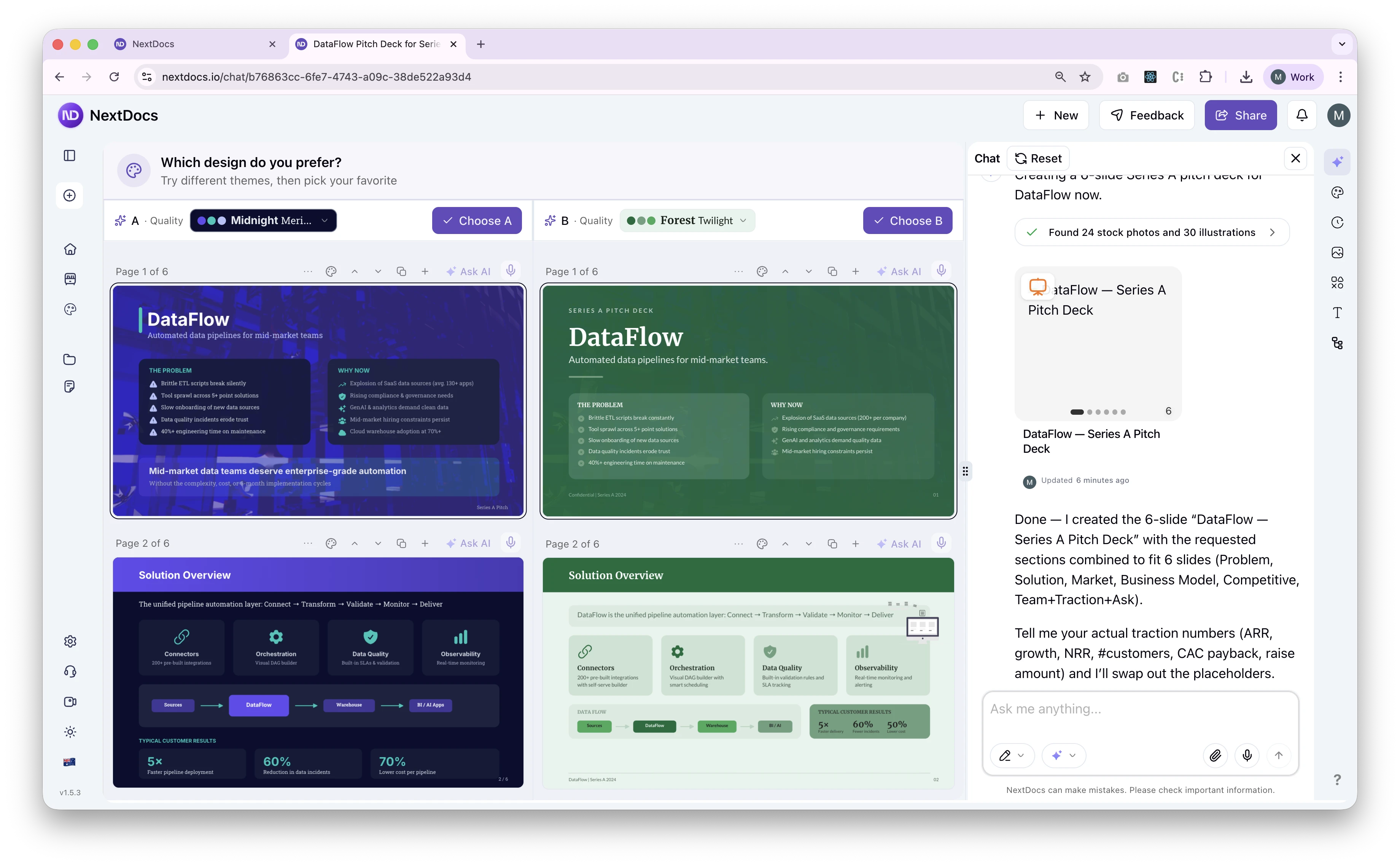
The standout feature of NextDocs is its multi-variant generation. When you provide a prompt, the system generates several distinct versions of the presentation simultaneously. This allows users to compare different narrative flows and visual styles before committing to a final path. For a deeper look at how AI architecture impacts results, see our comparison of Nano Banana Pro vs NextDocs 2026. Additionally, the deep research engine pulls actual market data and figures with citations, solving the common problem of AI hallucinations in business decks.
Key Features:
- Multi-variant generation offering multiple choices for every prompt.
- Deep research integration that pulls real-world data and citations.
- Universal exports to PDF, PPTX, Google Slides, and Google Docs.
- Comprehensive brand styling to ensure every deck matches company identity.
- Multi-model support allowing users to choose the best AI for their specific content.
Pricing: A free tier is available for new users. Pro plans start at $15 per month.
Best For: Overall use, research-heavy decks, consultants, founders, and sales teams.
Verdict: NextDocs is the most robust tool for professionals who need high-quality, research-backed presentations that can be exported anywhere. It eliminates the need for a separate research phase and provides the most flexible editing experience on the market.
2. Plus AI
Plus AI is a sophisticated add-in that brings powerful AI capabilities directly into the environments where most professionals already work: Google Slides and PowerPoint. It focuses on preserving existing workflows while adding a layer of intelligence for slide generation and editing. Stay updated with our full list of the best AI presentation builders of 2026 to see how Plus AI maintains its position.
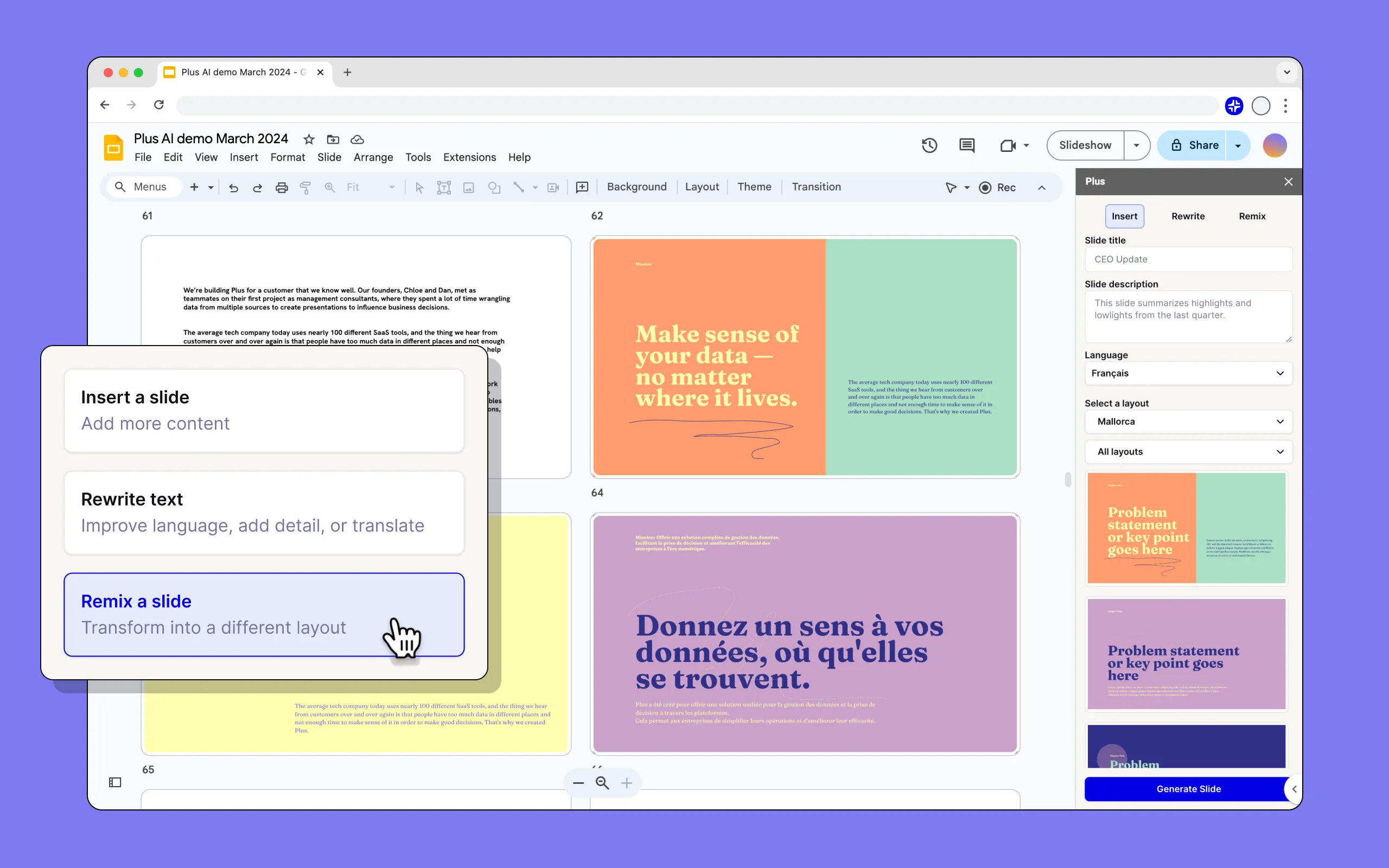
The tool excels at "remixing" existing slides. If you have a deck that feels outdated or disorganized, Plus AI can analyze the content and suggest a complete overhaul while maintaining your original template. This makes it an excellent choice for enterprise teams that have strict layout requirements but want to speed up the content creation process. If you are deciding between established add-ins, check our comparison of Plus AI vs SlidesAI for 2026.
Key Features:
- Seamless native integration with Google Slides and Microsoft PowerPoint.
- Template preservation that respects your existing master slides.
- Remix feature for updating and enhancing old presentations.
- Prompt-based generation for new slide decks.
Pricing: No free tier is available. Subscriptions start at $10 per month.
Best For: Power users of PowerPoint and Google Slides who want to stay within their familiar software.
Verdict: Plus AI is the best choice for those who refuse to leave the Microsoft or Google ecosystems. It is a workhorse for enterprise teams, though the lack of a free tier makes it harder to test for casual users.
3. Copilot for PowerPoint
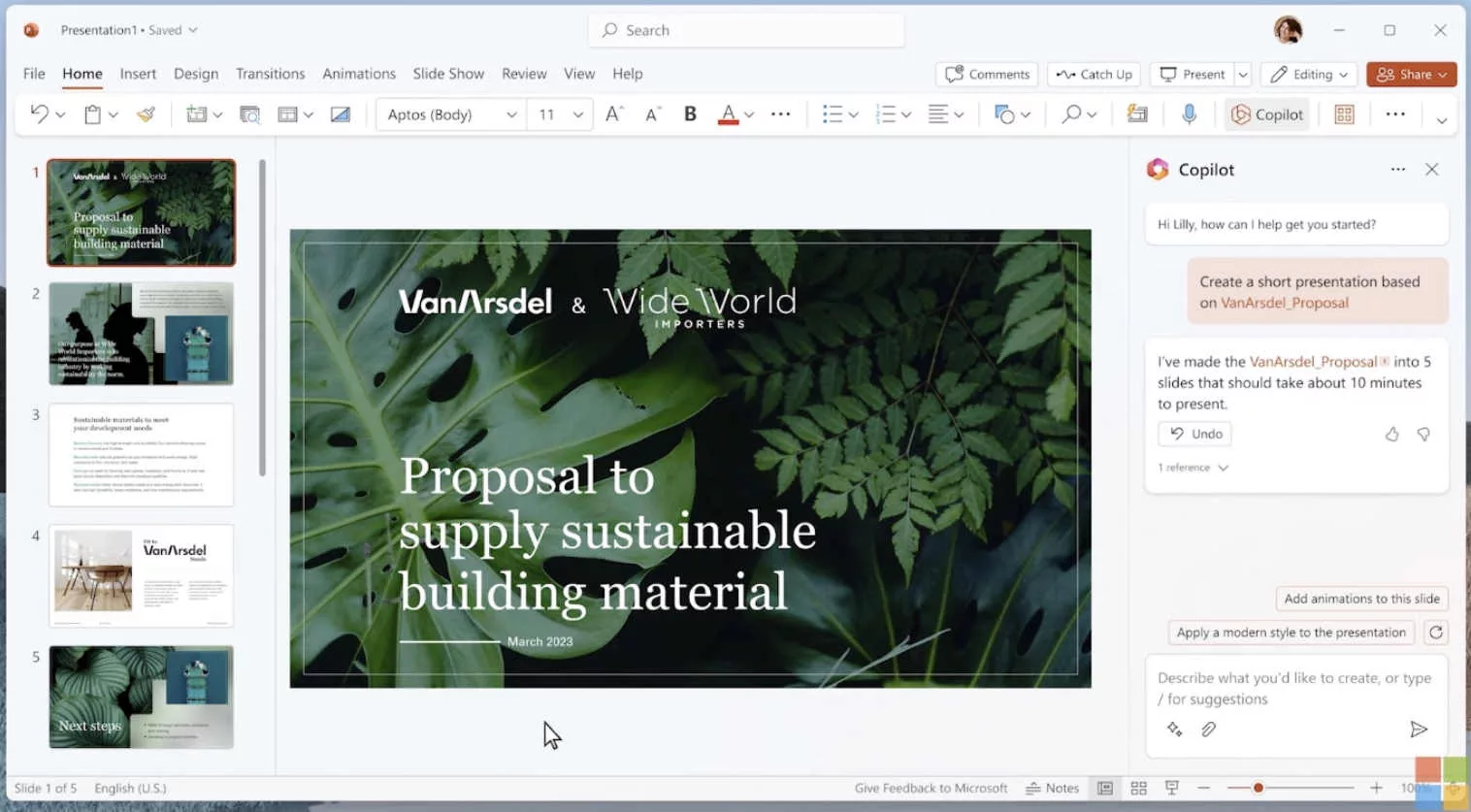
Microsoft Copilot for PowerPoint is the premier choice for organizations fully embedded in the Microsoft 365 ecosystem. Its primary strength lies in its organizational context awareness. Copilot can pull data from Word documents, Excel spreadsheets, and even Outlook emails to build a presentation that is grounded in your company's internal data.
While its design aesthetic tends to be more conservative than standalone creative tools, the security and integration it offers are unmatched for enterprise environments. It handles the heavy lifting of summarizing long reports into concise bullet points and generating relevant speaker notes for every slide.
Key Features:
- Deep integration with the entire Microsoft 365 suite.
- Enterprise-grade security and data privacy.
- Automatic speaker notes generation based on slide content.
- Ability to transform Word documents into full presentations instantly.
Pricing: No free tier is available. Pricing starts at $30 per month as an add-on to Microsoft 365.
Best For: Large enterprise teams and heavy users of the Microsoft 365 suite.
Verdict: For internal corporate presentations where security and data integration are the top priorities, Copilot is the logical choice. However, the high price point and conservative design limits its appeal for startups and creative agencies.
4. Gemini for Google Slides
Gemini is Google's answer to AI-driven productivity, and its integration into Google Slides is a major benefit for Workspace users. It functions as a side panel that helps users generate images, summarize text, and create new slides from scratch. If Google's native tool feels lacking, explore these Gemini for Google Slides alternatives.
The main advantage of Gemini is its accessibility. If your company already pays for Google Workspace, Gemini features are often included or available at a low incremental cost. It can access your Google Drive content to find relevant information, making it easy to build presentations based on existing project files.
Key Features:
- Native integration into the Google Workspace interface.
- Built-in AI image generation to create custom visuals.
- Content access across Google Drive, Docs, and Gmail.
- Real-time collaboration features inherent to Google Slides.
Pricing: Free tier options are available for standard users. Workspace AI features start at $20 per month for business users.
Best For: Google Workspace users who need quick drafts and internal presentations.
Verdict: Gemini is a convenient and accessible tool for basic slide generation. While its design output can sometimes feel generic, its ability to pull data from across your Google account makes it a powerful productivity booster for simple tasks.
5. Gamma
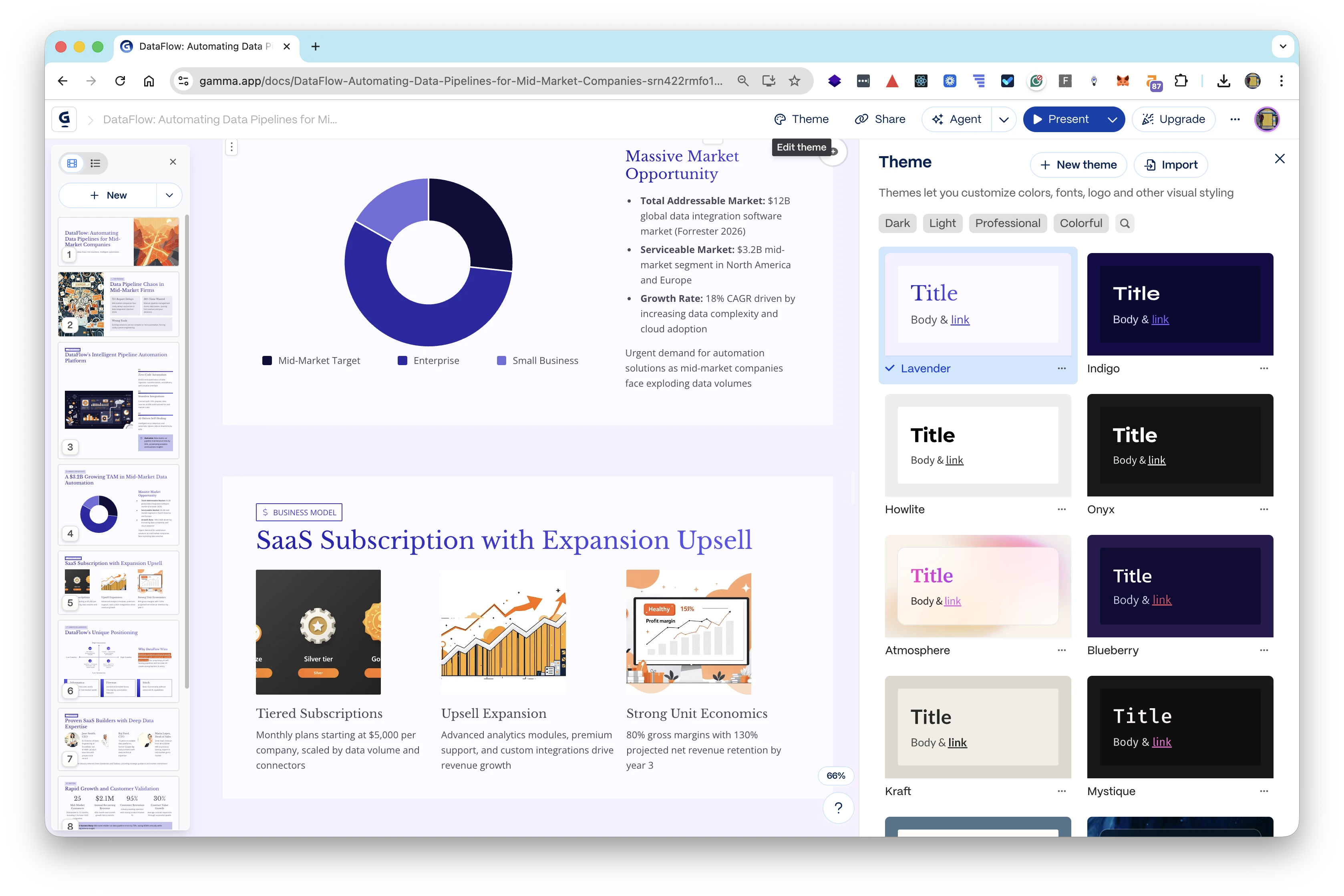
Gamma has gained a massive following by moving away from the traditional "slide" metaphor toward a more modern, web-native format. Gamma presentations look like a mix between a website and a document, featuring interactive elements and vertical scrolling. Startups frequently look for Gamma alternatives for 2026 when they need better export options for traditional board meetings.
The platform is incredibly fast. You can input a brief prompt and receive a visually stunning, themed presentation in seconds. Because it is web-native, sharing a Gamma is as easy as sending a link, and the content looks great on mobile devices.
Key Features:
- Web-native format optimized for online viewing and mobile devices.
- Generous free tier that allows for significant exploration.
- Fast, theme-based generation that requires minimal manual styling.
- Interactive cards that can embed videos and live data.
Pricing: Free tier available. Paid plans start at $8 per month.
Best For: Startups, students, and budget-conscious teams who prioritize modern web sharing.
Verdict: Gamma is perfect for internal updates or quick pitches where a traditional PowerPoint file is not required. Its speed and aesthetics are top-tier, though it can feel limited if you need to perform heavy manual editing or precise PPTX exports.
6. Beautiful.ai
Beautiful.ai focuses on a single goal: making it impossible to create an ugly slide. It uses smart templates that automatically adjust as you add content. If you add a fourth bullet point or a third image, the entire slide rearranges itself to maintain perfect visual balance and alignment. Users looking for high-end design often compare Beautiful.ai vs NextDocs to see which handles brand styling better.
This tool is ideal for non-designers who need to produce client-facing work. While it lacks the deep AI research capabilities of NextDocs, its design engine is highly sophisticated. It ensures that every presentation stays within brand guidelines and looks like it was created by a professional designer.
Key Features:
- Smart templates that automatically handle layout and alignment.
- Polished, professional-grade visual output.
- Robust brand kits for consistent company styling.
- Animation features that add a layer of sophistication to transitions.
Pricing: No free tier is available for individuals. Starting price is $12 per month.
Best For: Non-designers, consultants, and teams focused on high-quality visual output.
Verdict: Beautiful.ai is the best choice for those who want a "hands-off" design experience. It produces the most consistently polished slides of any tool on this list, though the restrictive nature of its smart templates can sometimes frustrate power users who want total control.
7. Pitch.com
Pitch.com has built its reputation on being the "Figma of presentations." It is designed for teams that need to work together in real-time. With built-in video conferencing, commenting, and task assignments, Pitch makes the collaborative part of deck building much more efficient.
While its AI features are solid, they act more as a starting point for human creativity rather than a replacement for it. Pitch offers a stunning library of templates and a very modern, intuitive editor. It also provides excellent version history, which is vital for teams working on high-stakes projects like investor decks.
Key Features:
- Superior real-time collaboration with commenting and version history.
- High-quality template library designed by professional artists.
- Brand assets and shared libraries for team consistency.
- Built-in analytics to see how viewers interact with your shared links.
Pricing: Free tier available. Pro plans start at $8 per month per user.
Best For: Collaborative teams and startups that value version control and modern design.
Verdict: Pitch is the clear winner for teams that prioritize the collaborative process. Its AI is helpful for getting started, but the true value lies in its professional-grade editor and team-management features.
8. Canva Magic Design
Canva is a household name in design, and its Magic Design AI brings that same ease of use to presentations. It leverages Canva's massive library of millions of images, icons, and templates to generate presentations from a simple text description.
The tool is particularly strong for marketers and social media managers who need to create visually engaging content across multiple formats. You can easily turn a presentation into a social media post or a video with a few clicks. However, it can sometimes struggle with professional formatting, and its AI-generated content can feel a bit too decorative for serious corporate environments.
Key Features:
- Enormous asset library with millions of photos and graphics.
- Multi-format export to video, social media, and print.
- Very strong free tier with a wealth of available tools.
- Simple, drag-and-drop interface that requires zero training.
Pricing: Free tier available. Canva Pro starts at $13 per month.
Best For: Marketers, small business owners, and creative professionals.
Verdict: Canva is the most versatile creative tool on the list. If your presentation needs to be flashy and asset-heavy, Canva is excellent. For data-heavy research decks, it may feel a bit too focused on aesthetics over substance.
9. MagicSlides
MagicSlides is a specialized Google Slides add-in that focuses on content repurposing. Its most impressive feature is the ability to turn a YouTube video or a long-form article into a presentation in seconds. This makes it a favorite for educators and content creators who need to summarize existing media into a slide format. For those focused on simple add-ons, the MagicSlides vs SlidesAI breakdown is helpful.
While its design capabilities are relatively basic compared to standalone platforms like NextDocs or Beautiful.ai, it excels at speed and utility. It is an excellent tool for creating quick training materials or summary decks from web content.
Key Features:
- YouTube-to-slides conversion for quick content repurposing.
- Simple, no-frills interface for rapid slide generation.
- Direct integration with Google Slides.
- Support for multiple languages.
Pricing: Free tier available. Paid plans start at $8 per month.
Best For: Content creators, trainers, and educators who repurpose existing media.
Verdict: MagicSlides is a great utility tool. It is not designed to create the world's most beautiful pitch deck, but it is incredibly efficient at turning raw information from the web into a usable slide structure.
10. SlidesAI
SlidesAI is another popular Google Slides add-in that focuses on transforming text prompts into presentation drafts. It is one of the most affordable options on the market, making it accessible for students and small teams. Small teams often seek SlidesAI alternatives for better design control as their needs grow.
The tool is designed for speed. You paste in your text, choose a general style, and the AI populates the slides for you. While the output often requires a fair amount of manual cleanup to look professional, it serves as a great way to overcome "blank page syndrome" and get a structure in place quickly.
Key Features:
- Fast text-to-presentation generation.
- Simple interface that lives entirely within Google Slides.
- Affordable entry-level pricing.
- Support for over 100 languages.
Pricing: Free tier available. Pro plans start at $10 per month.
Best For: Students and professionals who need a quick starting point for internal meetings.
Verdict: SlidesAI is a solid, budget-friendly option for those who already use Google Slides. It is best used as a drafting tool rather than a final production engine, as the design quality is more functional than impressive.
Decision Guide: Which Tool Should You Choose?
Selecting the right AI presentation builder depends on your specific role and the goals of your presentation. No single tool is perfect for every scenario, so we have categorized the best choices based on common professional needs.
For High-Stakes Professional Work
If you are a consultant or a founder preparing a pitch deck, accuracy and flexibility are your top priorities. You cannot rely on generic AI that makes up facts. NextDocs is the recommended choice here because its deep research integration and multi-variant generation provide a level of depth and choice that other tools lack. The ability to export to any format ensures you can meet the requirements of any client or investor.
For Enterprise and Corporate Workflows
If your organization is strictly managed by IT and requires high levels of security and integration, look toward the native add-ins. Copilot for PowerPoint is the obvious choice for Microsoft 365 environments, while Plus AI offers a slightly more flexible but still native experience for those using both Google and Microsoft suites.
For Creative and Visual Impact
When the goal is to wow the audience with design, Beautiful.ai and Canva are the leaders. Beautiful.ai is better for professional, clean, and modern business aesthetics. Canva is better for creative, colorful, and asset-heavy presentations that might need to be repurposed for marketing channels.
For Speed and Internal Collaboration
If you need to get an idea out of your head and into a shareable format as quickly as possible, Gamma and Pitch.com are excellent. Gamma's web-native format is perfect for quick links, while Pitch.com provides the best environment for a team to brainstorm and refine a deck together in real-time.
Conclusion: The Future of Presentations
The AI presentation builders of 2026 have moved beyond being simple novelties. They are now essential productivity tools that allow professionals to focus on their message rather than their margins. By automating the tedious aspects of design and research, these platforms enable a more strategic approach to communication.
For most professional users, a tool that balances research, design, and export flexibility is the best investment. NextDocs leads the pack in this regard, offering a comprehensive solution that handles everything from initial data gathering to final PowerPoint export. However, whether you choose a native add-in like Plus AI or a design-centric platform like Beautiful.ai, the transition to AI-assisted presentation building will undoubtedly save you hours of work and improve the quality of your output.
As these tools continue to evolve, we can expect even deeper integrations with live data and more sophisticated design reasoning. For now, the ten tools listed above represent the best the market has to offer for teams that value collaboration and efficiency.
Ready to Create Better Presentations?
Try NextDocs Free and experience multi-variant generation, universal exports, and deep research integration. No credit card required.