


We ran five models through the same 22-page document. Here is what we learned.
Every few weeks a new model arrives with a benchmark chart. None of those charts measure the thing a document tool needs most: can the model write a long, structured document all the way to the end, at a speed a person will wait for, without quietly stopping early?
So we built our own test, and every model has to pass it before it gets a lane in NextDocs. This post explains the test and what five current models did on it. Some of the results surprised us.
The gate
We took a real prompt from production: a request that had produced a 22-page document, with sections, tables and a specific structure. We replay it against a candidate model with the same generation budget the product uses, and we watch three things:
- Did it finish? All 22 pages, or did it stop mid-element with no error?
- How long did it take? NextDocs streams a document as it is written, and a user is watching. A model that finishes in two minutes and one that finishes in ten are not the same product.
- Did throughput hold? Some models start fast and slow down as the output grows. That pattern is what turns a long document into a truncated one.
A model that fails any of the three does not get promoted, however good its benchmark chart looks.
What five models did
GPT-5.6 Luna (OpenAI, running on Azure AI Foundry). Finished all 22 pages, in under two minutes on the fastest runs. Consistent throughput from the first page to the last. This is why Luna holds the fast lane for every plan.
Gemini 3.5 Flash (Google). Finished all 22 pages in a little over two minutes. Held the quality lane for most of the summer.
Gemini 3.8 Flash (Google, released 2 September). Passed the same gate within a day of release and was promoted to the quality lane on 3 September. The fourth Flash generation in four months, and the first one we moved onto within 24 hours.
Claude Sonnet 4.6 (Anthropic). Finished all 22 pages, but used almost the entire generation budget doing it, and wrote far more than any other model, around 170,000 characters. It is not slow to start and it does not decay; it is simply thorough. That makes it a superb premium writer and a model we watch closely on very long documents, because a slightly longer request could push it past the budget.
Claude Sonnet 5 (Anthropic, released 30 June). This was the surprise. Sonnet 5 is newer and cheaper than Sonnet 4.6, and its agentic benchmarks are better. On our gate it stopped at 16 of 22 pages after about eight minutes, mid-element, with no error. That is the exact signature of the truncation bug we spent July eliminating. So Sonnet 5 is not laddered, and Sonnet 4.6 keeps the premium lane until a re-test says otherwise.
What we learned
Newer is not the same as better for long documents. The two models we declined to promote this summer were both newer than the ones that kept their lanes. A model can be smarter per token and still lose a long document to a throughput curve.
Throughput decay is the failure mode to watch. The dangerous models do not error. They slow down as the document grows, exceed the streaming budget, and the stream ends with a half-finished document that looks complete. We changed NextDocs to detect an aborted stream and refuse to save the truncated result, which is why long documents now finish or fail loudly, never silently.
Thoroughness has a cost. Sonnet 4.6 writes the richest documents of the five and the longest. For a 40-page report you might want exactly that. For a ten-slide deck you would rather have Luna and your afternoon back. That is why the ladder has lanes instead of one model.
Test before promoting, every time. Gemini 3.8 Flash earned its lane in a day because the gate is repeatable. Sonnet 5 lost a lane it would otherwise have had for the same reason. A fixed test is how you stay fast without being reckless.
How this reaches you
You do not have to think about any of this. Pick a mode and the ladder picks the model:
- Fast for drafts and short documents.
- Quality for anything with sections that must stay consistent.
- Premium, on Pro+ and Ultra, for writing where depth matters more than time.
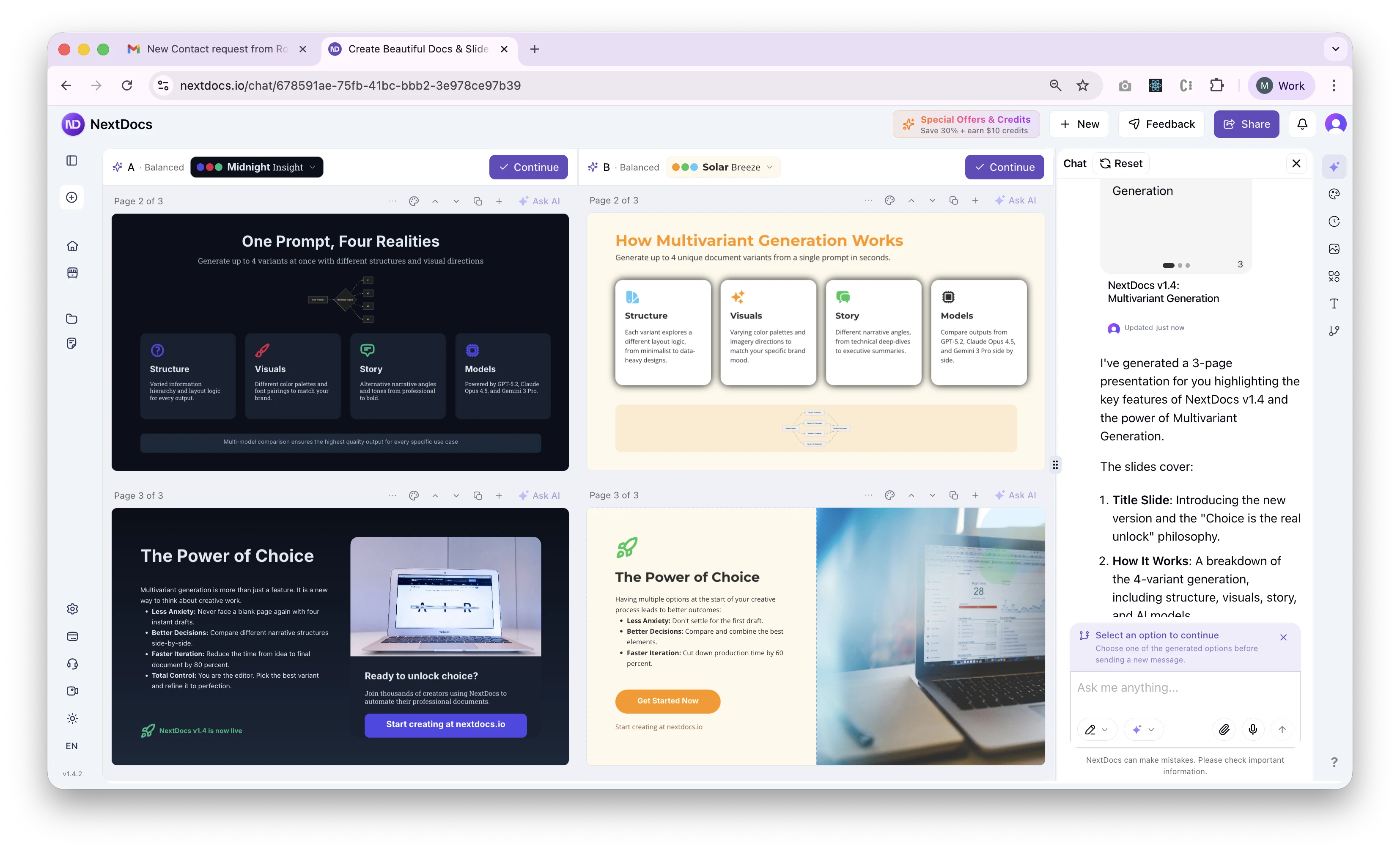
Or choose explicitly in the model picker. And if you want to run your own version of this test, multi-variant generation lets you send one prompt to several models at once and compare the complete documents side by side. It is the closest thing to a fair bake-off you can run without a lab.
If the models you most want to compare are the very newest, GPT-6 Astra and Claude Fable 5.1, they are not in NextDocs yet. The Shyne desktop app can run its agent on your own Claude Code or Codex subscription, which is the quickest way to put them to work on real documents today.
Try the model picker in NextDocs
The NextDocs Team