

NextDocs vs. DeepSeek: A Comprehensive Comparison of AI Productivity Tools
As artificial intelligence continues to reshape how we work, the landscape of tools available to professionals has branched into two distinct categories. On one side, we have general-purpose large language models (LLMs) designed for a wide range of reasoning and text generation tasks. On the other side, we have specialized document-native editors designed to transform ideas into structured, professional-grade assets.
This article provides a detailed comparison between NextDocs, a specialized AI document and presentation creator, and DeepSeek, a prominent developer of high-performance AI models. By understanding the fundamental differences in their architecture, focus, and user experience, you can better determine which tool aligns with your specific professional needs.
Table of Contents
- Introduction
- What is NextDocs?
- What is DeepSeek?
- Core Focus and Use Cases
- Document and Presentation Creation
- User Experience and Ease of Use
- Strengths and Limitations
- When to Choose NextDocs vs DeepSeek
- Conclusion
Introduction
The current AI era is defined by the transition from simple chat interfaces to sophisticated productivity environments. Initially, users were satisfied with AI that could answer questions or write short emails. However, as the technology matured, the demand for structured, high-fidelity output—such as business reports, technical documentation, and visual presentations—has grown significantly.
This evolution has led to the rise of specialized tools like NextDocs. While general models like those developed by DeepSeek provide the raw "intelligence" required for data processing, they often lack the structural framework necessary to produce a finished document. This comparison explores the nuances between a specialized document creator and a model-centric AI system, highlighting where each excels in the modern digital workflow.
What is NextDocs?
NextDocs is an AI-powered document creator designed specifically for professionals who need to generate comprehensive, well-structured, and visually engaging content. Unlike standard AI assistants that provide snippets of text, NextDocs is built to handle the entire lifecycle of document creation. It utilizes Markdown and MDX (Markdown for component-based documents) to ensure that the output is not only readable but also ready for professional distribution.
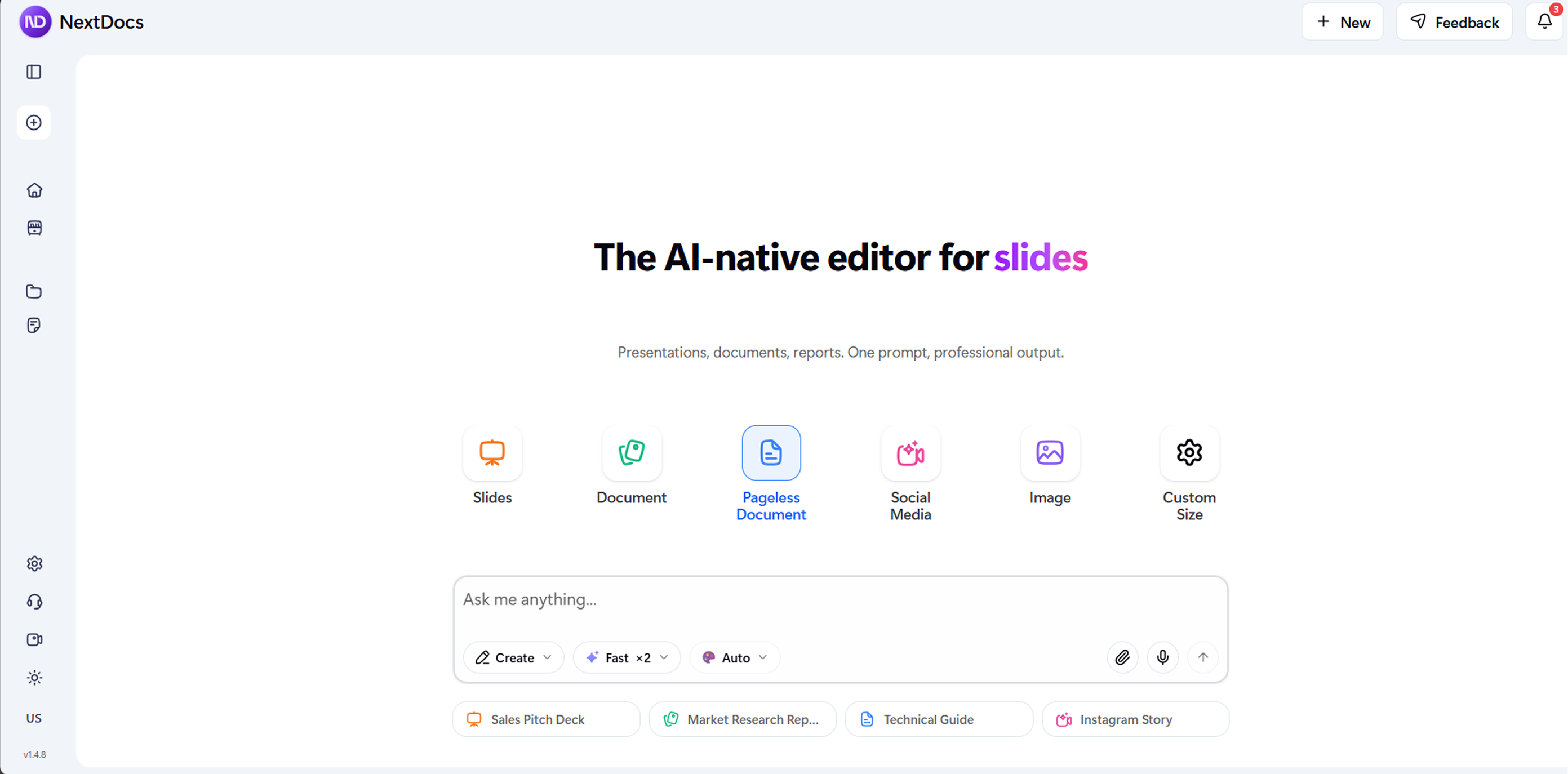
The primary philosophy behind NextDocs is "document-native" generation. This means the system understands the hierarchy of information, the importance of visual breaks, and the necessity of structured data. It focuses on producing long-form content that exceeds 1000 words while maintaining clarity through the use of specific elements like tables, callouts, and specialized lists. NextDocs is essentially a bridge between raw AI logic and the final, polished product that a user would present to a client or stakeholder.
What is DeepSeek?
DeepSeek is an AI research company that has gained significant attention for developing high-performance, open-source large language models, such as DeepSeek-V3 and DeepSeek-R1. DeepSeek is primarily a "model-centric" system. Its strength lies in its underlying architecture, which is optimized for reasoning, mathematics, and coding tasks. Users typically interact with DeepSeek through a chat interface or via API integration into other applications.
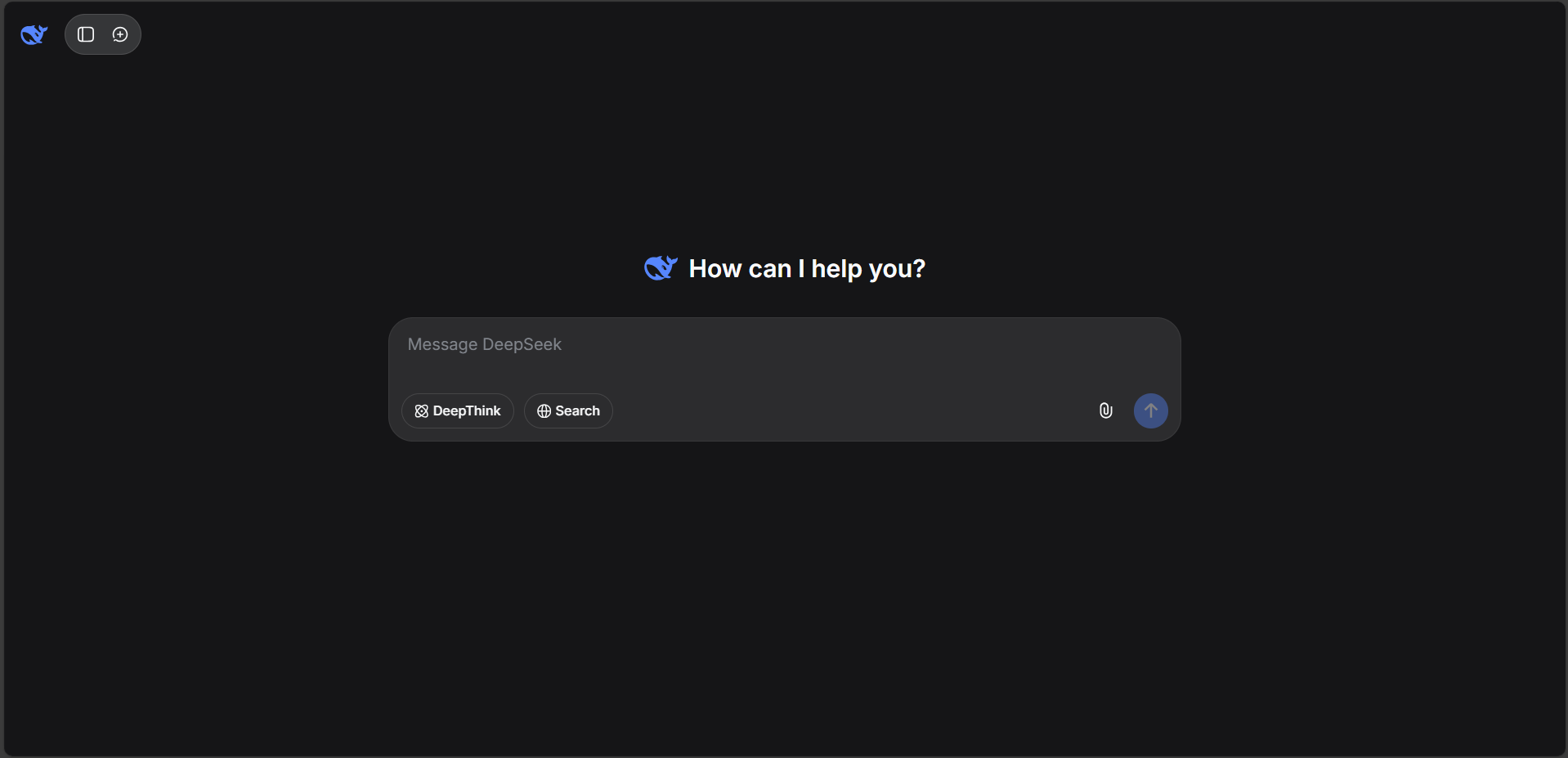
DeepSeek represents the "engine" of AI. It is designed to process complex instructions and provide accurate, logical responses. While it can generate text that can be copied into a document, it does not inherently function as a document editor or a layout engine. Its primary goal is to provide the most accurate and efficient answer to a prompt, whether that is a code snippet, a translation, or a summary of complex data.
Core Focus and Use Cases
The core focus of NextDocs is the final output. It is used by project managers, technical writers, and marketers who need to create "deliverables." Common use cases include generating technical manuals, detailed business proposals, educational guides, and comprehensive project plans. Because it understands document structure, it ensures that headings are logical, paragraphs are concise, and visual elements are placed where they add the most value.
In contrast, the core focus of DeepSeek is information processing and reasoning. It is a favorite among developers and researchers who need help with complex problem-solving. DeepSeek is used for debugging code, explaining mathematical theorems, or brainstorming ideas in a conversational format. While a user can ask DeepSeek to "write a report," the result is typically a continuous stream of text that requires significant manual formatting and structural adjustment before it is ready for professional use.
| Feature | NextDocs | DeepSeek |
|---|---|---|
| Primary Goal | Creating structured documents/presentations | General reasoning and text generation |
| Output Format | Markdown/MDX with visual components | Plain text, Code, or Chat responses |
| Primary User | Business professionals, Writers, Educators | Developers, Researchers, General users |
| Visual Elements | Integrated tables, icons, and structured lists | Minimal (mostly text and code blocks) |
| Context Length | Optimized for long-form, 1000+ word docs | Optimized for conversational accuracy |
Document and Presentation Creation
When it comes to document and presentation creation, NextDocs operates in a specialized way that sets it apart from general AI models. It does not just generate text; it organizes it. NextDocs uses a sophisticated understanding of MDX to incorporate elements that make a document "scannable." This includes the strategic use of blockquotes for emphasis, tables for data comparison, and specific formatting that ensures the document looks professional regardless of the platform it is viewed on.
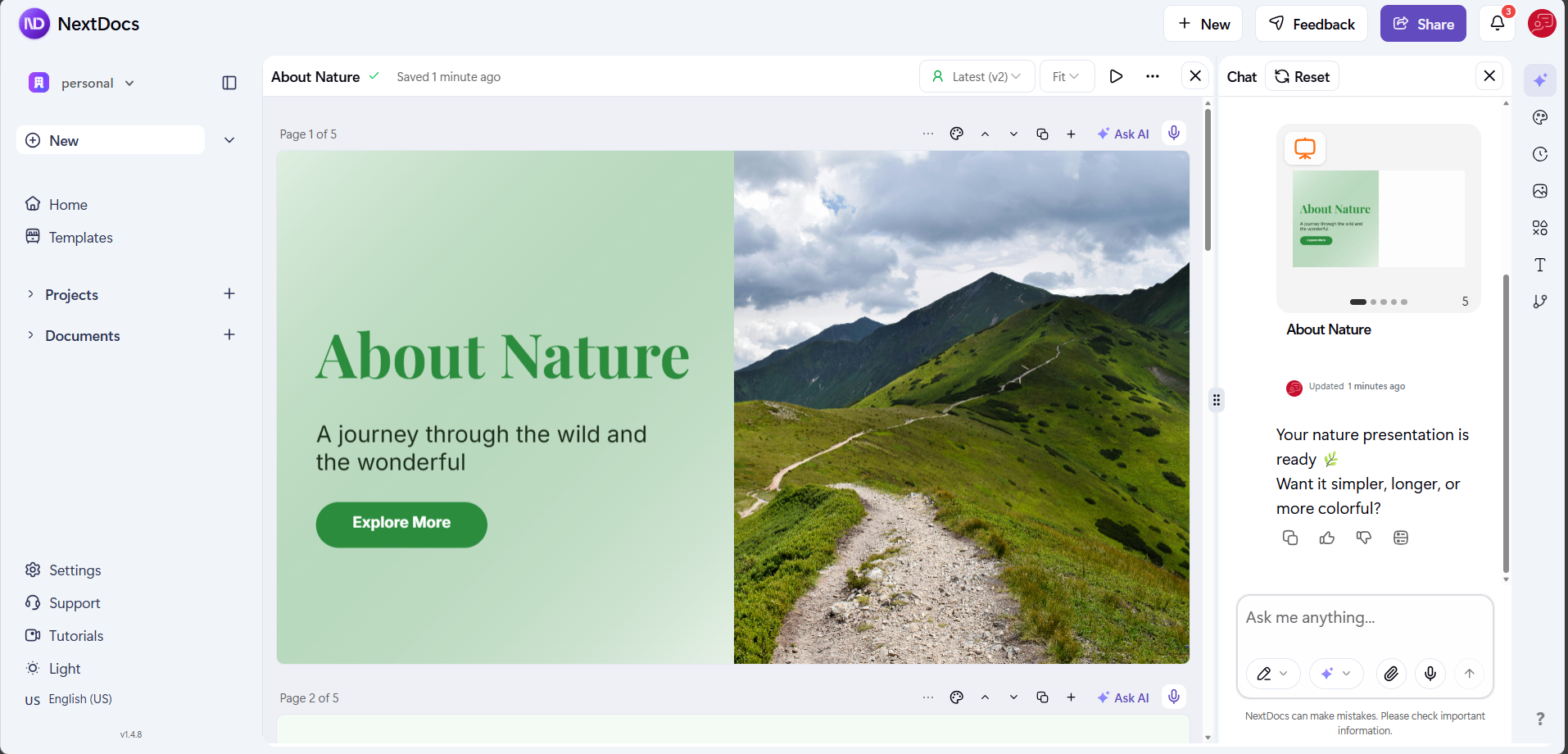
DeepSeek, being model-centric, treats document creation as a text-generation task. It follows the user's prompt to generate content but often lacks the "spatial awareness" of a document. For example, if you ask DeepSeek for a 2000-word report, it may provide the text, but the user must then manually handle the headers, create the tables in a separate editor, and ensure the flow is appropriate for a reader. NextDocs automates this structural layer, allowing the user to focus on the content's intent rather than its formatting.
User Experience and Ease of Use
The user experience in NextDocs is designed to be simple and distraction-free. It avoids the "blank page syndrome" by offering a guided creation process that focuses on the content's purpose. The interface is built to handle the complexities of document creation—like ensuring consistent heading levels and proper image placement—behind the scenes. This provides a user-friendly experience that avoids the unnecessary complexity of traditional word processors or the trial-and-error of prompting a general AI.
DeepSeek offers a standard chat-based user experience. While this is intuitive for quick questions, it can become cumbersome for complex document projects. Users often find themselves in a "prompt-refine-repeat" loop to get the structure they want. DeepSeek’s interface is highly efficient for technical tasks, but it lacks the specialized tools—such as document-specific previews or structured component libraries—that are central to the NextDocs experience.
Strengths and Limitations
NextDocs Strengths
- Specialized Formatting: Automatically generates MDX-compliant content with professional layouts.
- Content-Focused: Designed to produce long-form content that remains engaging and readable.
- Visual Richness: Seamlessly integrates tables, callouts, and structured lists to break up text.
- Efficiency: Reduces the time spent on manual formatting and structural organization.
NextDocs Limitations
- Specialization: Less focused on general-purpose chat or casual "Q&A" interactions.
- Scope: Primarily designed for document-based outputs rather than raw code execution or deep mathematical proofs.
DeepSeek Strengths
- Raw Intelligence: Exceptional performance in reasoning, logic, and coding tasks.
- Versatility: Can handle an almost infinite variety of prompts across different domains.
- Open Source Influence: Provides high-quality models that can be used via API for custom applications.
- Speed: Highly optimized for fast responses in a conversational context.
DeepSeek Limitations
- Lack of Structure: Output often requires significant manual editing to become a "document."
- Formatting Constraints: Does not natively support advanced document components or visual layout planning.
- Model-Centric: The focus is on the "answer," not the "presentation" of the answer.
When to Choose NextDocs vs DeepSeek
Choosing between these two tools depends entirely on your end goal. If your objective is to produce a finished asset that will be read by others, NextDocs is the superior choice. Its ability to create, edit, and refine documents in a specialized environment ensures that your final product is professional and polished.
Choose NextDocs when:
- You need to create a professional report, manual, or presentation.
- You want the AI to handle the structure and formatting of the content.
- You are looking for a simple, user-friendly experience focused on document output.
- You need to generate long-form content (1000+ words) that is easy to navigate.
Choose DeepSeek when:
- You are debugging complex code or solving mathematical problems.
- You need a quick answer to a specific question or a summary of a text.
- You are a developer looking to integrate high-quality AI models into your own software.
- You prefer a conversational, chat-based interaction for brainstorming raw ideas.
Conclusion
In the debate of NextDocs vs. DeepSeek, it is important to recognize that these tools serve different roles in the productivity ecosystem. DeepSeek is a powerful engine of general intelligence, capable of processing information with remarkable speed and accuracy. However, it remains a model-centric system that provides raw data rather than finished documents.
NextDocs, on the other hand, is a specialized document-native editor. It takes the power of AI and applies it specifically to the art of document and presentation creation. By offering powerful content-focused features and a simple, user-friendly interface, NextDocs removes the friction between an idea and a professional deliverable. While DeepSeek tells you the answer, NextDocs builds the document that communicates that answer to the world. For the modern professional, using these tools in tandem—DeepSeek for research and NextDocs for creation—can provide a comprehensive and highly efficient workflow.