
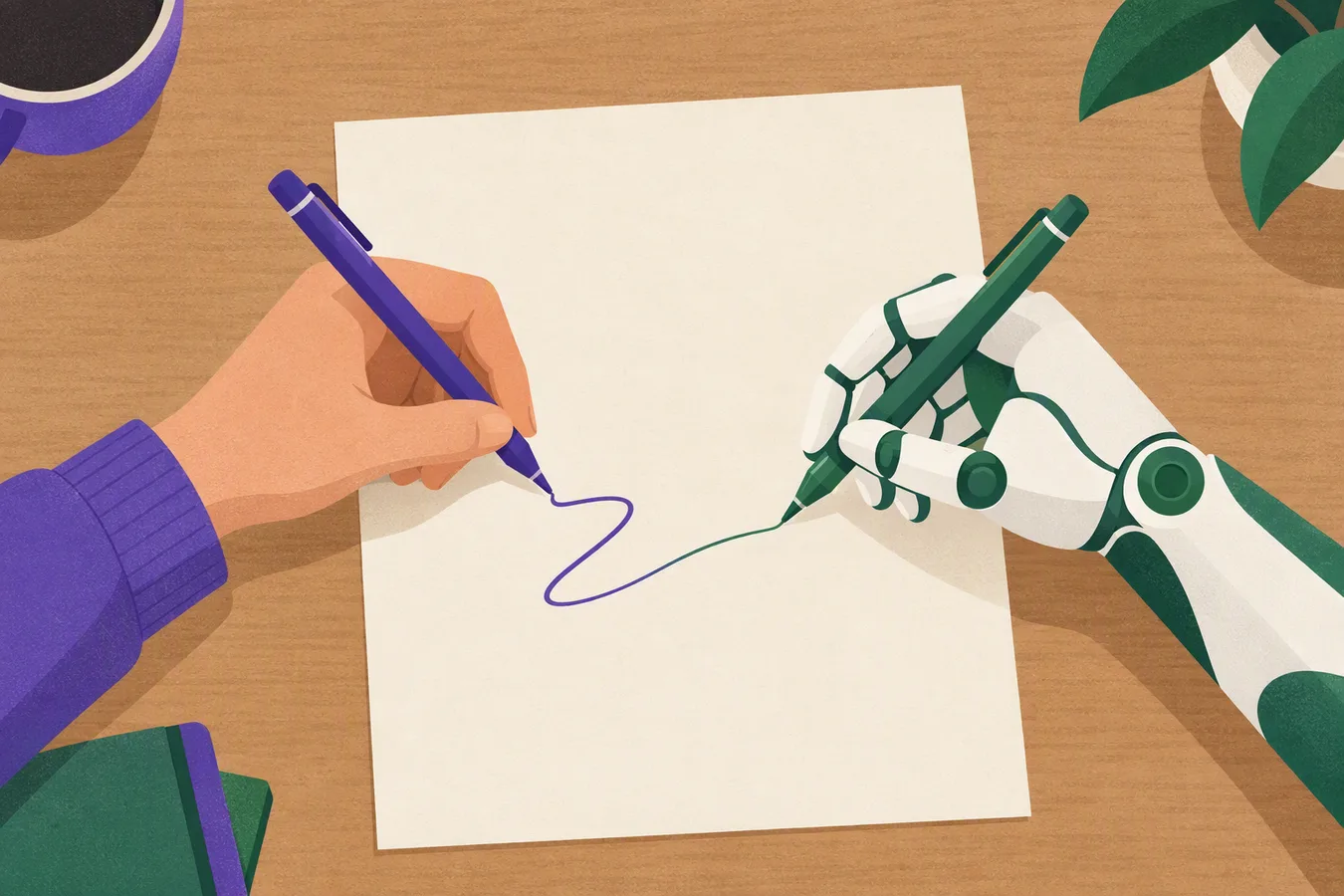
The AI that works next to you, and the AI that works for you
This was the year every tool got an agent. Copilot has Agent Mode in PowerPoint. Gemini builds whole decks in Google Slides. Claude writes a .pptx file and hands it to you. ChatGPT sits inside PowerPoint. Pitch, Plus AI, Prezi and Genspark each launched something called an agent. The models underneath got a new name every few weeks.
Look past the names and almost all of these agents work the same way. You describe what you want. The agent goes away. It comes back with a draft. Then it is your turn.
We think that is one of two kinds of AI, and that the difference between the two matters more than which model is underneath. We build one of each, so we have had to think about it carefully.
The AI that works for you
The first kind is a producer. You give it a brief, it disappears, it returns with a finished thing. Its virtues are speed and completeness: a proposal in two minutes, a deck before the coffee is cold.
Its weakness is what happens when the draft is 80 percent right. The AI has already left the room. The last 20 percent is yours to do by hand, in an editor, and the AI's understanding of what it was doing has evaporated. If the structure is wrong, you are either editing a wrong structure or starting again.
NextDocs is this kind of AI, and we think it is the best version of it, for one reason: it does not hand you one draft. It hands you several complete ones, written by different models if you like, and your job becomes choosing rather than fixing. Choosing is a job people are good at and fast at. That single change turns the 80 percent problem into a five-minute decision. Add a brand kit, real exports and a model that has passed a long-document test, and a producer AI is an excellent tool for a person working alone who needs a file at the end.
But it is still a producer. It works for you.
The AI that works next to you
The second kind is a colleague. It works on the same page you are on, while you watch. When it changes a heading, you see the heading change. When it gets the structure wrong, you say so on slide two, not after slide forty. You can take over mid-sentence, and it gets out of the way. You can undo what it did like any other edit, because it is any other edit.
This is harder to build, which is why it is rarer. It needs a document that both of you can hold at once, a live canvas rather than a file that gets generated and handed over. It needs the AI's edits to be the same kind of thing as yours. And it needs the AI to be able to look at the page, not just the prompt.
That is what Shyne is: a canvas where you, your team and the agent are all standing in the same file, editing the same thing at the same time. Decks, documents, social posts and video in one project, so that the launch video is made from the launch deck, not from a description of it. An agent that works where you can see it, so that you correct it early instead of redoing it late.
Why the difference matters more than the model
A better model makes a producer's drafts better. It does not change the shape of the interaction. You still brief, wait, receive and fix. A 90 percent draft is nicer than an 80 percent one; it is still a draft you were not in the room for.
A colleague, on the other hand, gets better twice with every model improvement: it makes fewer mistakes, and you catch the ones it makes sooner because you are watching. The interaction compounds in a way the handoff does not.
We noticed this because, as models improved through the year, our support tickets for NextDocs did not fall as fast as the quality of its drafts rose. People were not stuck on bad drafts. They were stuck on the last 20 percent, and on the moment they wanted to say "no, not like that" and there was no one to say it to.
Why we build both
A colleague is not always what you want. If you know exactly what you need and you need it in a file, on your own, in two minutes, a colleague is a slower way to get it. You want the producer, and you want to choose from three.
If the work is going to change, if someone else needs to be in it, if it is going to become a video, if you want to correct the AI while it works rather than after, you want the colleague.
So NextDocs stays the best producer we can make, and Shyne is the colleague. Same brand kit, same models where it makes sense, different shape. We wrote a plain guide to which one fits which job.
The industry will spend the next year arguing about which model is smartest. It is a fair argument. We would just add one question to it: when the model is working on your document, are you in the room?
Mas Abdi, founder
Related posts
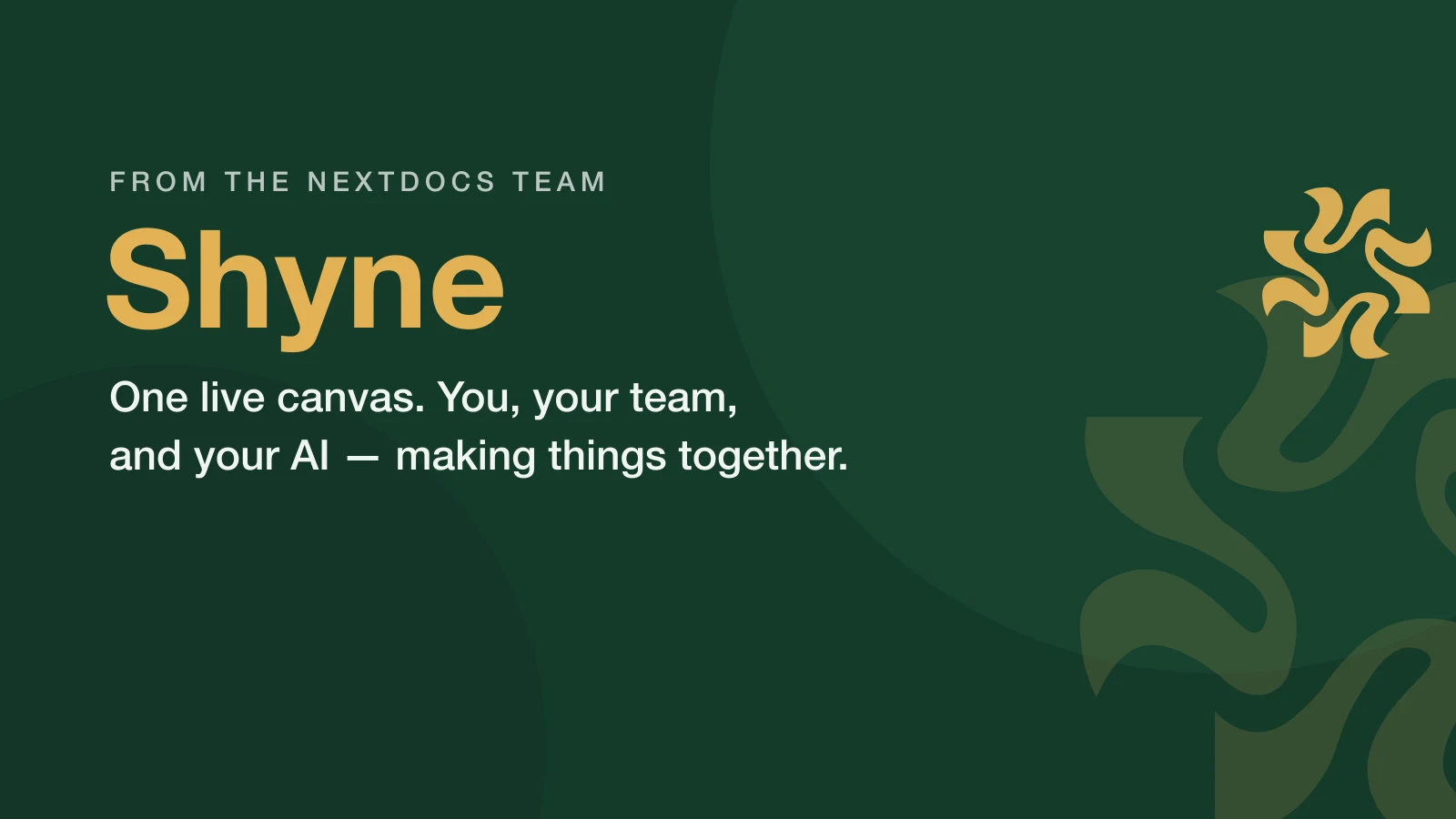
Why we built Shyne
NextDocs turns a prompt into a finished deck. But three requests kept coming back that no amount of new features would answer — working together, making video, and having the AI work alongside you instead of handing you a draft. So we built a second product.
Read more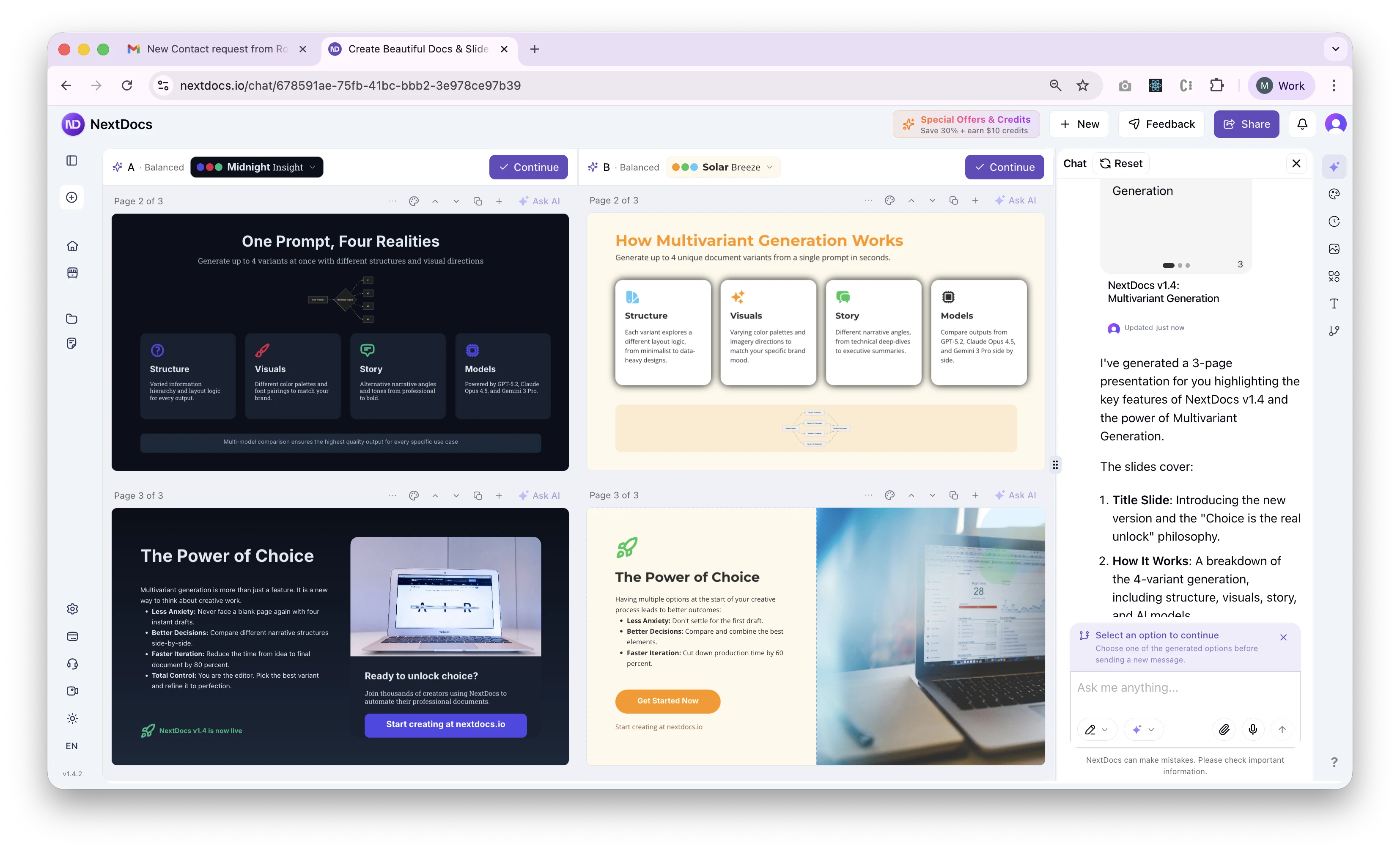
The Power of Choice — Why Selecting Beats Creating
The hardest part of creating documents isn't the work — it's the second-guessing. Multivariant generation turns subjective creative work into a selection problem. Here's why that changes everything.
Read more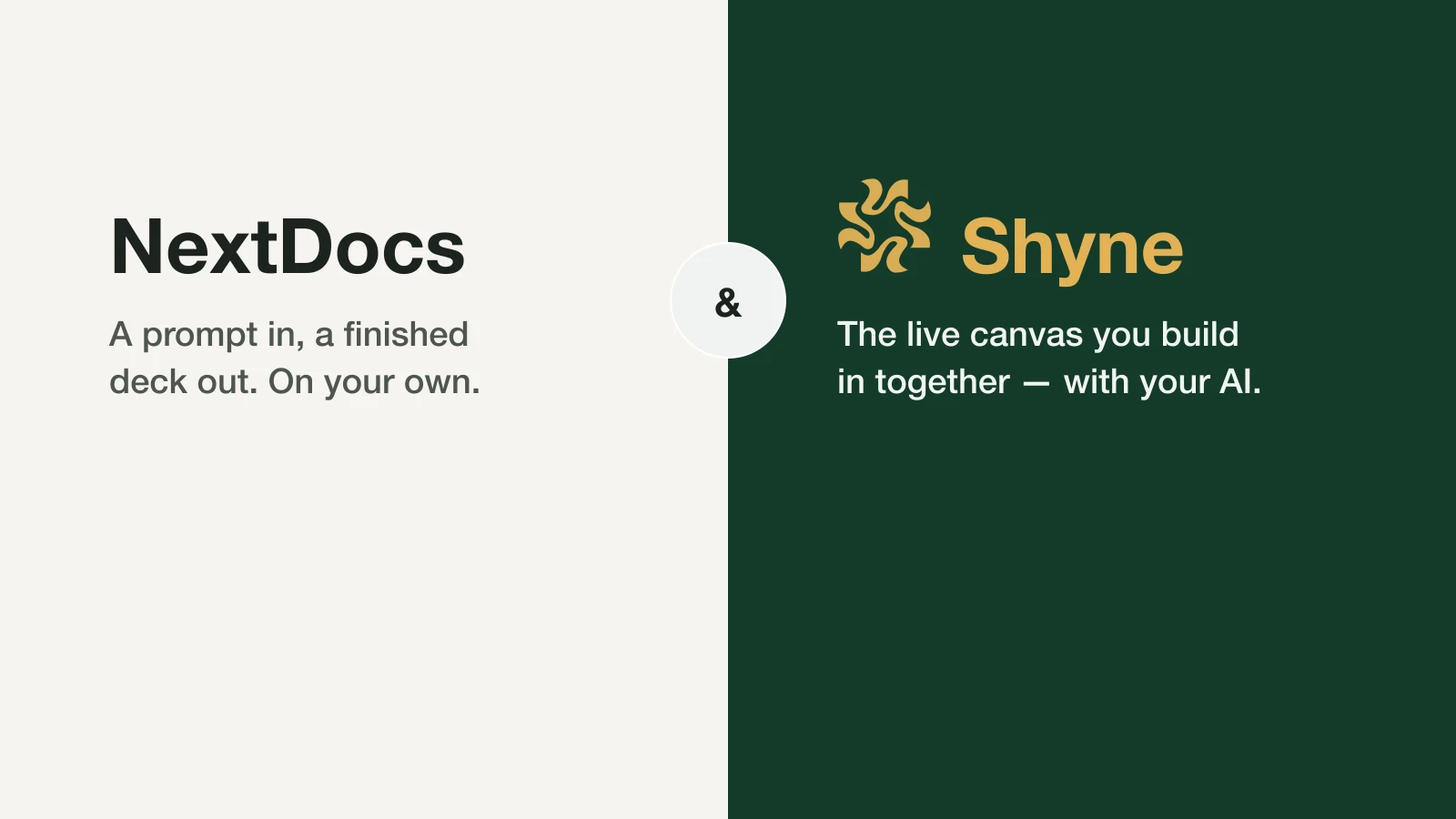
NextDocs and Shyne — which should you use?
We now make two products. This is the short, honest answer to which one fits what you're doing — plus what happens to your NextDocs account (nothing) and where our new work goes (Shyne).
Read more