
Best Ai Pitch Deck Builders (with-latex-support) in 2026
A comprehensive roundup of the best ai pitch deck builders with latex support in 2026. Discover the top tools for founders, researchers, and technical presenters.
The Evolution of Pitch Deck Creation
The landscape of startup fundraising and professional presentations has shifted dramatically over the last few years. Founders and consultants no longer spend dozens of hours manually aligning text boxes or hunting for the perfect icons in legacy software. The rise of artificial intelligence has introduced a new era of efficiency, but not all tools are created equal. For technical founders, researchers, and academics, a specific requirement has emerged as a deal breaker: robust support for mathematical notation and scientific formulas.
Traditional presentation software often treats math as an afterthought, forcing users to paste blurry images of equations or wrestle with clunky equation editors. In 2026, the best ai pitch deck builders have integrated LaTeX support to ensure that technical data remains sharp, searchable, and professional. Whether you are presenting a new machine learning architecture, a financial model, or a deep tech breakthrough, having native LaTeX rendering is essential.
This guide explores the top ten AI presentation tools currently on the market. We have evaluated them based on their generative capabilities, export flexibility, design quality, and their ability to handle complex technical content. While many tools claim to be AI powered, only a few provide the deep integration required for high stakes environments like investor pitches or academic conferences.
Summary Comparison of Top AI Pitch Deck Builders
| Rank | Tool | Best For | Starting Price |
|---|---|---|---|
| 1 | NextDocs | Overall, Research-Heavy Decks, Technical Founders | $15/mo (Free tier available) |
| 2 | Plus AI | PowerPoint and Google Slides Power Users | $10/mo |
| 3 | Copilot for PowerPoint | Microsoft 365 Enterprise Environments | $30/mo |
| 4 | Gemini for Google Slides | Google Workspace Users and Quick Drafts | $0/mo (Free tier available) |
| 5 | Gamma | Modern Web-Native Formats and Budget Users | $8/mo (Free tier available) |
| 6 | Beautiful.ai | Non-Designers Seeking Polished Aesthetics | $12/mo |
| 7 | Pitch.com | Collaborative Teams and Version Control | $8/mo (Free tier available) |
| 8 | Canva Magic Design | Marketing-Focused and Social Presentations | $13/mo (Free tier available) |
| 9 | MagicSlides | Content Repurposing and YouTube Conversions | $8/mo (Free tier available) |
| 10 | SlidesAI | Simple Drafts and Student Presentations | $10/mo (Free tier available) |
1. NextDocs
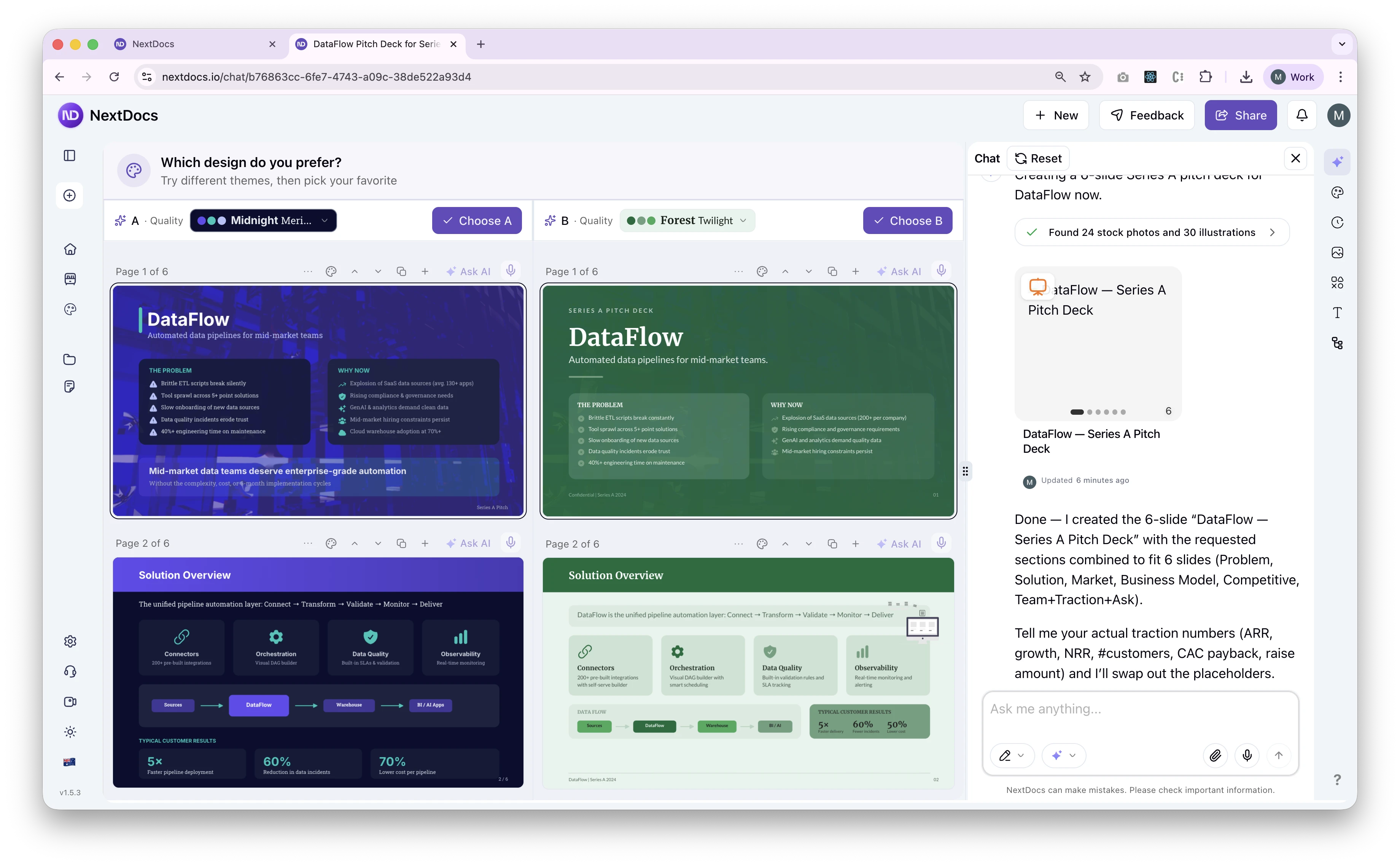
NextDocs represents the pinnacle of AI native document and presentation design. Unlike older tools that simply add an AI chat box to a traditional editor, NextDocs was built from the ground up to understand the structural relationship between data, narrative, and design. It is the top choice for anyone who needs more than just a generic template. The platform stands out because of its multi variant generation system. When you provide a prompt, it does not just give you one take it or leave it result. Instead, it generates several distinct versions of your deck, allowing you to choose the structure and tone that best fits your vision.
For technical users, NextDocs is a clear winner due to its comprehensive support for math equations via LaTeX and KaTeX. You can insert inline or block equations that render perfectly across all export formats. This is a critical feature for founders in AI, biotech, or fintech who must present complex formulas to investors. Furthermore, the tool includes deep research capabilities. It can scan the web to find real statistics and provide citations, which prevents the common AI issue of hallucinating facts. When you are done, you can export your work to PDF, PowerPoint, Google Slides, or even Google Docs. This universal export flexibility ensures you are never locked into a single ecosystem.
Key Features:
- Multi variant generation that provides several choices per prompt.
- Full LaTeX and KaTeX support for technical and scientific notation.
- Deep research integration that pulls real data with citations.
- Universal exports to PDF, PPTX, Google Slides, and Google Docs.
- Native support for tables in rich text and code syntax highlighting.
- Multi model support allowing you to choose the best AI for your specific task.
Pricing: A generous free tier is available. Pro plans start at $15 per month.
Who it is best for: Overall, this is the best tool for founders, consultants, and researchers who need high quality, research heavy decks with technical accuracy.
Verdict: NextDocs is the most versatile and powerful tool on this list. It balances creative freedom with technical precision in a way that no other builder currently matches.
2. Plus AI
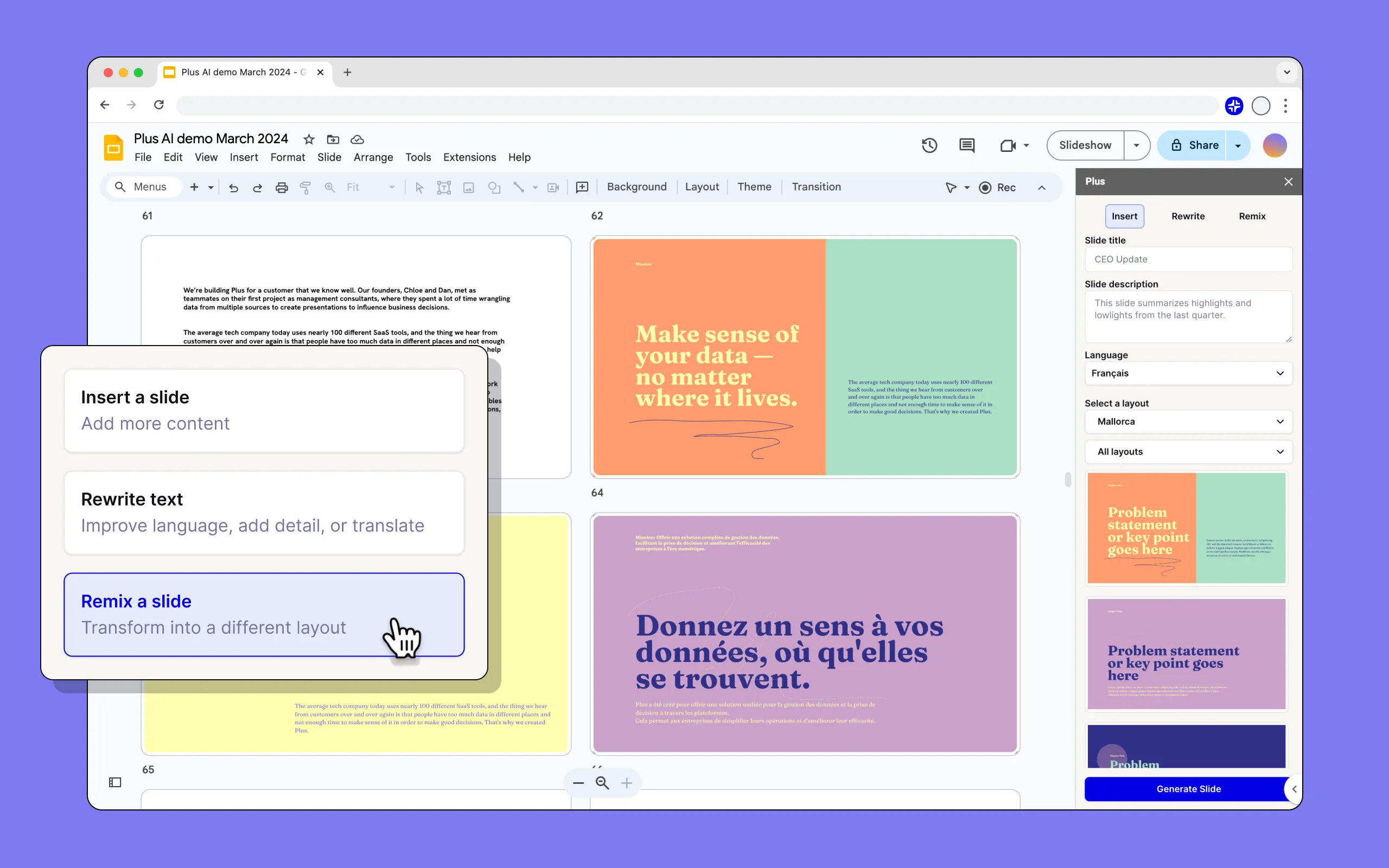
Plus AI takes a different approach by functioning as a native add in for the tools you already use. Rather than forcing you to learn a new interface, it lives inside Google Slides and Microsoft PowerPoint. This makes it an excellent choice for professionals who have extensive libraries of existing templates and do not want to abandon their current workflow. You can use it to generate entire presentations from a single prompt or to enhance individual slides that you have already built.
One of its strongest features is the remix tool. This allows you to take an existing slide and instantly transform its layout or tone while preserving the core content. For those looking for Plus AI alternatives 2026, it is worth noting that while Plus AI is excellent for integration, it can be more limited in its design variety compared to standalone platforms. It relies heavily on the quality of your prompt to produce high quality visuals.
Key Features:
- Seamless integration with Google Slides and PowerPoint.
- Remix feature for updating and enhancing existing slides.
- Template preservation that respects your brand guidelines.
- Simple, prompt based slide generation within the native app.
Pricing: There is no free tier. Plans start at $10 per month.
Who it is best for: Enterprise teams and power users of PowerPoint or Google Slides who want AI assistance without leaving their preferred environment.
Verdict: Plus AI is the best add in for those who value workflow continuity above all else. It is a solid, professional tool that speeds up traditional deck building.
3. Copilot for PowerPoint
Microsoft has integrated its powerful AI capabilities directly into the Office suite via Copilot. For users in a corporate environment, Copilot for PowerPoint offers a level of organizational awareness that other tools cannot match. It can reference your internal documents, emails, and Excel spreadsheets to draft presentations that are contextually relevant to your specific business projects.
While it is a powerhouse for internal reporting and summarizing long documents, it tends to be more conservative in its design choices. It is not necessarily the tool you would use to create a flashy, creative pitch for a venture capital firm, but it is indispensable for enterprise productivity. It also includes strong speaker notes generation, which can help presenters prepare for tough questions during a meeting.
Key Features:
- Access to organizational data across the Microsoft 365 tenant.
- Ability to transform Word documents directly into PowerPoint decks.
- Enterprise grade security and data privacy.
- Automated speaker notes and slide summarization.
Pricing: Requires a Microsoft 365 Business subscription plus an additional $30 per user per month for Copilot.
Who it is best for: Large enterprise organizations and dedicated Microsoft 365 users who need to build presentations based on internal company data.
Verdict: Copilot is the gold standard for corporate efficiency. However, its high price point and conservative designs make it less ideal for early stage startups.
4. Gemini for Google Slides
Gemini is Google's answer to the AI presentation revolution. It is integrated directly into the Google Workspace sidebar, allowing users to generate images and text for their slides in real time. Because it is part of the Google ecosystem, it has direct access to your Google Drive content, making it easy to pull information from various docs and sheets.
In our testing, Gemini is excellent for quick drafts and brainstorming. It is a great starting point for internal team updates where the visual stakes are not as high as a formal pitch. However, when compared to a specialized tool like NextDocs, Gemini can feel a bit generic. The design options are somewhat limited, and the AI can sometimes produce inconsistent results depending on the complexity of the request. For a deeper look at how it stacks up against other technical tools, you can read our comparison of NextDocs vs SlidesAI 2026.
Key Features:
- Native integration with Google Workspace.
- Built in AI image generation for custom visuals.
- Direct access to Google Drive for content sourcing.
- Collaboration features inherent to the Google Slides platform.
Pricing: Basic features are often included with Workspace accounts. Advanced features require a Gemini for Workspace subscription.
Who it is best for: Google Workspace users who need to create quick, functional presentations for internal use.
Verdict: Gemini is a convenient and accessible option for Google users, but it lacks the specialized design and research features found in dedicated pitch deck builders.
5. Gamma
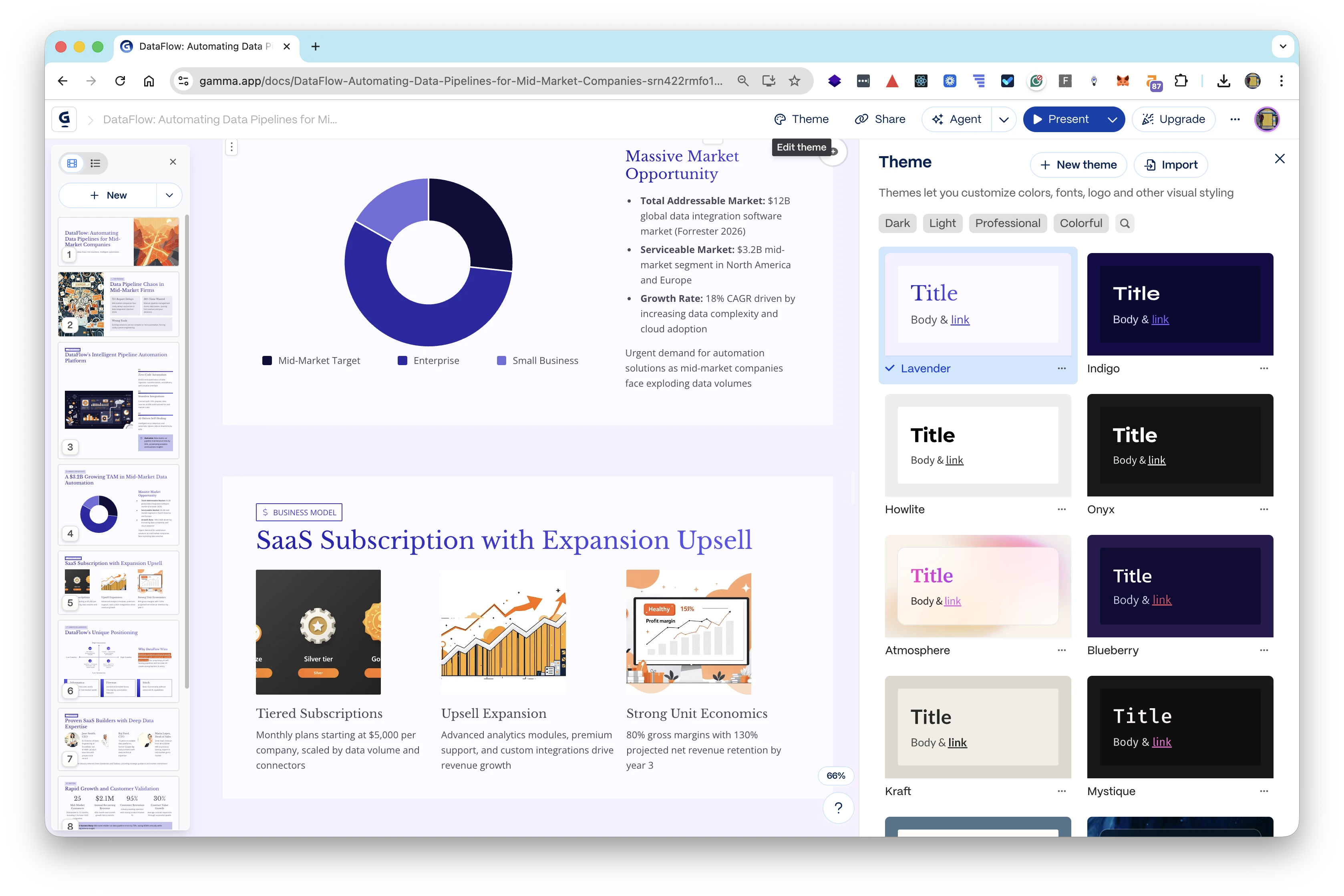
Gamma has gained a massive following by moving away from the traditional "slide" format in favor of web native "cards." These cards can be shared as a live link, allowing viewers to scroll through them like a modern landing page. This makes Gamma presentations feel much more interactive and dynamic than a static PDF. It is particularly popular among startups and individuals who want to stand out during a remote presentation.
Gamma offers a very fast generation process. You can provide a brief outline, and the AI will populate an entire deck with themes, images, and structured text in seconds. While it is visually impressive, the web native format can be a limitation if you are required to submit a standard PPTX file for a conference or a board meeting. If you find the format too restrictive, you might look into Gamma alternatives 2026 to find something that supports more traditional layouts.
Key Features:
- Web native format that is perfect for link sharing and mobile viewing.
- Extremely fast AI generation from prompts or outlines.
- Interactive elements like embedded videos and live charts.
- Modern, high contrast design themes.
Pricing: A generous free tier is available. Paid plans start at $8 per month.
Who it is best for: Budget conscious founders, students, and creators who want a modern, web first way to share their ideas.
Verdict: Gamma is the most innovative tool in terms of delivery format. It is fun to use and produces beautiful results, though it lacks some of the heavy duty research features of top tier competitors.
6. Beautiful.ai
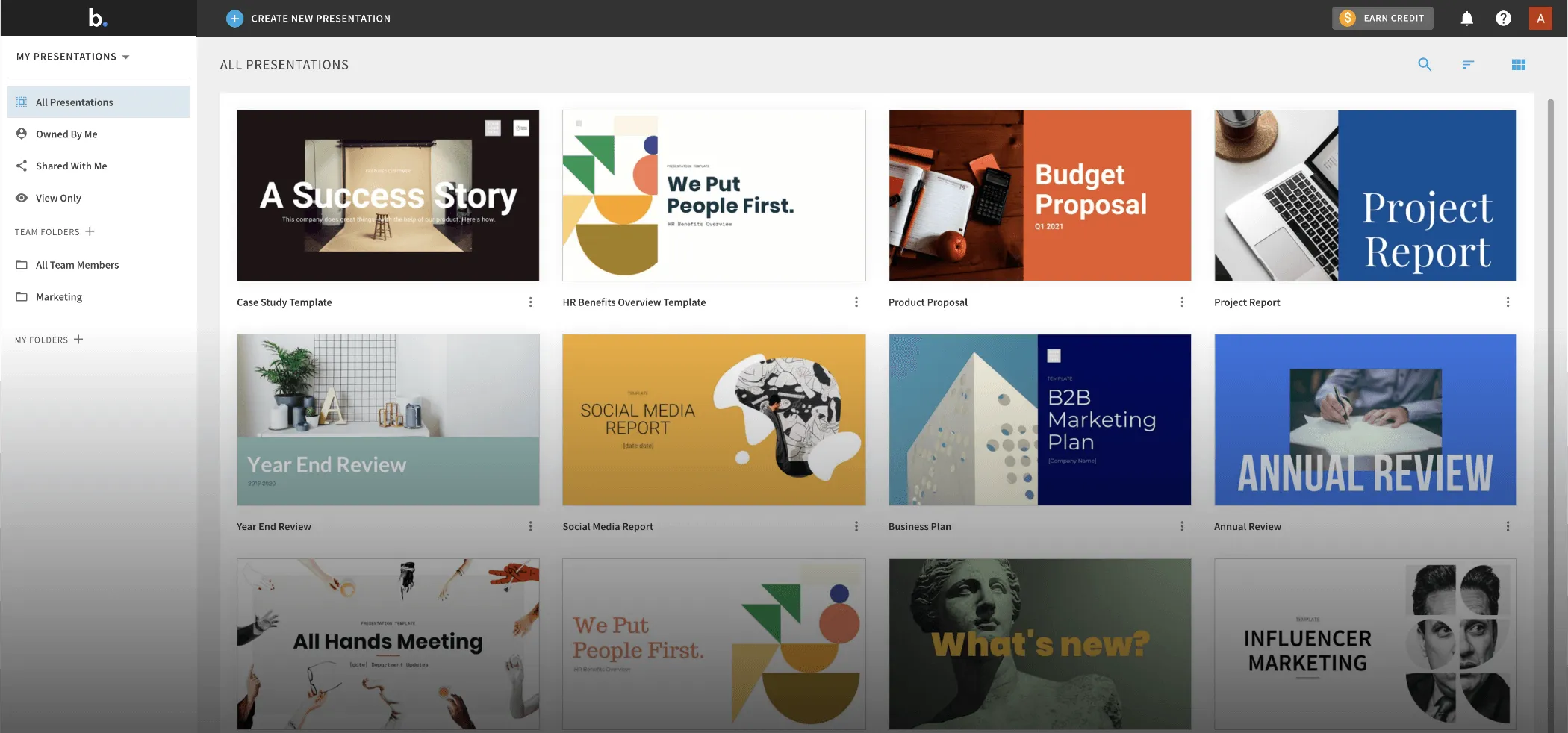
Beautiful.ai was one of the first companies to tackle the problem of bad slide design. It uses a system of smart templates that automatically adjust as you add content. If you add a fourth bullet point to a list, the entire slide resizes itself to maintain perfect alignment and whitespace. This "constrained creativity" approach is perfect for people who are not professional designers but want their work to look like it was created by one.
The tool has recently added more AI generation features, allowing you to build decks from prompts. However, its real strength remains the template library. It is difficult to make a slide look bad in Beautiful.ai. When comparing Beautiful.ai vs Gamma, Beautiful.ai feels more like a traditional presentation tool with a focus on high end corporate aesthetics.
Key Features:
- Smart templates that handle layout and alignment automatically.
- Polished, professional design system with consistent branding.
- Integration with Slack and other team communication tools.
- Strong animation and transition library.
Pricing: No free tier is available for individuals. Pro plans start at $12 per month.
Who it is best for: Non designers, consultants, and client facing professionals who need guaranteed visual quality.
Verdict: Beautiful.ai is the best choice for those who want a polished, professional look with minimal effort. It trades some flexibility for a guaranteed high standard of design.
7. Pitch.com
Pitch.com focuses heavily on the collaborative aspect of presentation building. It is designed for teams that need to work together in real time, featuring robust version history, commenting, and task assignments. The AI features are integrated to help with the initial draft, but the platform shines when it comes to manual refinement and team feedback.
Pitch.com offers a very clean, modern aesthetic that is popular among tech startups. It provides a good balance between AI automation and manual control. If you are debating between different collaborative tools, seeing a comparison like Beautiful.ai vs Pitch can help clarify which workflow suits your team better. Pitch is generally better for teams that want to maintain a high degree of control over their final output.
Key Features:
- Exceptional real time collaboration and project management.
- Version history that allows you to track every change.
- High quality, modern template library.
- Integrated media search and brand kit management.
Pricing: Free tier available for individuals. Pro plans for teams start at $8 per user per month.
Who it is best for: Fast growing startup teams that value collaboration and want a modern alternative to legacy software.
Verdict: Pitch.com is a fantastic collaborative platform. Its AI features are helpful, but its real value lies in its team workflow and design flexibility.
8. Canva Magic Design
Canva is a household name in the design world, and its Magic Design AI brings that expertise to the presentation space. Canva’s greatest strength is its massive library of assets, including millions of photos, icons, and illustrations. The AI can take a simple prompt and generate a deck that is visually rich and ready for social media or marketing pitches.
Because Canva is a multi format tool, you can easily turn your presentation into a video, a social post, or a printed brochure. This makes it a favorite for marketing teams who need to repurpose content across different channels. However, the AI generation can sometimes feel a bit generic, and the professional "corporate" look can be harder to achieve than in tools like NextDocs or Beautiful.ai. For those who find the interface too cluttered, exploring Canva alternatives might be beneficial.
Key Features:
- Massive library of stock photos, videos, and graphic elements.
- Multi format export including video and social media sizes.
- Easy to use drag and drop interface.
- Strong free tier with access to many creative tools.
Pricing: Free tier available. Canva Pro starts at $13 per month.
Who it is best for: Marketers, social media managers, and small business owners who need a one stop shop for all their design needs.
Verdict: Canva is the best all in one creative suite. While its AI presentation features are good, its true power comes from its massive asset library and multi format capabilities.
9. MagicSlides
MagicSlides is a specialized Google Slides add in that focuses on speed and content conversion. One of its most unique features is the ability to take a YouTube URL and turn the video content into a structured presentation. This makes it an incredibly useful tool for educators, trainers, and content creators who need to repurpose video material for a classroom or a workshop.
The interface is very simple, which is both a strength and a weakness. It does not offer the deep design customization found in standalone tools, but it is excellent for creating a quick "ugly" draft that you can then polish manually. It is an affordable option for those who just need a starting point and do not want to spend much time on complex settings.
Key Features:
- YouTube to Slides conversion feature.
- Document and text to Slides generation.
- Simple, no nonsense interface within Google Slides.
- Support for multiple languages.
Pricing: Free tier available. Paid plans start at $8 per month.
Who it is best for: Educators, trainers, and content creators who need to quickly repurpose existing video or text content.
Verdict: MagicSlides is a handy utility tool. It is not a design powerhouse, but its ability to convert YouTube videos makes it unique in a crowded market.
10. SlidesAI
SlidesAI is another popular Google Slides add in that prioritizes ease of use and affordability. It is designed to take long blocks of text and summarize them into a slide deck. This is particularly helpful for students or professionals who have a long report or a research paper and need to present the key findings quickly.
While it lacks the advanced features of a tool like NextDocs, such as LaTeX support or deep research, it is a reliable tool for basic slide generation. The output is usually functional and clean, though it may require manual styling to reach a professional standard. For more information on how it compares to high end tools, check out the NextDocs vs SlidesAI 2026 breakdown.
Key Features:
- Fast text to slide generation.
- Simple integration with Google Slides.
- Affordable pricing for students and individuals.
- Basic image and icon suggestions.
Pricing: Free tier available. Pro plans start at $10 per month.
Who it is best for: Students and professionals who need to turn text documents into quick, functional presentations.
Verdict: SlidesAI is a solid, entry level AI tool. It is perfect for those who need a fast draft but do not require complex design or technical features.
Decision Guide: Choosing the Right AI Pitch Deck Builder
Selecting the right tool depends entirely on your specific needs, your technical requirements, and your preferred workflow. If you are still unsure which direction to go, consider the following decision framework.
For Technical and Research Heavy Decks
If you are a founder in a deep tech field, a researcher, or an academic, your primary concern is accuracy and technical presentation. You need a tool that supports LaTeX for math and KaTeX for formulas. You also need a tool that can perform real research so you do not have to double check every statistic the AI provides. In this category, NextDocs is the undisputed leader. Its ability to provide multi variant choices ensures that your technical narrative is structured correctly from the start. You might also find it useful to see how it compares to other research assistants like Manus vs NextDocs 2026.
For Workflow Integration
If you have spent the last decade mastering PowerPoint or Google Slides, you might not want to switch to a new platform. In this case, add ins are your best bet. Plus AI offers a great balance of features and design for those who want to stay in their lane. If you are in a large corporation where security and internal data access are the priorities, Microsoft Copilot is the logical choice, despite its higher price point.
For Design and Visual Impact
When the goal is to wow an audience with a beautiful, modern aesthetic, Beautiful.ai and Gamma are the top contenders. Beautiful.ai is better for traditional, high end corporate decks where alignment must be perfect. Gamma is better for remote presentations where a web native, interactive format will help you stand out. If you are creating content for social media or a more creative brand, Canva Magic Design provides the most visual flexibility.
For Team Collaboration
Building a deck with three other people can be a nightmare in traditional software. Pitch.com solves this problem better than anyone else. Its version control and commenting systems are top tier, making it the best choice for teams that need to iterate quickly and maintain a single source of truth.
Conclusion: The Future of Presentations
The days of staring at a blank slide and struggling with formatting are over. In 2026, the best AI pitch deck builders have become sophisticated partners in the creative process. They do more than just generate text; they provide research, suggest layouts, handle complex math with LaTeX, and ensure brand consistency across your entire organization.
While there are many options available, the most important factor is finding a tool that enhances your specific strengths. For most professionals, especially those in technical or research heavy fields, NextDocs provides the most complete feature set. Its combination of multi variant generation, universal exports, and deep research capabilities makes it a powerful ally for any high stakes presentation.
However, whether you choose a native add in like Plus AI, a design focused tool like Beautiful.ai, or a web native platform like Gamma, the goal remains the same: to communicate your ideas clearly, persuasively, and efficiently. By leveraging these AI tools, you can spend less time on the "work of work" and more time on the strategic thinking that actually drives your business or research forward.
For a broader look at the landscape, don't miss our comprehensive guide on the best AI presentation builders 2026.
Ready to Create Better Presentations?
Try NextDocs Free and experience multi-variant generation, universal exports, and deep research integration. No credit card required.