


From research to investor deck: the AI pitch deck workflow
An investor deck has a known shape. Problem, solution, why now, market, product, traction, business model, competition, team, the ask. The shape is not the hard part. The hard part is that every number on it will be checked, and that ten slides is not enough room for everything you want to say.
AI helps with both, if you use it in the right order. This is the workflow.
Step 1: research before you write
Start with the numbers you do not have yet: market size, the growth rate, what competitors charge, the regulation that makes "why now" true. In NextDocs, turn on deep research and ask for exactly that:
Research the market for [category] in [region]: current size, growth rate over the last three years, the three largest players and their pricing, and any regulatory change since 2024 that affects it. Cite every figure.
Deep research searches and crawls the web, and returns figures with their sources attached. You will use those citations twice: once in the deck's footnotes, and once when an investor asks where a number came from.
Do the research as its own document. It becomes the appendix, and the source of truth for everything after.
Step 2: write the brief, not the deck
Paste the research into a new presentation prompt along with the things only you know: what the product does, the traction so far, the team, the round. Then ask for the deck in the standard shape:
Ten-slide investor deck for a seed round. Problem, solution, why now, market (use the researched figures with citations), product, traction, business model, competition as a two-axis chart, team, the ask. One idea per slide, no slide with more than 30 words except the market slide. Confident, plain, no buzzwords. Use the brand kit.
Set the mode to Quality and generate three versions. This is where the ten decisions get made for you three different ways: one version will lead with the problem, one with the traction, one with the market. Read all three. Pick the one that tells the story the way you would in a room.
Step 3: apply the brand once
If your brand kit is set, the deck already has your colours, fonts and logo. If not, set it now; it takes two minutes and every follow-up document, the one-pager, the data room memo, the update email, inherits it. Upload your actual brand font and it is embedded in the PDF, so the deck looks the same on the investor's laptop as on yours.
Step 4: the three human passes
- The problem slide. Rewrite it in your own voice. It is the slide that decides whether they keep reading.
- The numbers. Check every figure against the research document. Where the AI rounded, un-round.
- The ask. Be specific: the amount, what it buys, the milestone it reaches.
Each change is a sentence in the chat, and the slide updates in place.
Step 5: export for the room and for the inbox
Export to PowerPoint if you will present from someone else's machine, to Google Slides if the partner wants to comment, and to PDF for the email, always the PDF for the email. Keep the source in NextDocs for the inevitable "can you send the version with the updated traction slide".
Step 6: the video most founders skip
Investors increasingly see a deck before they see you, in a message, a data room or a LinkedIn post. A sixty-second video of the story, in your voice, does what a PDF cannot.
This is the step where the workflow moves to Shyne, our sister product. Bring the same brand kit, drop the deck on the canvas, and ask the agent for a launch video: it lays the slides on a timeline, generates any footage you need with Veo 3.1 or Kling 3, adds narration in an ElevenLabs voice, and exports an MP4 or publishes it to LinkedIn or YouTube directly. The deck and the video live in the same project, so when the traction slide changes, the video's does too.
The whole thing, timed
Research, twenty minutes, mostly reading. Brief and three versions, ten. Brand and human passes, twenty. Exports, two. The video, another half hour if you want it. An afternoon, for a deck that is sourced, chosen from three, on brand, and ready in every format a partner might ask for.
Start with the AI pitch deck builder · Make the video in Shyne
The NextDocs Team
Related posts
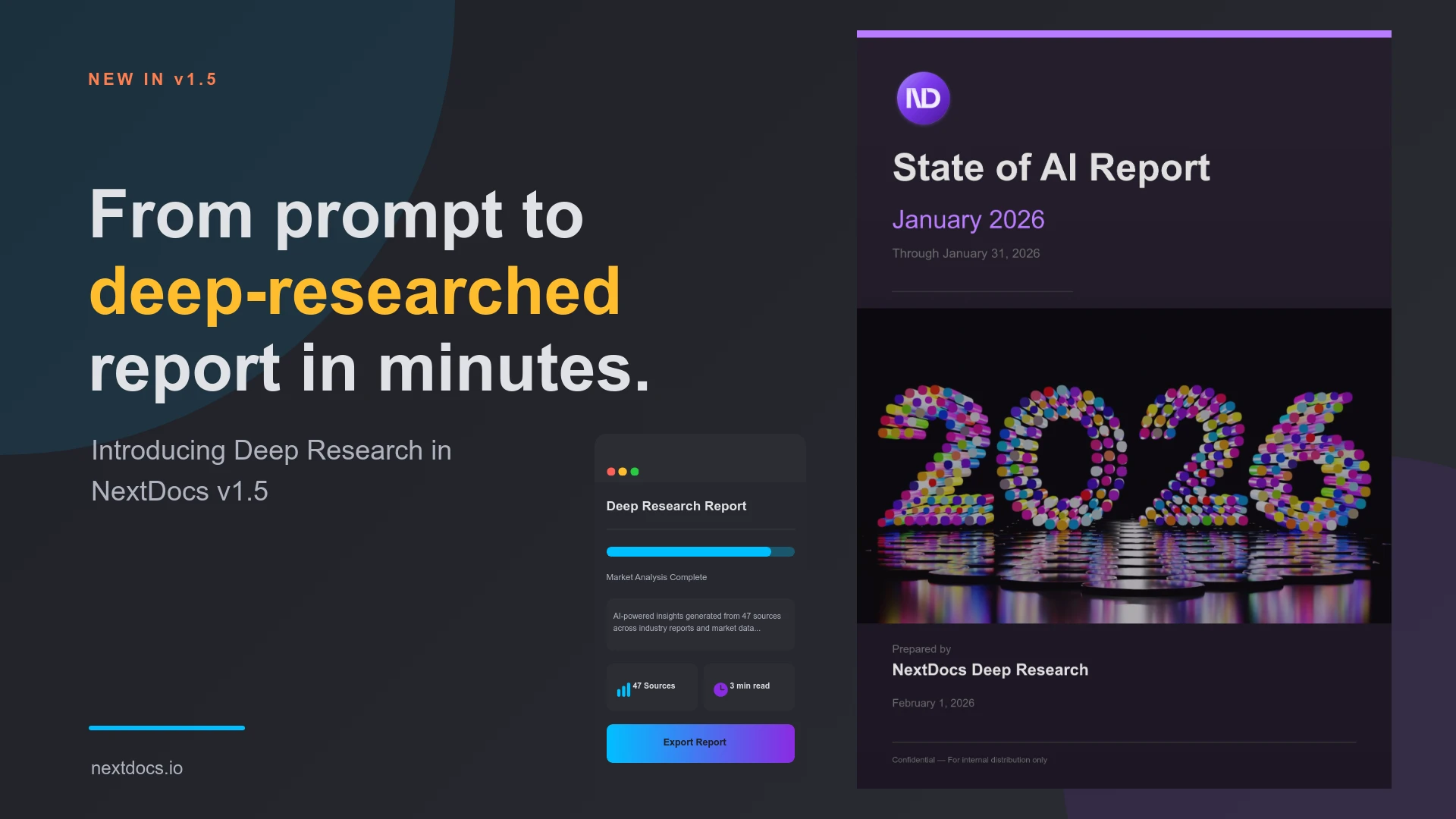
Introducing Deep Research — NextDocs v1.5
AI now researches your topic before creating your document. Deep Research searches the web, reads articles, and synthesizes information from multiple sources. Get documents backed by real data and proper citations.
Read more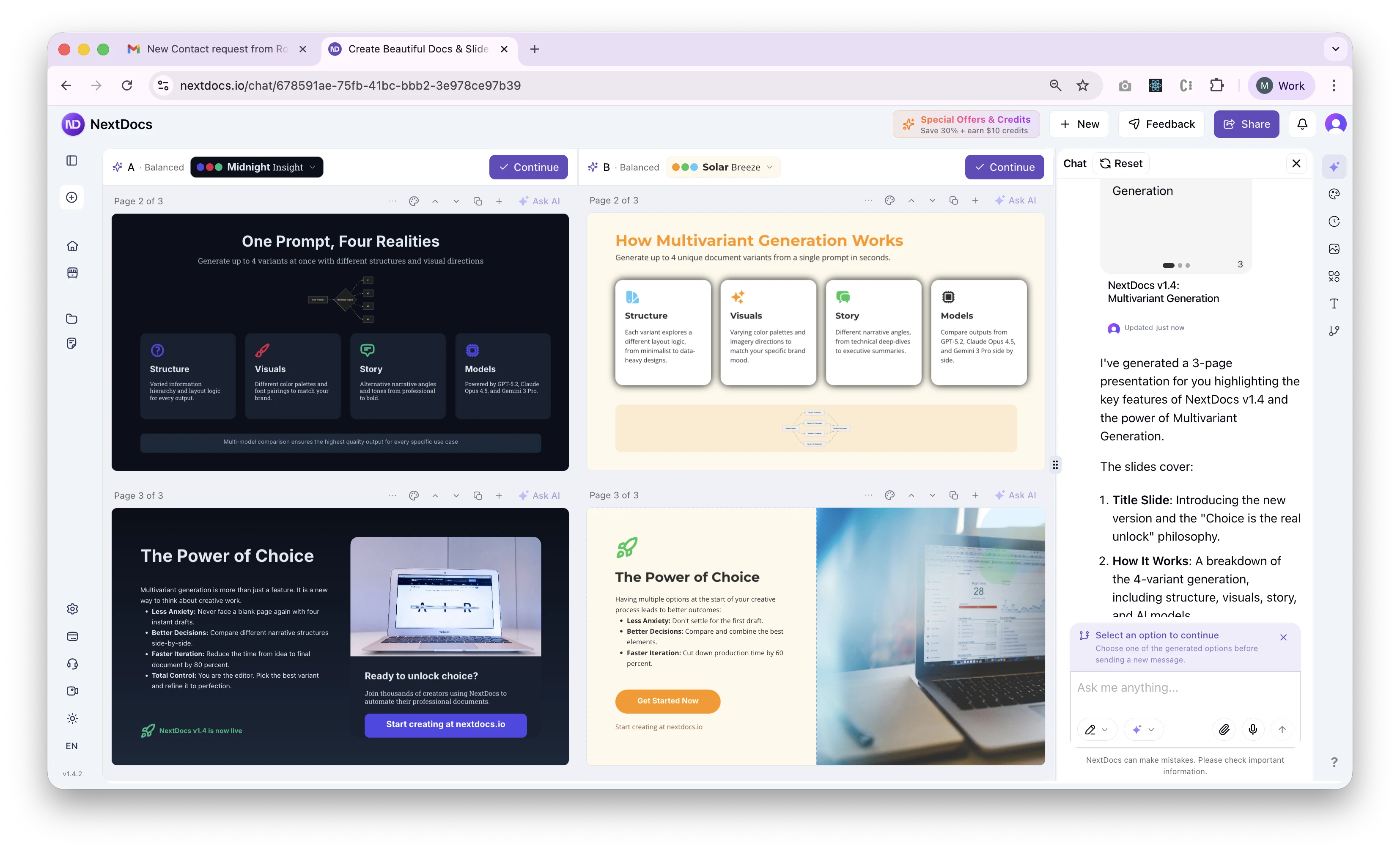
Introducing Multivariant Generation — NextDocs v1.4
Generate up to 4 document variants simultaneously. Compare different structures, visual directions, and stories side by side. Layer themes on top. Pick your favorite. This changes everything about how you create.
Read more
Sora shuts down on 24 September. Here is how to put AI video in a deck now.
OpenAI closed the Sora app in April and retires the Sora API on 24 September 2026. If video was part of your presentation workflow, here are the two routes that work today, one in NextDocs and one in Shyne.
Read more