
Best Ai Slide Makers for academics in 2026
A comprehensive roundup of the best AI slide makers for academics, researchers, and professors, ranking the top tools for technical presentations, research-heavy decks, and classroom lectures.
Academic presentations are fundamentally different from corporate pitch decks or marketing slides. A researcher presenting at a conference or a professor delivering a lecture requires a level of precision, data integrity, and technical formatting that most generic AI tools struggle to provide. While many platforms can generate a beautiful background, an academic needs support for LaTeX equations, proper code syntax highlighting, and content backed by verifiable citations.
In 2026, the landscape of AI presentation software has matured significantly. We have moved past the era of simple text to image generation and into an era of deep research integration and structural intelligence. For academics, this means tools can now assist in synthesizing complex papers into coherent narratives while maintaining the rigor required for scientific and scholarly work.
When searching for the best AI presentation builders 2026, the focus must shift from mere aesthetics to content accuracy and technical flexibility. This guide ranks the best AI slide makers specifically through the lens of academic needs, evaluating how well they handle complex data, research workflows, and various export requirements.
Summary Comparison of the Best AI Slide Makers for Academics
| Rank | Tool | Best For | Starting Price |
|---|---|---|---|
| 1 | NextDocs | Research-heavy decks, Math, and Technical slides | $15/mo |
| 2 | Plus AI | Traditional Google Slides and PowerPoint users | $10/mo |
| 3 | Beautiful.ai | Visual quality and automated design | $12/mo |
| 4 | Gamma | Quick web-based lectures and sharing | $8/mo |
| 5 | Copilot for PowerPoint | Microsoft 365 users and internal reports | $30/mo |
| 6 | Gemini for Google Slides | Native Google Workspace integration | $0 (Free tier) |
| 7 | Pitch.com | Collaborative research team projects | $8/mo |
| 8 | Canva Magic Design | Visual aids and creative classroom materials | $13/mo |
| 9 | MagicSlides | Turning YouTube lectures or papers into slides | $8/mo |
| 10 | SlidesAI | Rapid drafting of basic internal presentations | $10/mo |
1. NextDocs (Best Overall for Academics)
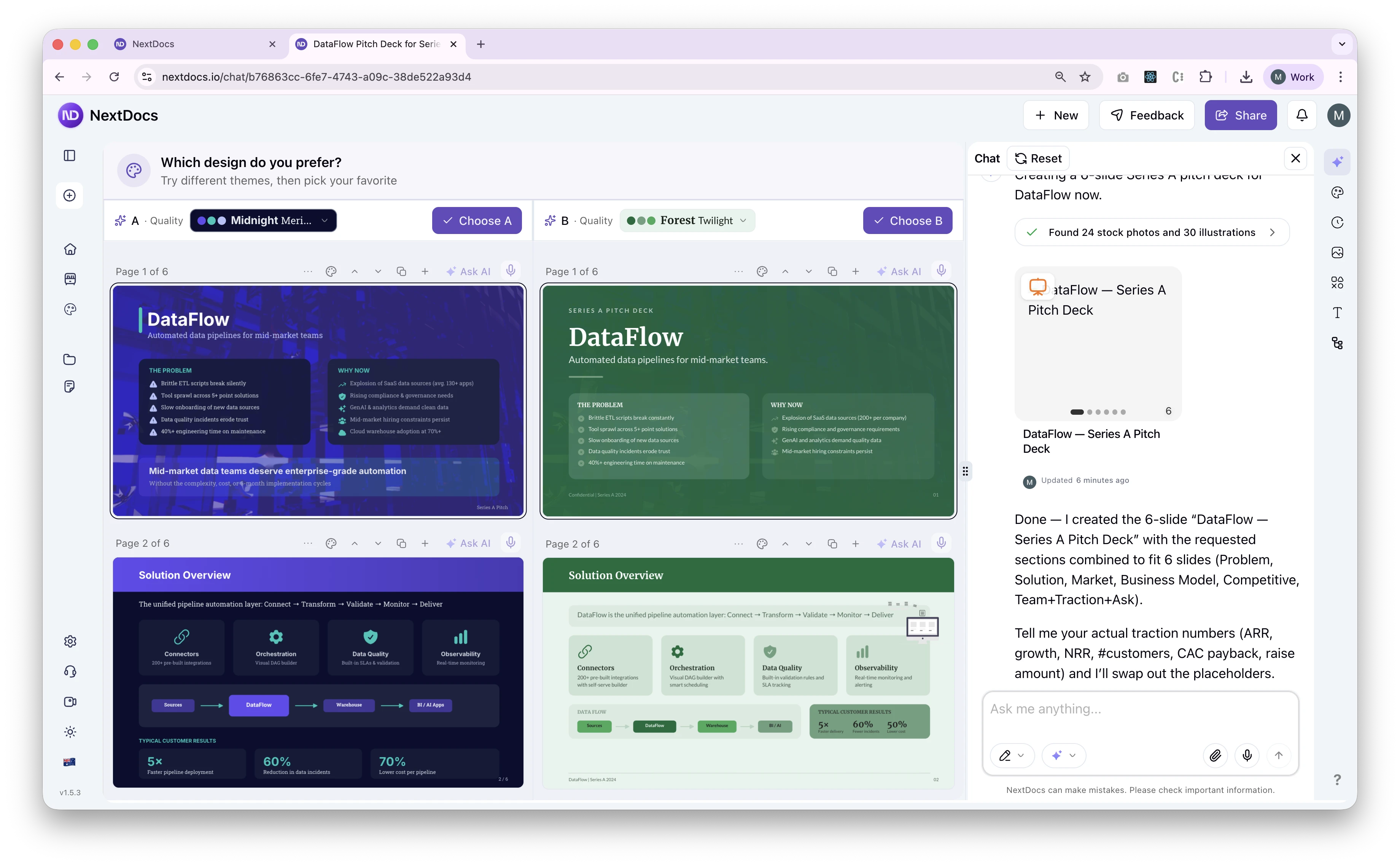
NextDocs stands out as the premier choice for academics because it treats the presentation as a structured document rather than just a series of images. It is built on an AI native architecture that understands the nuances of technical content. For researchers, the most significant advantage is the multi-variant generation. Instead of giving you one take it or leave it result, NextDocs generates several versions of your deck, allowing you to choose the narrative structure that best fits your thesis or data.
The tool includes native support for math equations via LaTeX and KaTeX, which is a critical requirement for STEM researchers. It also features robust code syntax highlighting for computer science and engineering presentations. Unlike other tools that hallucinate data, NextDocs includes a deep research integration that pulls real figures and citations from the web. When comparing nextdocs vs plus ai, NextDocs offers superior flexibility in terms of export formats, allowing users to move seamlessly between PDF, PPTX, Google Slides, and even Google Docs. It is also a strong contender when looking at nano banana pro vs nextdocs 2026 due to its superior text and data handling.
Key Features:
- Multi-variant generation for diverse layout and narrative options.
- Deep research integration that provides real data and citations.
- Native support for LaTeX math equations and code syntax highlighting.
- Universal exports to PDF, PPTX, and Google Slides.
- Brand styling that maintains a professional academic aesthetic.
Pricing: Free tier available. Pro plans start at $15 per month.
Best For: Overall academic use, research-heavy presentations, technical lectures, and consultants.
Verdict: NextDocs is the most comprehensive tool for academics who need more than just pretty slides. Its ability to handle technical content and provide multiple variations makes it the top choice for serious scholarly work.
2. Plus AI
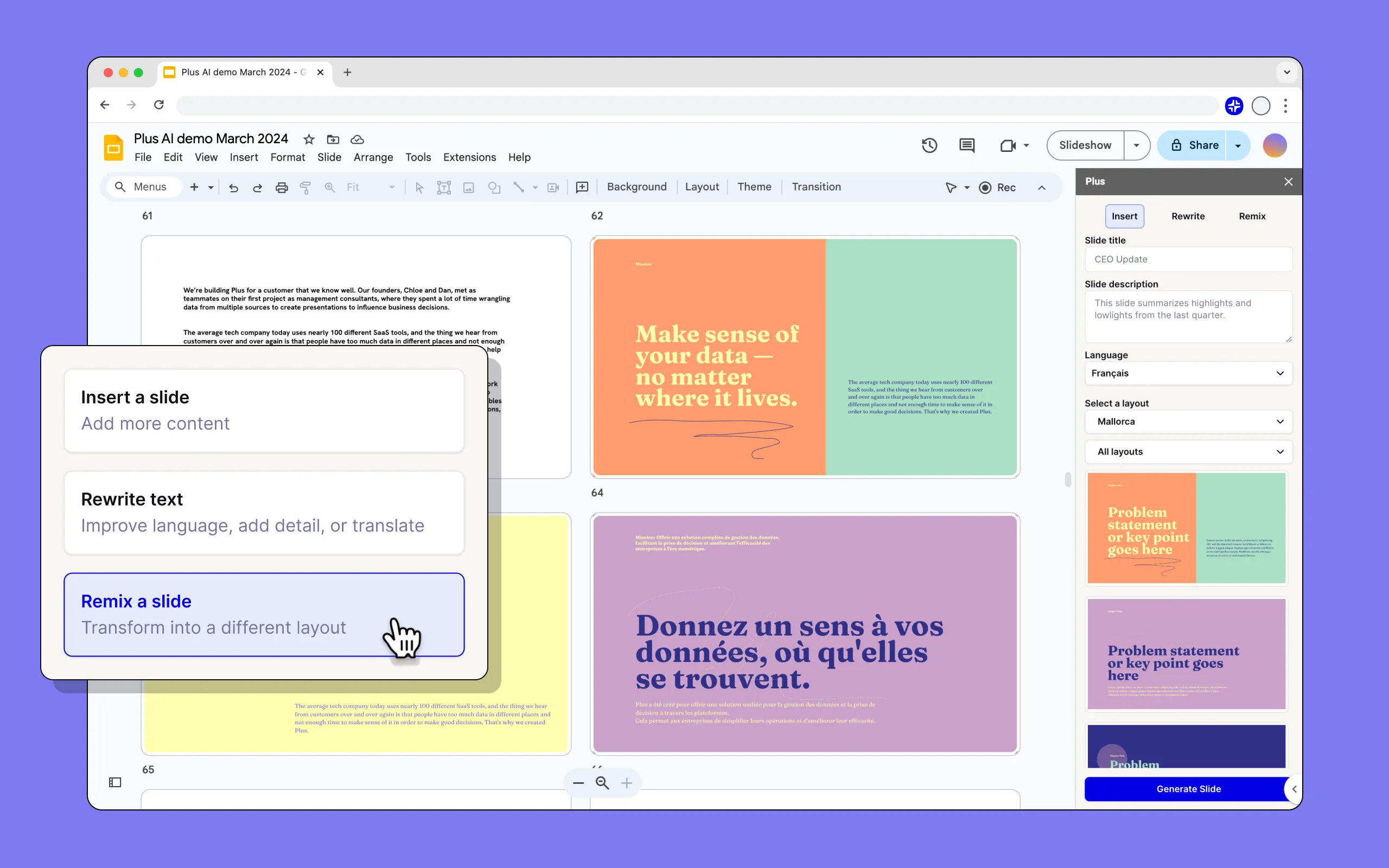
Plus AI is a powerful add-in that lives directly inside Google Slides and PowerPoint. For academics who are already comfortable in these traditional environments, Plus AI provides a way to integrate AI without changing their entire workflow. It excels at preserving existing templates, which is vital for professors who must adhere to strict university branding or departmental slide masters.
The remix feature is particularly useful for academics who need to update old lecture materials. You can take an existing slide and ask the AI to rewrite it for a different audience or to include new research findings. While it lacks some of the deep technical features of NextDocs, its integration is seamless. It is a reliable choice for those who do not want to learn a new standalone platform.
Key Features:
- Native integration as a Google Slides and PowerPoint add-in.
- Template preservation that works with your existing university slide masters.
- Remix feature for updating and enhancing existing content.
- AI powered rewriting and content expansion.
Pricing: No free tier. Starting at $10 per month.
Best For: PowerPoint and Google Slides power users who want AI assistance within their current apps.
Verdict: Plus AI is the best option for those who want to stick with traditional software while gaining the speed of AI generation. It is professional, reliable, and keeps your branding consistent.
3. Beautiful.ai
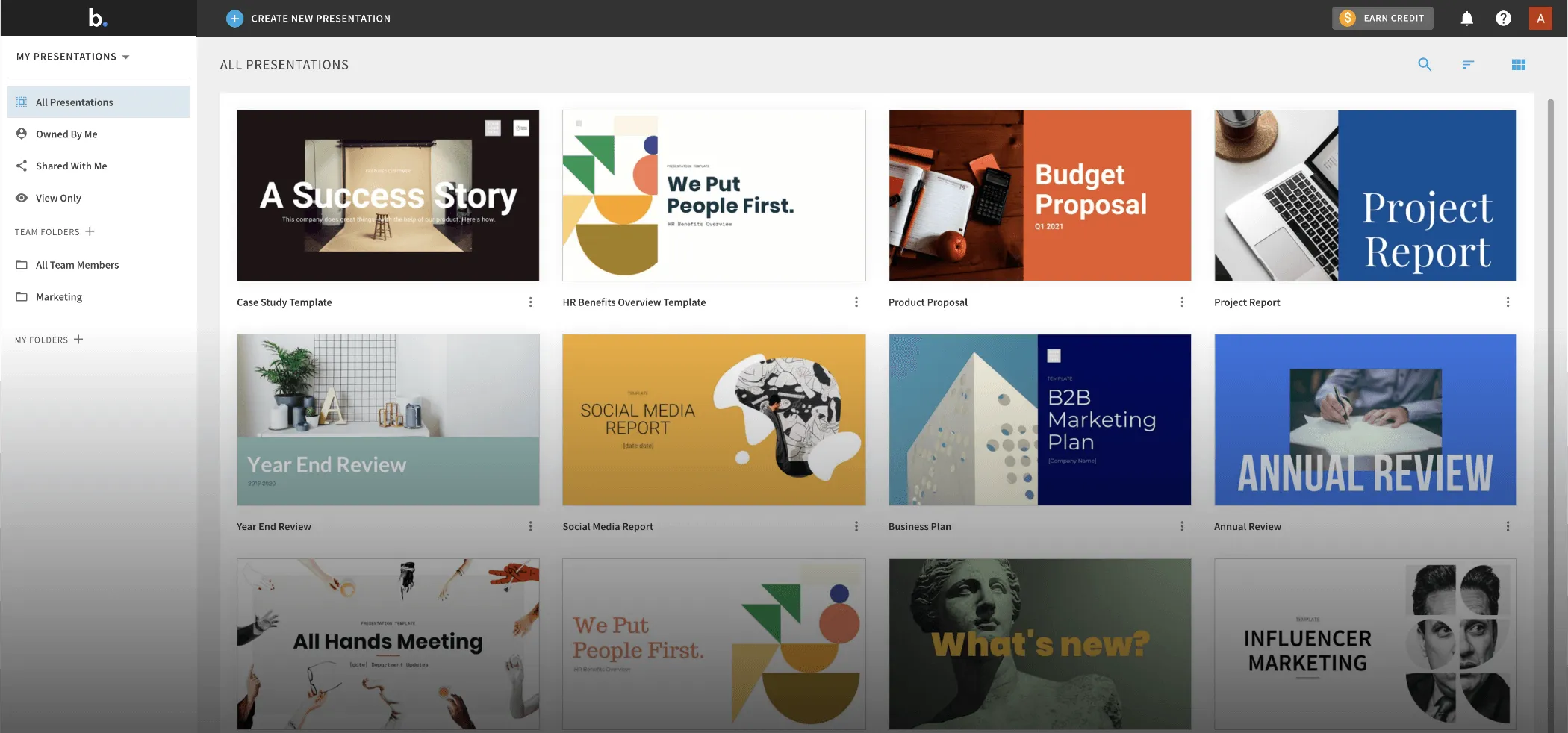
Beautiful.ai is designed for the non-designer who needs a polished, professional look every time. It uses smart templates that automatically adjust as you add content. For an academic who might have a lot of text or several complex charts, this tool ensures that the layout remains clean and readable.
While it has less AI generation depth than some newer competitors, its design constraints are actually a benefit. It prevents users from making "ugly" slides by enforcing good design principles. This is excellent for conference presentations where visual clarity is paramount. If you find yourself looking for canva alternatives that feel more professional and less like a social media tool, Beautiful.ai is a strong candidate.
Key Features:
- Smart templates that automatically resize and realign elements.
- Polished, professional design aesthetic.
- Intuitive animations that add value without being distracting.
- Asset library with high quality icons and images.
Pricing: No free tier. Starting at $12 per month.
Best For: Academics who prioritize visual quality and want a designer look without the effort.
Verdict: Beautiful.ai is the gold standard for design consistency. It is ideal for high stakes presentations where you want the visuals to be as impressive as the research.
4. Gamma
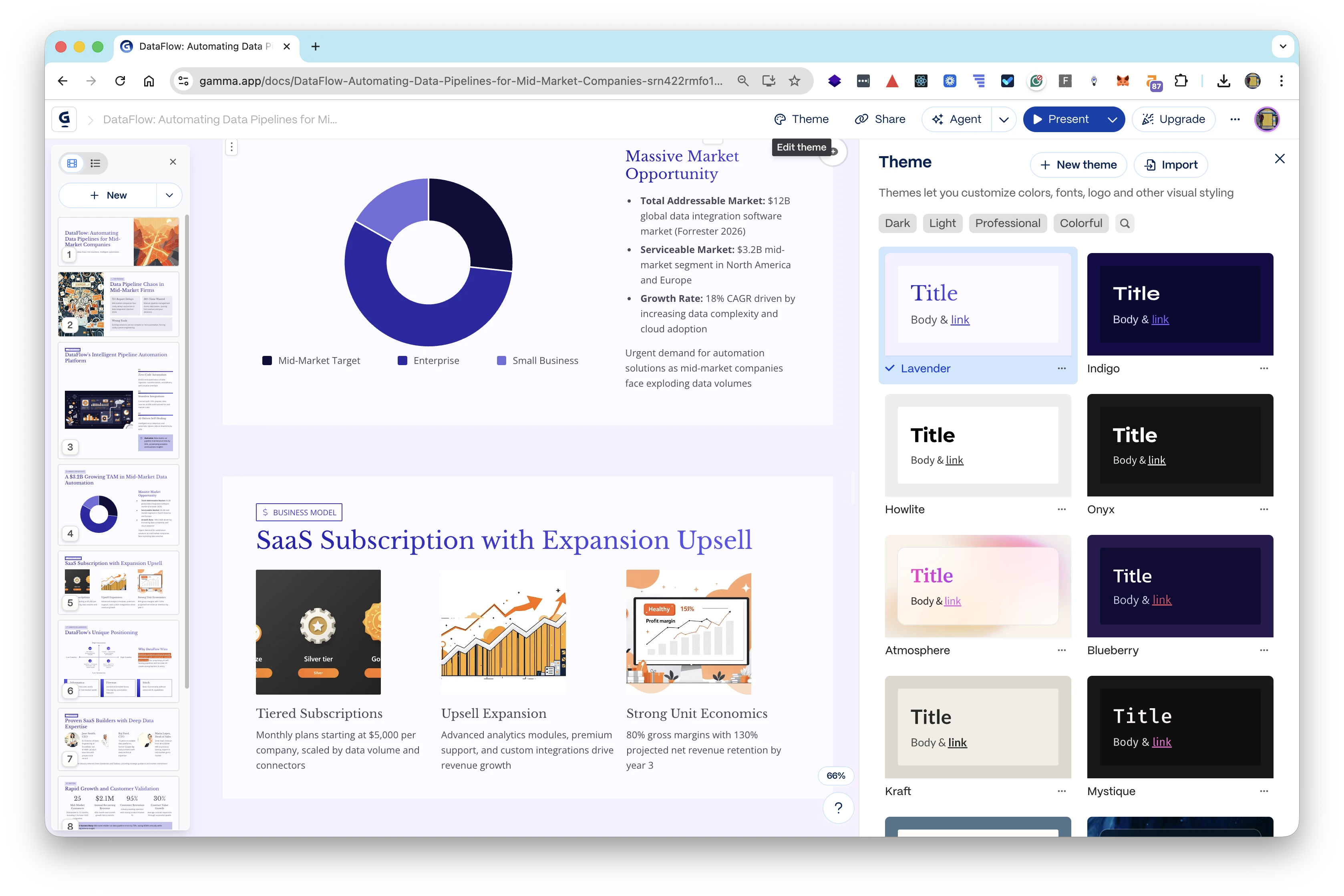
Gamma offers a web native approach to presentations. Instead of traditional slides, Gamma creates "cards" that look more like a modern website. This is particularly useful for academics who want to share their lectures online or provide a more interactive experience for students.
It has a very generous free tier, making it accessible for students and early career researchers. The generation speed is impressive, and the default themes are modern and clean. However, the web native format can be a limitation if you are required to present offline using a standard PPTX file. For those exploring gamma alternatives 2026, it remains a top choice for its ease of use.
Key Features:
- Web native format that is easy to share via a simple URL.
- Fast AI generation from simple text prompts.
- Modern, clean design themes that look great on mobile and desktop.
- Interactive elements like embeds and videos.
Pricing: Free tier available. Pro plans start at $8 per month.
Best For: Budget-conscious academics, quick lectures, and sharing research summaries online.
Verdict: Gamma is a fantastic tool for the modern, digital-first academic. It is the best free option for creating visually engaging, shareable content quickly.
5. Copilot for PowerPoint
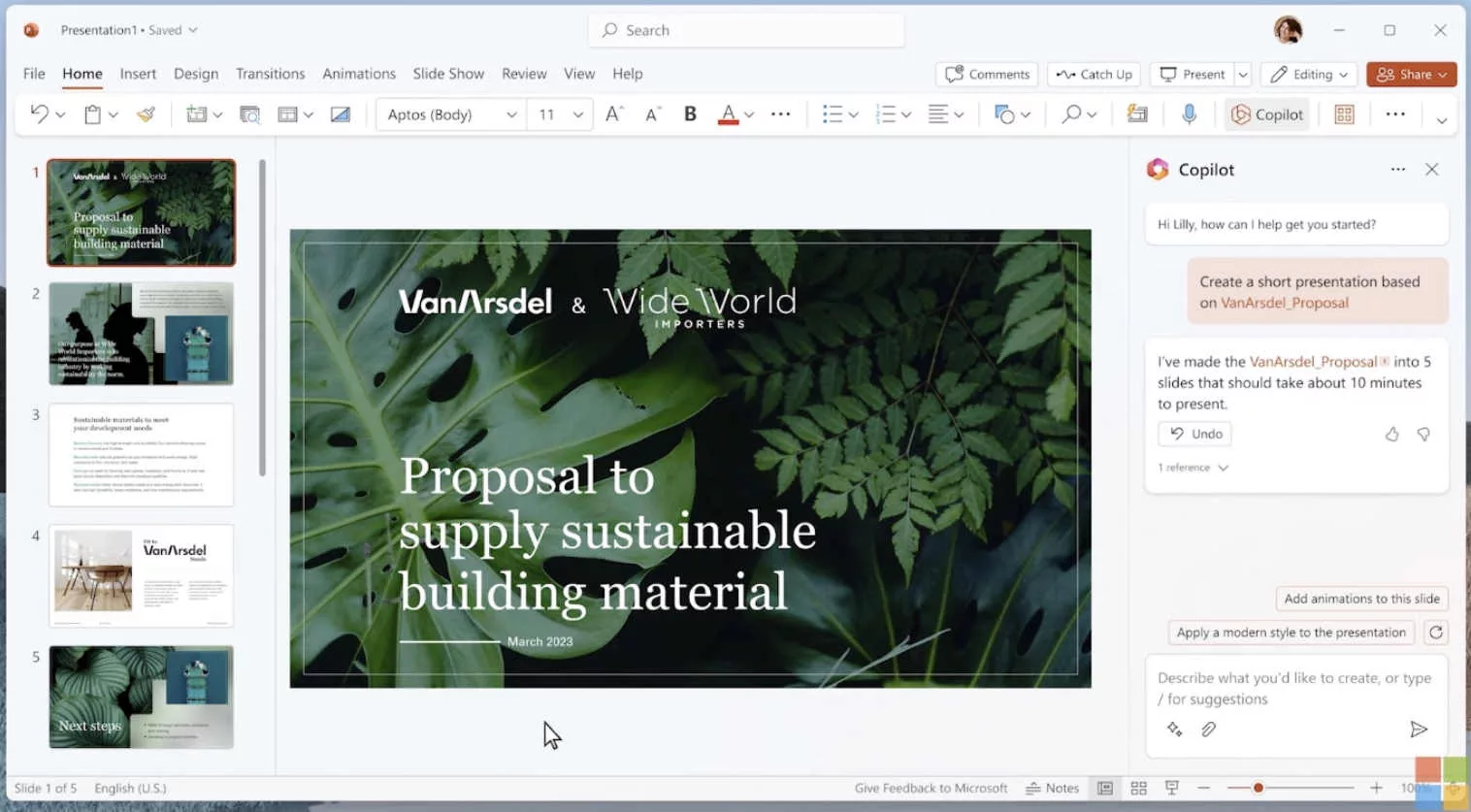
Microsoft Copilot is the enterprise choice for those already within the Microsoft 365 ecosystem. For academics at large research institutions that provide M365 licenses, Copilot offers the advantage of organizational context. It can reference your existing Word documents or Outlook emails to build a presentation.
In a comparison of copilot powerpoint vs magicslides, Copilot wins on security and integration, though it often trails in creative design. It is a very conservative tool that produces standard, professional slides. It is excellent for internal departmental reports or administrative presentations where security and institutional data access are the main concerns.
Key Features:
- Deep integration with the entire Microsoft 365 suite.
- Organizational context awareness that pulls from your documents.
- Automatic generation of speaker notes.
- Enterprise grade security and data protection.
Pricing: No free tier. Starting at $30 per month (requires M365 subscription).
Best For: Enterprise university users and those who need to turn long Word documents into slides.
Verdict: Copilot is a solid, albeit expensive, choice for academics who live in Word and Excel. It is the safest choice for handling sensitive institutional data.
6. Gemini for Google Slides
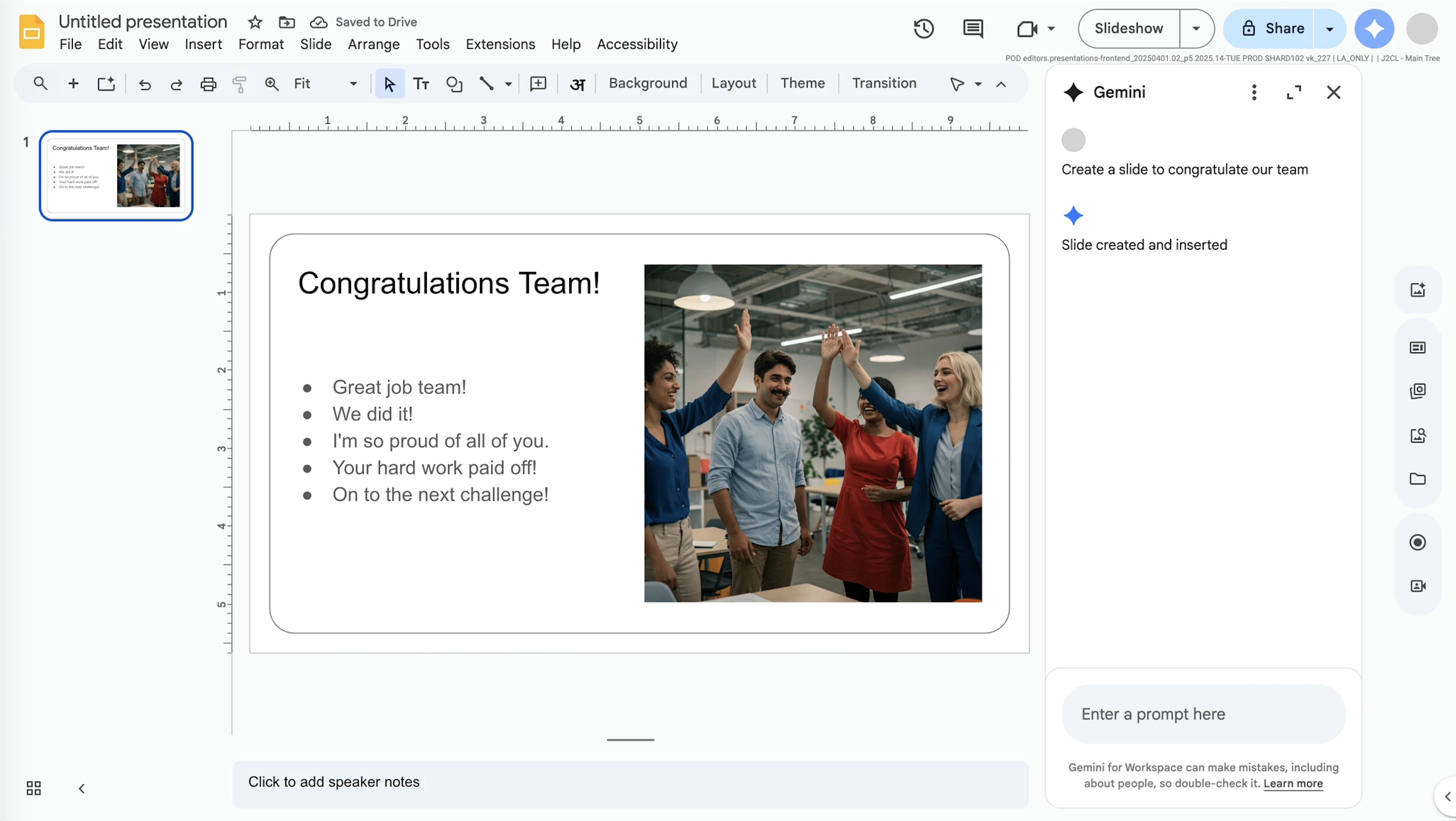
Gemini is Google's answer to Copilot, integrated directly into Google Slides. It is particularly effective for academics who store all their research in Google Drive. Gemini can scan your folders to help generate content and even create custom images to illustrate complex concepts.
While the output can sometimes feel generic, the convenience of having AI inside Google Workspace is hard to beat. If you are looking for 2026 gemini google slides alternatives, you might find more specialized tools, but Gemini remains the most accessible for Google users. It is also worth checking out the gemini google slides vs magicslides 2026 comparison to see how it stacks up against third party add-ins.
Key Features:
- Native integration with Google Workspace and Drive.
- Built-in AI image generation.
- Capable of referencing and summarizing Drive content.
- Easy collaboration features.
Pricing: Free tier available. Workspace Pro plans start at $20 per month.
Best For: Google Workspace users who need quick drafts and simple image generation.
Verdict: Gemini is the most convenient tool for Google users. While not as feature-rich as standalone tools, it is perfect for everyday academic tasks and quick slide drafts.
7. Pitch.com
Pitch.com is built for teams. In an academic setting, this is ideal for research groups or collaborative projects where multiple authors need to contribute to a single deck. It offers excellent version history and commenting features, which are far superior to the basic collaboration tools in PowerPoint.
The AI generation in Pitch is solid, providing a good balance between automation and manual control. It focuses on professional, high-end templates that work well for grant proposals or high-level academic pitches. It is a modern, sleek platform that feels more intuitive than traditional software.
Key Features:
- Real-time collaboration with advanced commenting and task assignments.
- Excellent version history to track changes across authors.
- High quality template library designed for professional decks.
- Seamless integration with data sources like Google Sheets.
Pricing: Free tier available. Starting at $8 per month.
Best For: Research teams, collaborative projects, and version control needs.
Verdict: Pitch is the best choice for collaborative academic work. It streamlines the process of building a presentation with multiple stakeholders while maintaining a high design standard.
8. Canva Magic Design
Canva is a powerhouse of visual assets. Its Magic Design AI allows academics to transform a simple prompt into a visually rich presentation. For educators who need to create engaging classroom materials, Canva’s massive library of icons, illustrations, and stock photos is an invaluable resource.
However, Canva can sometimes feel too "designed" for a formal academic conference. Its AI quality can be inconsistent compared to research-focused tools. That said, for teaching and public outreach, it is incredibly effective. It remains one of the top canva alternatives for those who want a more visual, less text-heavy approach.
Key Features:
- Enormous library of templates, icons, and visual assets.
- Magic Design AI for quick layout generation.
- Multi-format export including video and social media graphics.
- Strong free tier with access to many features.
Pricing: Free tier available. Pro plans start at $13 per month.
Best For: Teachers, professors doing public outreach, and visual-heavy presentations.
Verdict: Canva is the king of visual variety. It is the best tool for creating engaging, student-friendly materials that require a lot of illustrative content.
9. MagicSlides
MagicSlides is a specialized Google Slides add-on that focuses on content repurposing. For an academic, this is a huge time saver. You can feed the AI a YouTube link of a lecture or a long research paper, and it will generate a summary slide deck.
The design output is quite basic, and you will almost certainly need to do some manual editing to get the slides to a professional standard. However, as a tool for creating a "first draft" from existing materials, it is very effective. It is a niche tool that solves the specific problem of turning one format of information into another.
Key Features:
- YouTube to slides conversion.
- Document to slides generation.
- Simple, focused interface for quick drafting.
- Works directly within Google Slides.
Pricing: Free tier available. Starting at $8 per month.
Best For: Repurposing lectures, summarizing papers, and quick training materials.
Verdict: MagicSlides is a great utility tool. It is not a full design suite, but it is excellent for academics who need to quickly turn their existing content into a presentable format.
10. SlidesAI
SlidesAI is another Google Slides add-on that prioritizes speed and simplicity. It is designed for users who want to paste a block of text and have it instantly converted into slides. It does not have the sophisticated research or math features of NextDocs, but it is very affordable and easy to use.
For students or for internal departmental meetings where design is not the primary concern, SlidesAI does the job well. It is a straightforward tool that eliminates the "blank page" problem by providing a quick starting point based on your notes.
Key Features:
- Fast generation from text inputs.
- Affordable pricing for students and individuals.
- Simple interface with no learning curve.
- Integrated directly into Google Slides.
Pricing: Free tier available. Starting at $10 per month.
Best For: Students, quick internal drafts, and simple presentations.
Verdict: SlidesAI is a reliable, budget-friendly tool for basic slide generation. It is best suited for low stakes presentations where speed is the most important factor.
Choosing the Right Tool for Academic Success
Selecting the right AI slide maker depends heavily on the specific nature of your academic work. If you are in a technical field like Mathematics, Physics, or Computer Science, you cannot settle for a tool that lacks LaTeX or code support. In these cases, NextDocs is the clear winner because it handles the complexities of technical notation while providing the flexibility of multiple versions.
For those who are strictly bound to their university’s IT ecosystem, the choice often comes down to the big players like Microsoft Copilot or Gemini. These tools offer the peace of mind that comes with enterprise security and native integration, even if they lack some of the more advanced design features of standalone apps.
If your goal is to create the most visually impressive deck for a major conference, Beautiful.ai or Pitch.com are likely your best bets. They provide the guardrails necessary to ensure your slides look professional and polished, regardless of your design skills. Meanwhile, tools like Gamma and Canva are better suited for teaching and public engagement, where interactivity and visual flair are more important than rigid academic formatting.
Ultimately, the best AI slide makers for academics are those that save time without compromising the integrity of the research. By automating the layout and initial content drafting, these tools allow scholars to focus on what really matters: their ideas and their data.
Ready to Create Better Presentations?
Try NextDocs Free and experience multi-variant generation, universal exports, and deep research integration. No credit card required.