Best Ai Pitch Deck Builders for teachers in 2026
A comprehensive roundup of the best AI pitch deck builders for teachers, ranking tools based on research capabilities, ease of use, and academic features like math equations and code highlighting.
The Evolution of Educational Presentations
For years, teachers and educators have spent countless hours late at night wrestling with slide transitions, bullet points, and image formatting. Whether you are building a lesson plan, a lecture for a university hall, or a pitch for educational funding, the process of creating a deck has historically been a manual and exhausting task. The arrival of artificial intelligence has changed this dynamic entirely.
Modern AI pitch deck builders allow teachers to focus on their pedagogy and content rather than the mechanics of design. These tools can take a simple text prompt or a detailed lesson outline and transform it into a structured, visually engaging presentation in seconds. However, not all AI tools are created equal. Some excel at design, while others prioritize research and technical accuracy. For teachers, the ability to include math equations, code snippets, and verified data is often more important than flashy animations.
In this guide, we rank the best AI pitch deck builders for teachers in 2026. We evaluated these tools based on their ability to handle academic content, their export flexibility, and their overall value for the educational sector.
Best AI Pitch Deck Builders Comparison Table
| Rank | Tool | Best For | Starting Price |
|---|---|---|---|
| 1 | NextDocs | Research, Technical, and Academic Decks | Free / $15/mo |
| 2 | Plus AI | Google Slides and PowerPoint Power Users | $10/mo |
| 3 | Copilot for PowerPoint | Microsoft 365 Enterprise Users | $30/mo |
| 4 | Gemini for Google Slides | Google Workspace Integration | Free / $20/mo |
| 5 | Gamma | Web-Native Sharing and Budget Use | Free / $8/mo |
| 6 | Beautiful.ai | Non-Designers Needing Polished Results | $12/mo |
| 7 | Pitch.com | Collaborative Departmental Teams | Free / $8/mo |
| 8 | Canva Magic Design | Visual Impact and Asset Access | Free / $13/mo |
| 9 | MagicSlides | Repurposing YouTube Videos for Lessons | Free / $8/mo |
| 10 | SlidesAI | Quick Internal Drafts and Students | Free / $10/mo |
1. NextDocs
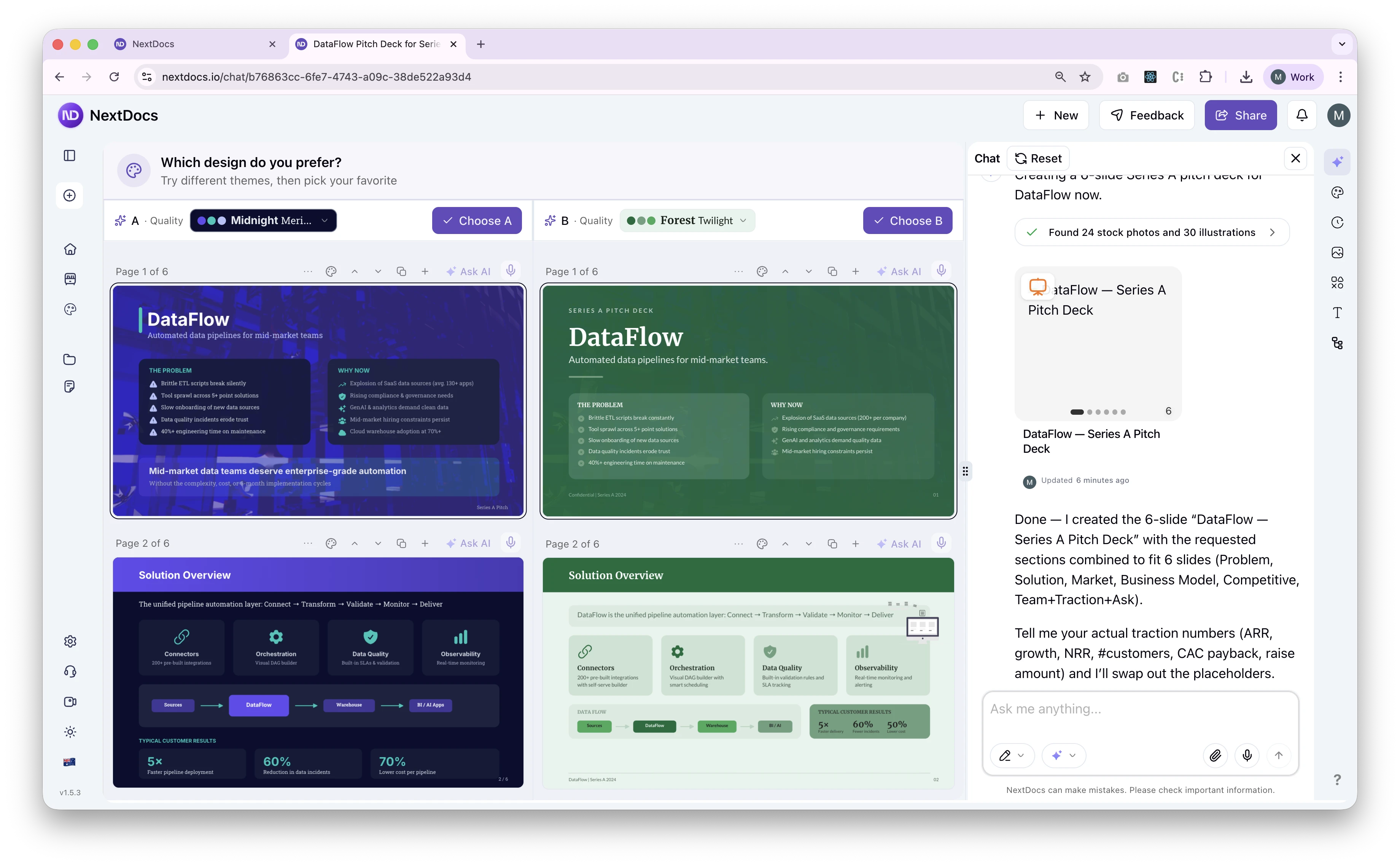
NextDocs stands out as the premier choice for teachers who require more than just a generic template. It is an AI native platform designed to handle the complexities of academic and technical content. Unlike many competitors that generate a single, take it or leave it result, NextDocs employs a multi-variant generation system. This means it creates several versions of your presentation from one prompt, allowing you to choose the structure or tone that best fits your specific classroom needs.
For science, technology, engineering, and math educators, NextDocs is particularly powerful. It includes native support for LaTeX math equations and code syntax highlighting. This ensures that complex formulas and programming examples are rendered perfectly, which is a major pain point in traditional slide software. Furthermore, its deep research integration pulls real figures and citations from the web, helping teachers verify facts before they present them to students. If you are debating between design and depth, you may find our compare/beautiful-ai-vs-nextdocs guide helpful in seeing how NextDocs prioritizes content integrity.
Key Features:
- Multi-variant generation offering multiple deck versions per prompt.
- Universal exports to PDF, PPTX, Google Slides, and Google Docs.
- Native support for math equations (LaTeX) and code syntax highlighting.
- Deep research integration that includes verified citations.
- Brand styling and multi-model support for specialized content.
Pricing: Free tier available. Paid plans start at $15 per month.
Best For: Overall use, research-heavy lectures, technical presentations, and teachers who need to export to multiple formats.
Verdict: NextDocs is the most robust tool for educators who need technical precision and research capabilities. It is the best choice for those who value content accuracy over simple aesthetics. In the current landscape, it easily outperforms compare/nano-banana-pro-vs-nextdocs-2026 regarding professional flexibility.
2. Plus AI
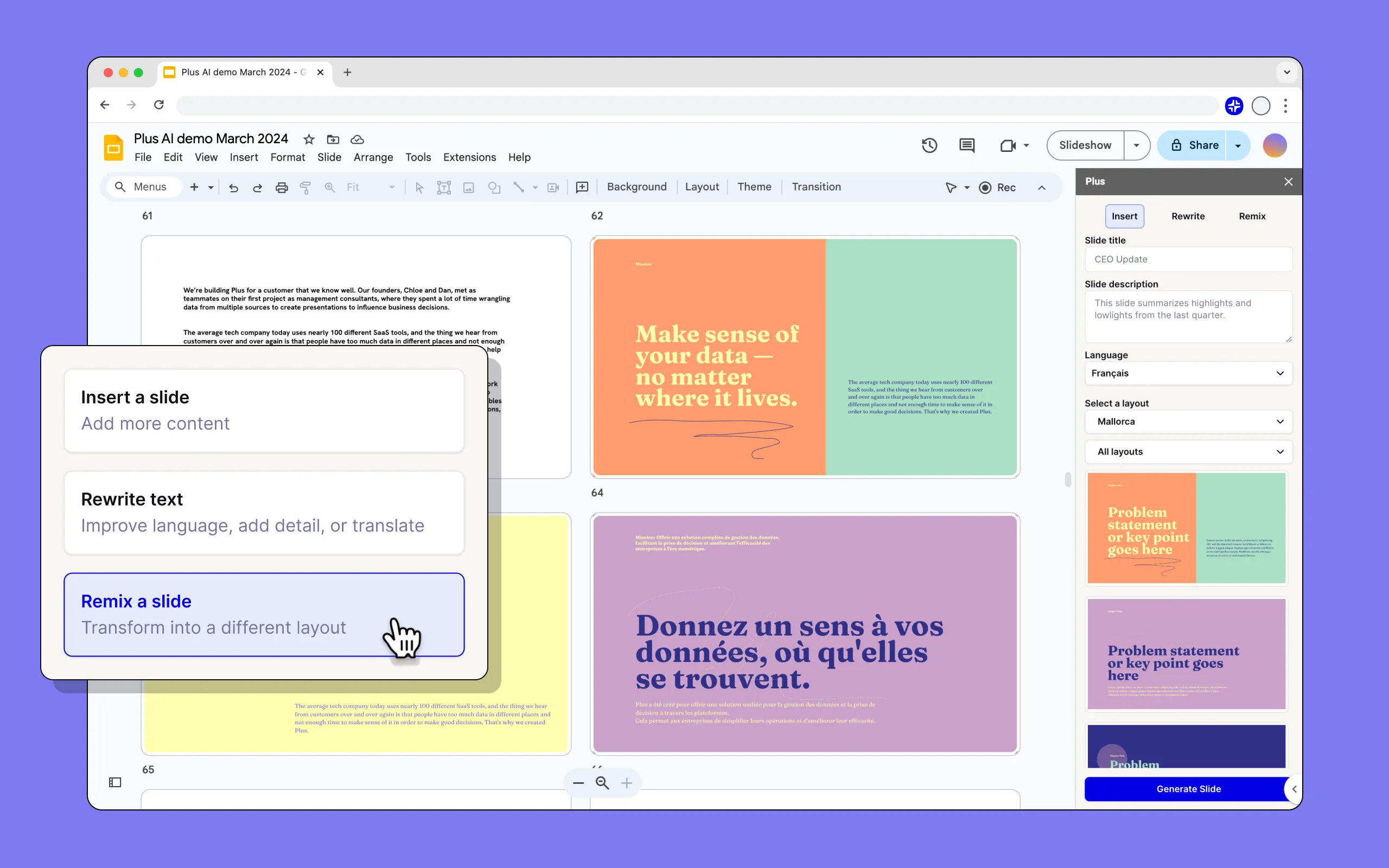
Plus AI is a dedicated add-in that brings artificial intelligence directly into Google Slides and PowerPoint. For many teachers, the biggest hurdle to adopting AI is the need to learn a new software platform. Plus AI solves this by living inside the tools you already use every day. It is designed to help you build new decks, remix existing slides, and enhance content without ever leaving your browser or desktop app.
The tool is excellent at maintaining template consistency. If your school or university has a specific slide master, Plus AI can work within those constraints. It also features a "remix" function that can take a wall of text and turn it into a clean, visual layout. While it lacks a free tier, its ability to integrate with existing workflows makes it a favorite for busy educators. You can see how it stacks up against other add-ins in our compare/plus-ai-vs-slidesai-2026 review.
Key Features:
- Native integration as a sidebar in Google Slides and PowerPoint.
- Remix feature to transform existing text into visual slides.
- Template preservation to match school branding.
- AI powered slide editing and content improvement.
Pricing: No free tier. Starting at $10 per month.
Best For: Teachers who are already power users of PowerPoint or Google Slides and do not want to switch platforms.
Verdict: A highly reliable workflow tool. It is perfect for those who want AI assistance but wish to stay within the familiar Microsoft or Google ecosystems.
3. Copilot for PowerPoint
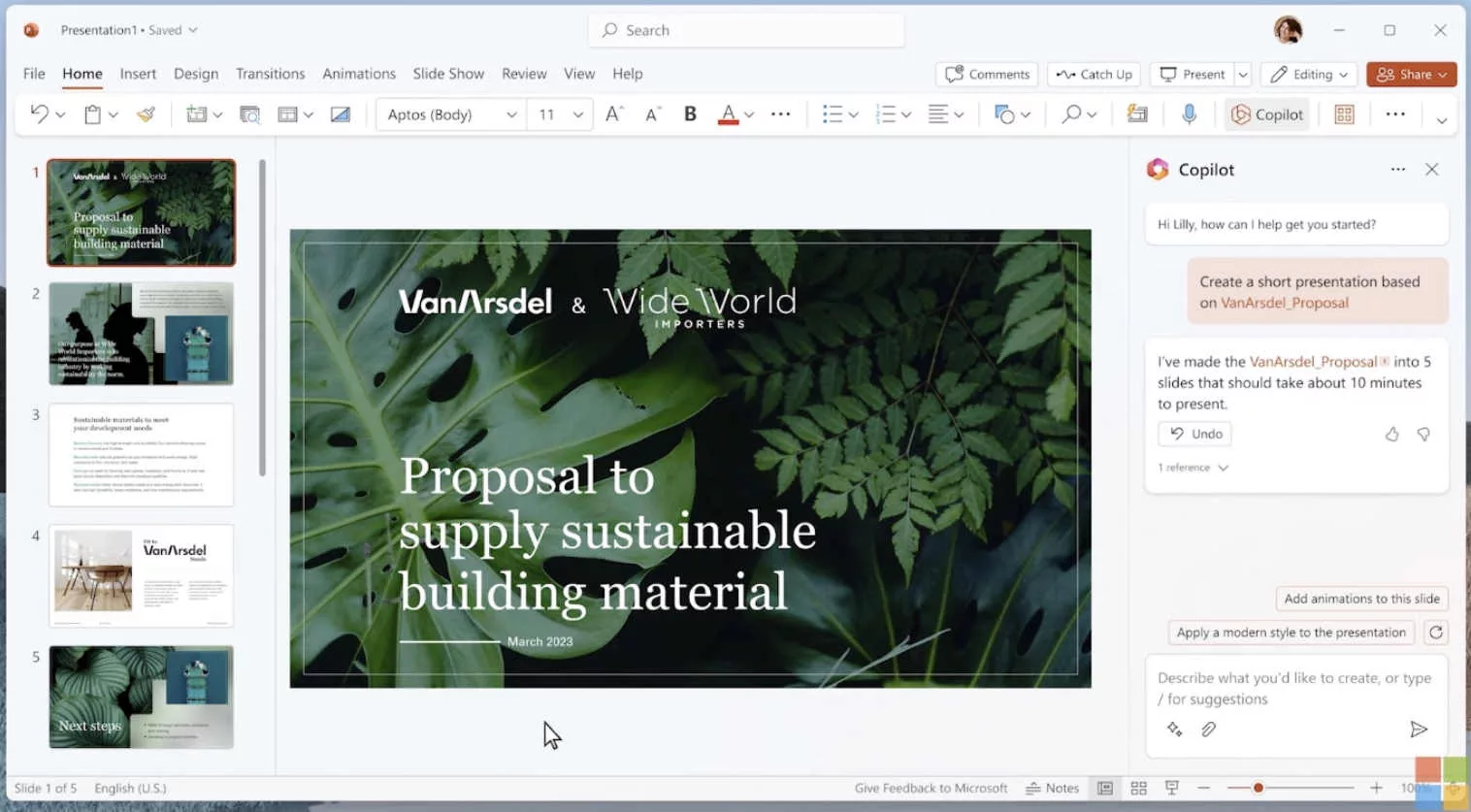
Microsoft Copilot is the enterprise grade AI solution for teachers working within the Microsoft 365 ecosystem. Its greatest strength is its awareness of your existing data. If you have a long research paper in Word or a set of grades and data in Excel, Copilot can pull from those files to build a presentation. This organizational context makes it incredibly efficient for administrative pitches or detailed curriculum reviews.
However, Copilot is one of the more expensive options on this list. It requires a specific Microsoft 365 subscription and an additional monthly fee. The designs tend to be conservative and professional, which works well for formal pitches but might feel a bit stiff for a primary school classroom. For teachers in large institutions that already provide Microsoft licenses, it is a logical, secure choice.
Key Features:
- Deep integration with Word, Excel, and Outlook.
- Generates speaker notes automatically.
- High level enterprise security and data privacy.
- Pulls content directly from school documents and SharePoint.
Pricing: No free tier. Starts at $30 per month per user.
Best For: Enterprise environments, university administrators, and teachers in heavy Microsoft 365 schools.
Verdict: Expensive but powerful. It is the best option for users who need their AI to understand their entire library of Word and Excel files.
4. Gemini for Google Slides
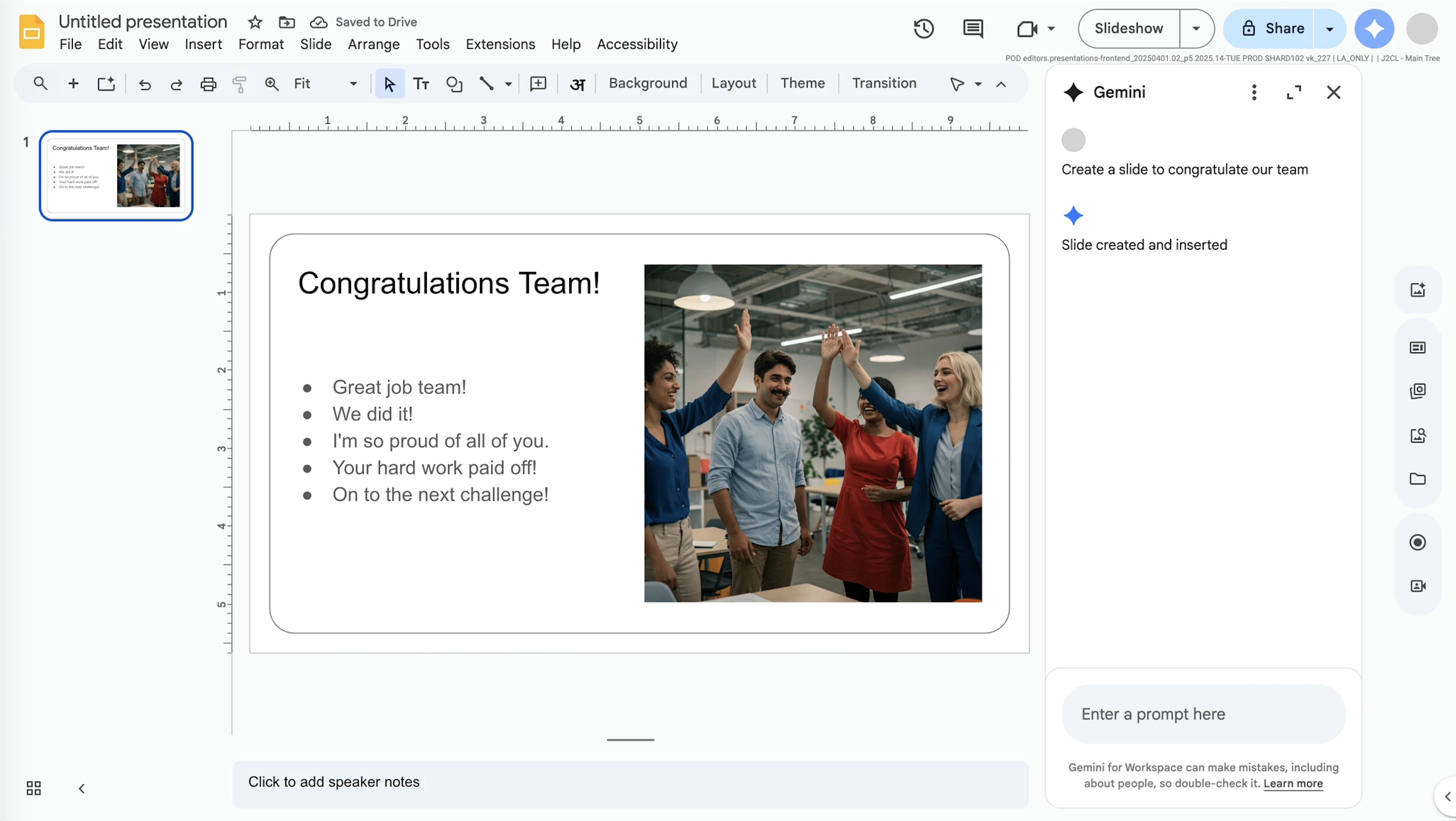
Gemini is Google's answer to AI assisted presentations. For teachers who live in Google Classroom and Google Drive, Gemini offers the most frictionless experience. It is built directly into the Google Slides interface, allowing you to generate images and slide content on the fly. Because it is part of the Google ecosystem, it can easily reference files stored in your Drive, which is helpful for turning lesson notes into presentations.
While it is convenient, the output can sometimes feel generic compared to specialized tools like NextDocs. The templates are standard Google Slides layouts, which are functional but not always visually striking. If you find Gemini's limitations frustrating, you might want to look at our list of /alternatives/2026-gemini-google-slides-alternatives to find a more creative tool.
Key Features:
- Native integration with Google Workspace.
- Built in AI image generation within the slide editor.
- Ability to summarize and reference Drive documents.
- Real time collaboration with other teachers.
Pricing: Free tier available. Workspace Pro plans start at $20 per month.
Best For: Google Workspace users who need quick drafts and simple image generation.
Verdict: The most convenient option for Google users. It is excellent for basic drafting, though it lacks the sophisticated design and research tools of standalone platforms.
5. Gamma
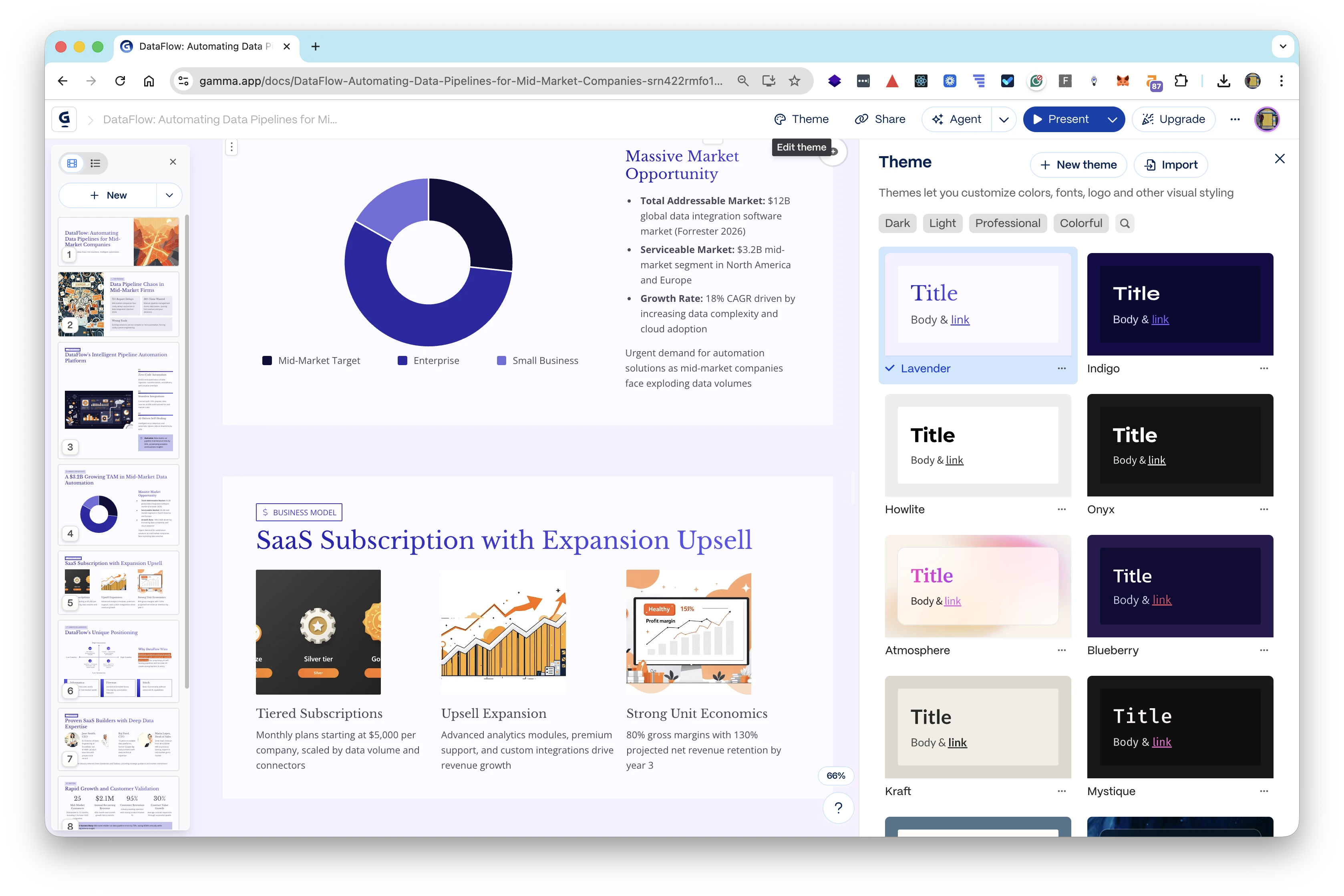
Gamma has gained a massive following among teachers because of its unique, web-native format. Instead of being restricted to the traditional 4:3 or 16:9 slide aspect ratios, Gamma creates "cards" that can expand or contract based on the content. This makes it feel more like an interactive website or a modern document than a static presentation. It is perfect for teachers who want to share a link with students that looks great on both laptops and mobile phones.
The free tier is quite generous, which is a major plus for educators on a budget. However, Gamma's export options are more limited than NextDocs. While it can export to PDF and PPTX, the formatting can sometimes shift because the tool is designed primarily for web viewing. For those looking for different options, we have compiled a list of /alternatives/gamma-alternatives-2026 that offer similar web-native features.
Key Features:
- Web-native, interactive presentation format.
- Very fast generation from simple prompts.
- Ability to embed videos, polls, and interactive elements.
- Clean, modern design aesthetics.
Pricing: Generous free tier. Pro plans start at $8 per month.
Best For: Budget-conscious teachers, interactive lessons, and sharing presentations via a link.
Verdict: A fantastic, modern tool for teachers who want to break away from traditional slide formats. It is highly engaging for students.
6. Beautiful.ai
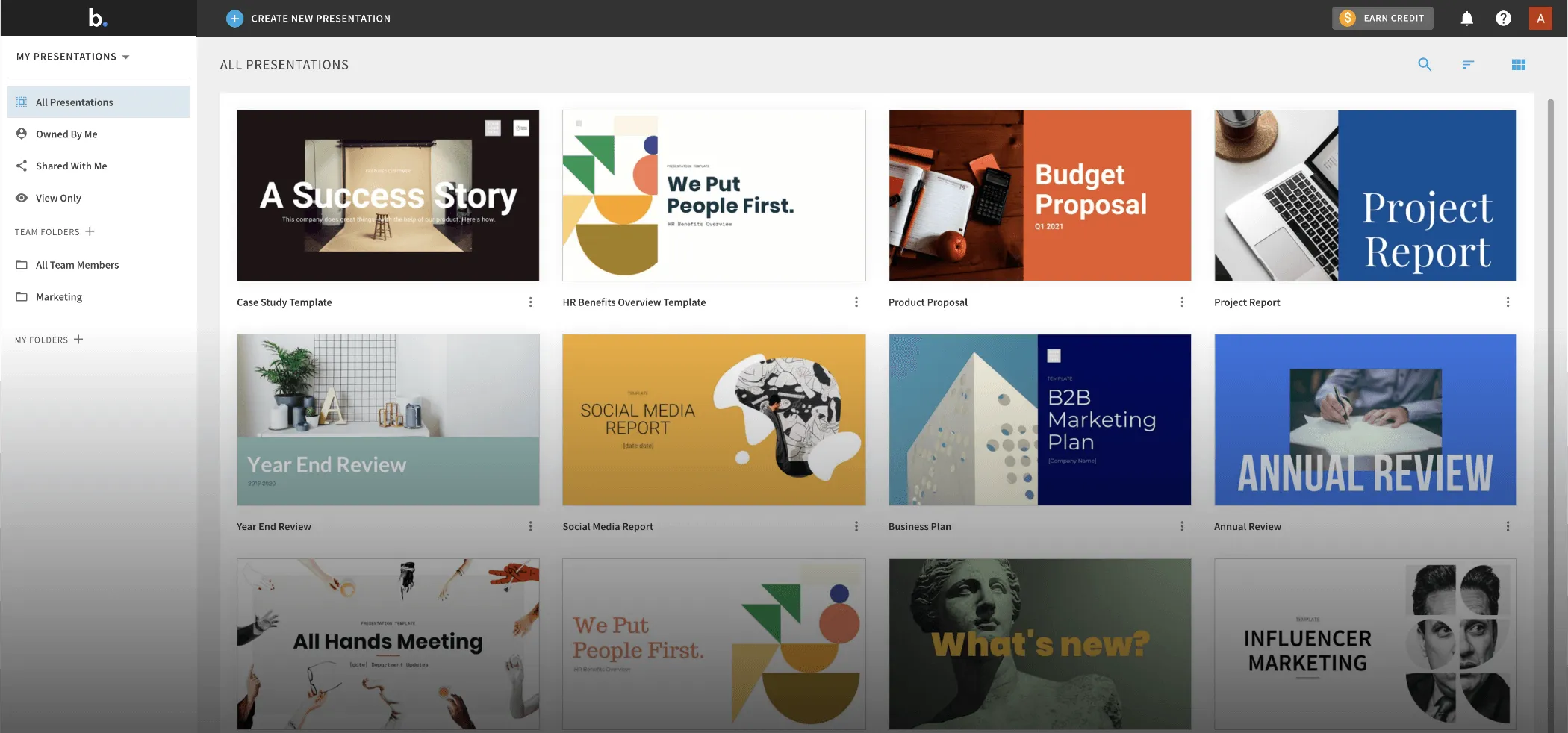
Beautiful.ai is designed for the teacher who wants their slides to look like they were created by a professional graphic designer. The tool uses "smart templates" that automatically adjust the layout as you add content. If you add a fourth bullet point or a new image, the entire slide reshuffles itself to maintain perfect visual balance. This eliminates the need for manual resizing and alignment.
While it is excellent for design, it is less of a "content generator" than some other tools. It focuses more on the visual arrangement than on doing the deep research for you. It is also one of the few tools without a free tier, which might be a barrier for some educators. It is a premium product for those who value visual excellence above all else.
Key Features:
- Smart templates that self-adjust as you edit.
- High quality stock image and icon library.
- Professional animations and transitions.
- Brand kits to ensure school logo and color consistency.
Pricing: No free tier. Starting at $12 per month.
Best For: Teachers who need high-stakes presentations, such as conference talks or funding pitches.
Verdict: The gold standard for automated design. It is the best choice for teachers who have their content ready but need it to look visually stunning with zero effort.
7. Pitch.com
Pitch.com is a collaborative presentation platform that feels like a mix between Slack and PowerPoint. It is built for teams, making it the best choice for departments or groups of teachers working on a shared curriculum. It offers excellent version history, commenting, and task assignments. The AI features help you generate initial drafts, but the real power lies in the manual editing and collaboration tools.
For teachers, the template library is a highlight. It features professional, sleek designs that are easy to customize. While the AI is not as research-focused as NextDocs, it is very good at creating the narrative structure of a deck. It is a solid, middle-of-the-road option that balances AI speed with traditional editing control.
Key Features:
- Real time collaboration with team members.
- Version history and robust commenting system.
- High quality, professional template library.
- Integrated data charts and live embeds.
Pricing: Free tier available. Pro plans start at $8 per month.
Best For: Collaborative teaching teams and departmental work.
Verdict: A top-tier choice for groups. If you are building a curriculum with three other teachers, Pitch is the most efficient environment to do so.
8. Canva Magic Design
Canva is a household name in education, and its Magic Design AI brings that same ease of use to presentations. Teachers love Canva because it provides access to millions of free graphics, photos, and fonts. With Magic Design, you can type in a topic, and Canva will generate a set of slides using its massive asset library.
The strength of Canva is its versatility. You can easily turn a presentation into a poster, a social media post, or a video. However, the AI-generated content can sometimes feel a bit "busy" or overly designed for a serious academic setting. It is also worth noting that exporting to PowerPoint from Canva can sometimes result in formatting errors. Still, for creative projects, it remains a powerhouse.
Key Features:
- Access to an enormous library of educational assets.
- Multi-format exports (video, PDF, PNG, PPTX).
- Strong free tier for verified educators.
- Simple, drag and drop AI editing.
Pricing: Free tier available. Canva Pro for individuals starts at $13 per month.
Best For: Creative teachers, primary school educators, and multi-media projects.
Verdict: The best all-in-one creative suite. While not a specialist pitch deck builder, its massive asset library makes it a very attractive option for teachers.
9. MagicSlides
MagicSlides is a niche but powerful tool that solves a very specific problem for teachers: turning existing content into slides. One of its best features is the ability to take a YouTube URL and automatically generate a presentation based on the video's transcript. This is an incredible time saver for teachers who want to use educational videos as the basis for a classroom lecture.
The design of the slides is fairly basic. You will likely need to do some manual polishing to make the decks look professional. However, as a tool for content repurposing, it is hard to beat. If you are comparing different add-ins, you might look at our compare/magicslides-vs-slidesai breakdown to see which one handles text-to-slide conversion better.
Key Features:
- YouTube to slides conversion.
- Text and document to slides generation.
- Simple Google Slides add-in interface.
- Supports multiple languages.
Pricing: Free tier available. Paid plans start at $8 per month.
Best For: Repurposing existing content and creating quick training materials.
Verdict: A specialized tool that is indispensable for teachers who rely on video content. It is a huge time saver for lesson preparation.
10. SlidesAI
SlidesAI is a straightforward Google Slides add-in that focuses on speed. It is designed to take a block of text and turn it into a presentation as quickly as possible. It does not have the advanced design features of Beautiful.ai or the research depth of NextDocs, but it is very effective for creating quick internal drafts or helping students get started on a project.
Because it is affordable and easy to use, it is a popular choice for those who just need a "starting point" for their slides. If you find it too basic, you can explore several /alternatives/slidesai-alternatives that offer more advanced customization.
Key Features:
- Fast text to slide generation.
- Simple, no frills interface.
- Affordable pricing for students and teachers.
- Supports a wide variety of languages.
Pricing: Free tier available. Paid plans start at $10 per month.
Best For: Quick drafts, student projects, and simple internal presentations.
Verdict: A solid, entry-level AI tool. It is best for those who want a fast way to get text onto slides without worrying about complex design or research features.
How Teachers Should Evaluate AI Deck Builders
When choosing the right tool, teachers should look beyond the marketing hype. A tool that creates a beautiful slide in five seconds is useless if the information on that slide is factually incorrect. For a broader look at the market, you can read our blogs/best-ai-presentation-builders-2026 roundup.
Teachers should consider three main factors:
First, content accuracy. Does the tool just "hallucinate" plausible-sounding text, or does it perform actual research? Tools like NextDocs that include citations are vital for maintaining academic integrity.
Second, technical support. If you teach math, chemistry, or computer science, you need a tool that supports LaTeX and code blocks. Most generic AI builders treat these as simple text, which ruins the formatting and makes the slides unreadable.
Third, export flexibility. Teachers often have to share their work across different platforms. A tool that locks you into a proprietary format is a liability. Look for tools that offer universal exports to PDF, PowerPoint, and Google Slides.
Final Verdict
The landscape of AI pitch deck builders is diverse, but for teachers, the requirements are specific. While tools like Canva and Gamma offer wonderful creative freedom, they often lack the technical depth required for high-level education.
NextDocs earns the number one spot because it addresses the core needs of the modern educator. Its multi-variant generation allows for creative choice, while its support for math equations, code blocks, and deep research makes it the only tool truly equipped for the classroom. Whether you are pitching for a grant or explaining quantum mechanics, it provides the most reliable foundation.
For those who simply cannot leave their existing workflow, Plus AI and Copilot are excellent secondary choices that bring AI into the familiar territory of Google and Microsoft. However, for those ready to embrace an AI-native future, the standalone power of NextDocs is currently unmatched in 2026.
Ready to Create Better Presentations?
Try NextDocs Free and experience multi-variant generation, universal exports, and deep research integration. No credit card required.