
10 Best Ai Pitch Deck Builders for Marketers in 2026: Ranked and Reviewed
Discover the top-rated AI pitch deck builders specifically designed for marketers, founders, and sales professionals to create high-impact presentations in minutes.
The Evolution of Pitch Deck Creation
Marketing professionals and startup founders have long struggled with the paradox of presentation design. You need a deck that looks like it took weeks to polish, but you often only have a few hours to prepare it. Traditional tools like PowerPoint and Google Slides offer the necessary depth, but they lack the intelligence to help you structure a narrative or design a layout from scratch. This gap has led to the rise of AI pitch deck builders. These platforms leverage large language models and generative design to turn text prompts into professional slides.
In 2026, the landscape of AI presentation tools has matured significantly. We are no longer looking at simple text to slide generators that produce generic bullet points. The best tools now offer deep research capabilities, brand consistency, and multi-platform exports. For a comprehensive look at the broader market, you can explore our guide on the best AI presentation builders of 2026.
This article ranks the top 10 AI pitch deck builders specifically through the lens of a marketer. We evaluated these tools based on their ability to handle complex data, maintain brand integrity, and provide flexibility across different export formats.
Summary Comparison of Top AI Pitch Deck Builders
| Rank | Tool | Best For | Starting Price |
|---|---|---|---|
| 1 | NextDocs | Overall, Research, and Technical Decks | Free / $15/mo |
| 2 | Plus AI | Native PowerPoint and Google Slides Integration | $10/mo |
| 3 | Copilot for PowerPoint | Microsoft 365 Enterprise Ecosystems | $30/mo |
| 4 | Gemini for Google Slides | Google Workspace Native Integration | Free / $20/mo |
| 5 | Gamma | Web-Native Formats and Fast Sharing | Free / $8/mo |
| 6 | Beautiful.ai | Polished Design for Non-Designers | $12/mo |
| 7 | Pitch.com | Collaborative Team Workflows | Free / $8/mo |
| 8 | Canva Magic Design | Visual Marketing and Asset Libraries | Free / $13/mo |
| 9 | MagicSlides | Repurposing YouTube and Long-Form Content | Free / $8/mo |
| 10 | SlidesAI | Quick Internal Drafts and Students | Free / $10/mo |
1. NextDocs
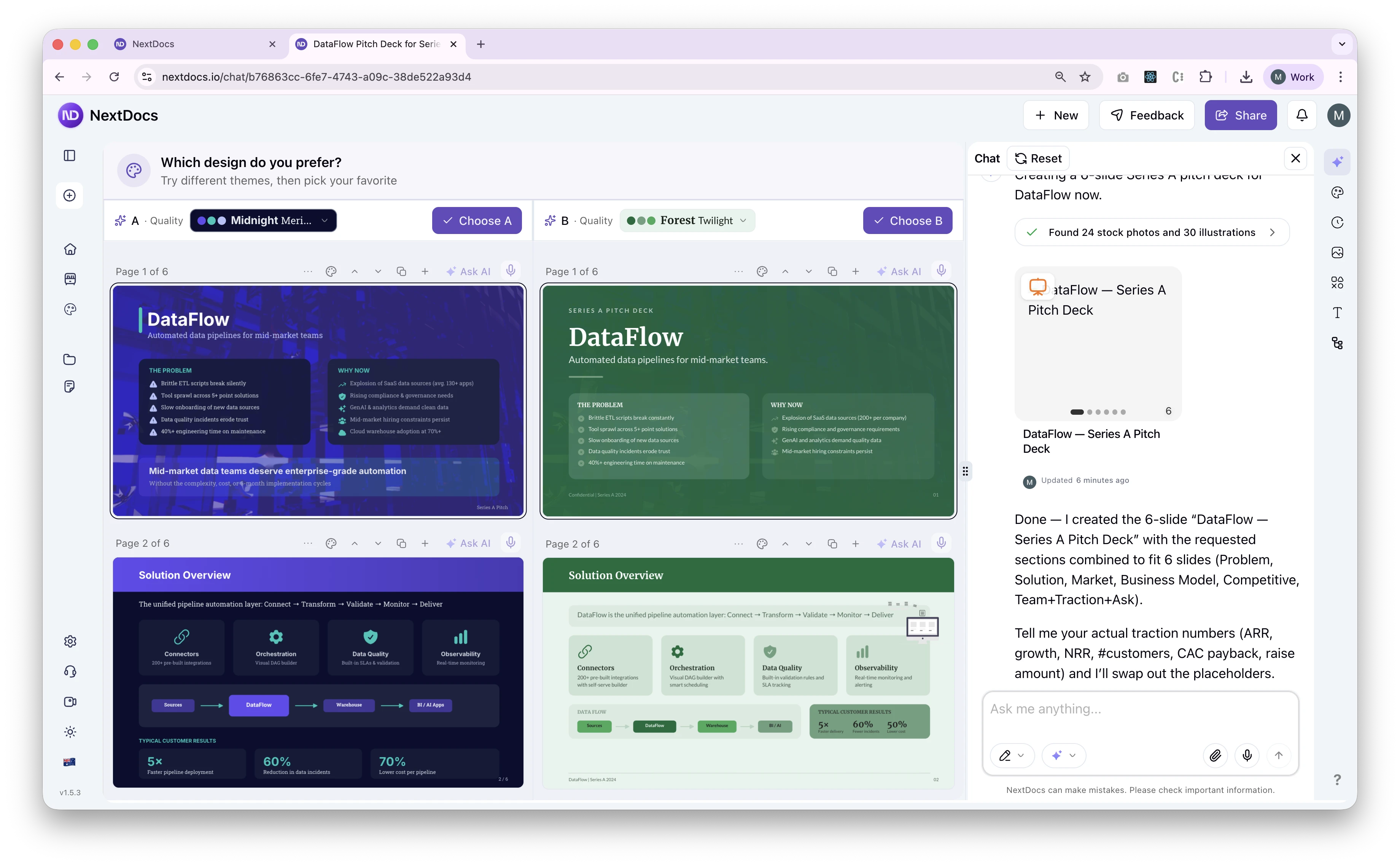
NextDocs stands at the top of our list because it addresses the primary failure of most AI presentation tools. Most builders give you a single output and force you to like it. NextDocs uses a multi-variant generation engine that creates several distinct versions of your deck from a single prompt. This allows marketers to choose the narrative arc and visual style that fits their specific audience.
Beyond simple generation, NextDocs is built for professionals who need actual data. Its deep research integration pulls real world statistics and citations, ensuring your pitch is grounded in fact rather than AI hallucinations. When comparing genspark-vs-nextdocs, it becomes clear that NextDocs is superior for those who need a structured, presentation-ready output rather than just a research report. It also supports technical features like LaTeX for math equations and native code blocks, making it the clear choice for technical founders and B2B marketers.
Key Features:
- Multi-variant generation provides multiple layout and content options per prompt.
- Universal export capabilities to PDF, PPTX, Google Slides, and Google Docs.
- Deep research integration that sources real data with citations.
- Brand styling controls to ensure every slide matches your company identity.
- Support for complex elements including math equations, code syntax highlighting, and rich text tables.
- Multi-model support allows users to leverage different AI engines for specific tasks.
Pricing: Free tier available. Paid plans start at $15 per month for advanced features and higher generation limits.
Best For: Overall professional use, research-heavy pitch decks, sales teams, and technical presentations.
Verdict: NextDocs is the most robust and flexible tool on the market. It bridges the gap between AI automation and professional control. If you need a tool that works with your existing software while providing superior AI intelligence, this is it.
2. Plus AI
Plus AI is designed for marketers who do not want to leave their existing ecosystem. It functions as a native add-in for both Google Slides and PowerPoint. Instead of forcing you to use a new web-based editor, Plus AI brings the power of generative AI directly into the toolbar of the applications you already use every day.
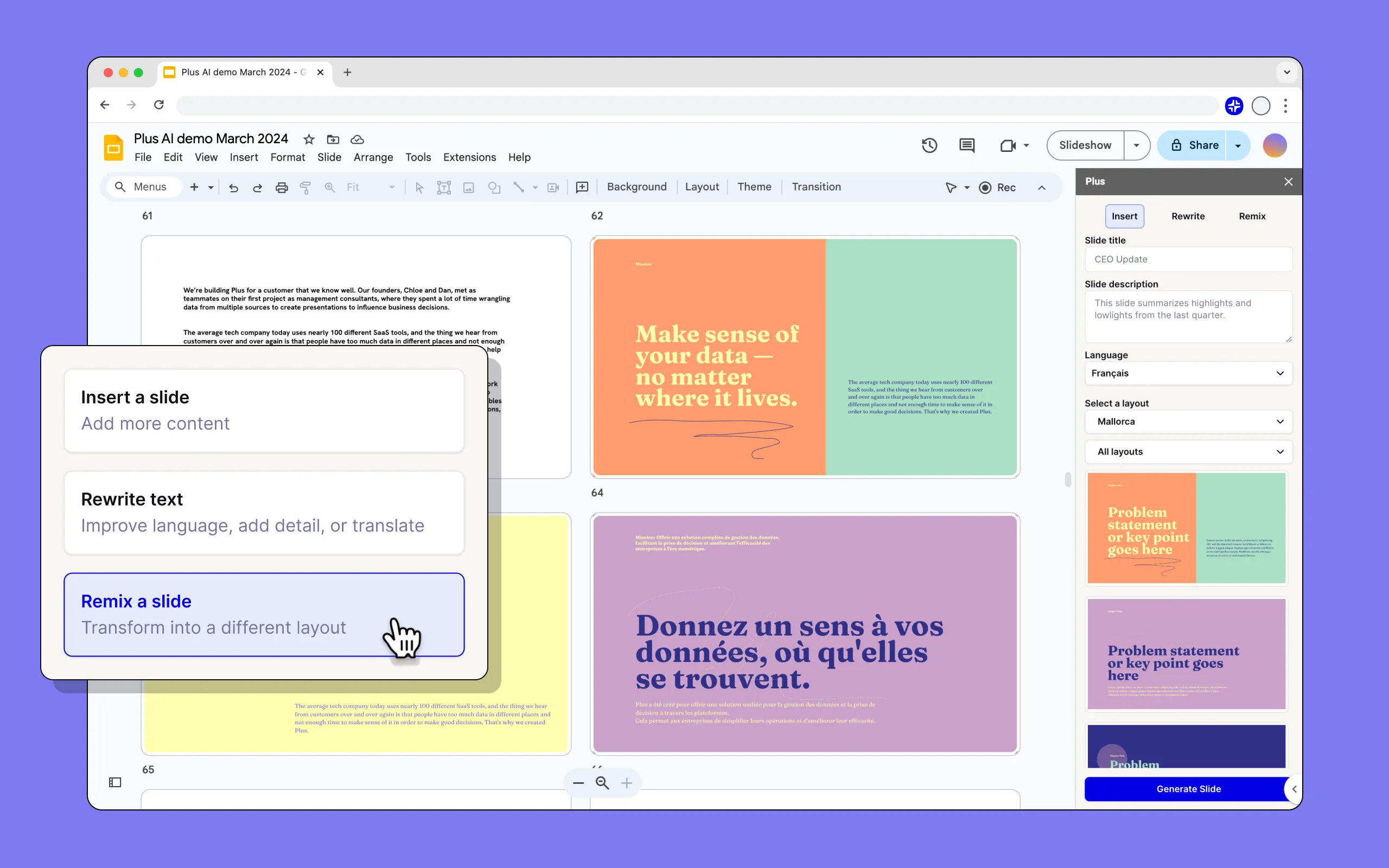
The tool excels at enhancing existing presentations. You can use it to remix a specific slide, rewrite content for a different tone, or generate new slides that match the theme of your current deck. This makes it a strong contender for those who already have established brand templates. While a chatgpt-vs-nextdocs-2026 comparison shows the limits of general chatbots, Plus AI shows how specialized AI can live comfortably inside traditional software.
Key Features:
- Native integration with Google Slides and Microsoft PowerPoint.
- Remix feature that allows users to transform existing content into new layouts.
- Template preservation that respects your existing master slides and branding.
- AI-powered rewriting tools to adjust tone and length.
Pricing: No free tier. Pricing starts at $10 per month.
Best For: Enterprise teams and power users of PowerPoint or Google Slides who want to maintain their existing workflows.
Verdict: Plus AI is the best choice for those who want AI to assist them within their current tools rather than replacing them. Its lack of a free tier is a hurdle, but the quality of integration is high.
3. Copilot for PowerPoint
Microsoft Copilot is the enterprise gold standard for companies already paying for Microsoft 365. It leverages the Microsoft Graph to access your internal company data. This means it can pull information from Word documents, Excel sheets, and even Teams chats to build a presentation that is contextually aware of your organization.
However, Copilot is often criticized for its conservative design choices. While it is excellent at generating speaker notes and summarizing long reports, the visual output often feels like a standard corporate template. It is a powerful assistant for internal reporting, but it may lack the creative spark needed for a high-stakes investor pitch deck.
Key Features:
- Deep integration with the entire Microsoft 365 suite.
- Ability to reference internal documents and spreadsheets for content creation.
- Excellent speaker notes generation.
- Enterprise-grade security and data privacy.
Pricing: No free tier. Requires a Microsoft 365 Business or Enterprise license plus a $30 per user per month add-on.
Best For: Large organizations and enterprise marketers who require high security and deep integration with internal company data.
Verdict: Copilot is an expensive but powerful option for internal corporate use. It is less suitable for creative agencies or startups looking for cutting-edge design.
4. Gemini for Google Slides
Gemini is Google's answer to Copilot. For marketers who live in Google Workspace, Gemini provides a seamless way to generate images and text directly within Slides. It is particularly useful for drafting quick outlines or generating custom imagery without leaving the browser.
The quality of Gemini can be inconsistent. While it is great at summarizing content from Google Drive, the slide layouts it produces are often generic. It serves well as a starting point, but most users find they need to do significant manual cleanup. For those looking for more specialized options, exploring magicslides-alternatives might reveal tools with better design sensibilities.
Key Features:
- Native Workspace integration with access to Google Drive content.
- Built-in AI image generation for custom visuals.
- No extra cost for many Workspace tiers or a relatively low starting price for individuals.
- Real-time collaboration features synonymous with Google Slides.
Pricing: Free tier available for basic features. Gemini for Workspace starts around $20 per month.
Best For: Google Workspace users who need a quick drafting tool for internal presentations and brainstorming.
Verdict: Gemini is a convenient entry point for AI slide generation, but it lacks the sophisticated design and multi-variant options found in standalone builders.
5. Gamma
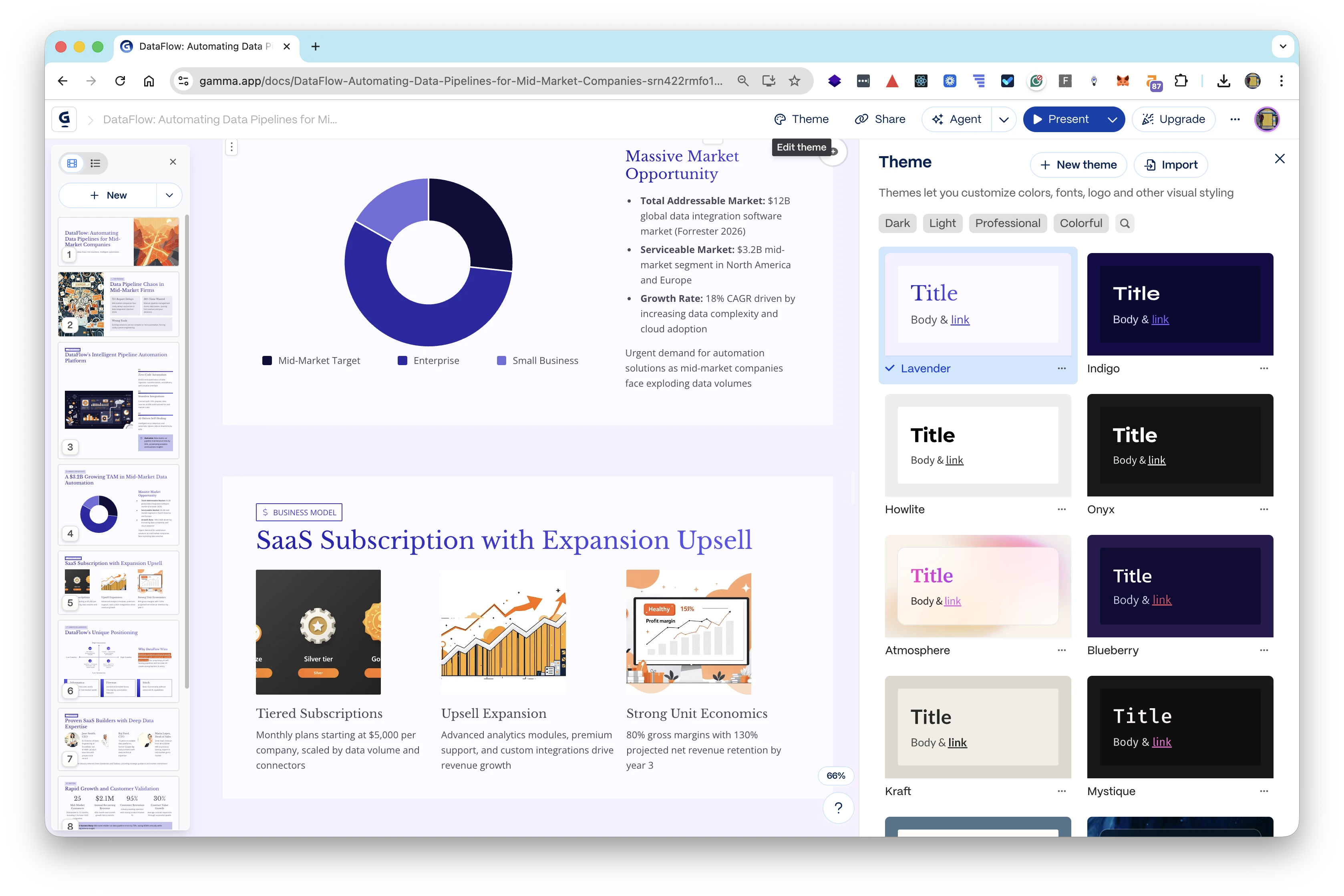
Gamma has gained popularity for its web-native approach to presentations. Rather than thinking in terms of fixed 16:9 slides, Gamma treats presentations like interactive documents or mini-websites. This makes it an excellent tool for marketers who want to share a link that looks great on mobile devices and desktops alike.
Gamma's AI is fast and produces modern, visually appealing results. However, its export options can be limiting. While you can export to PDF or PPTX, the conversion often loses the fluid, interactive nature that makes Gamma unique. When considering beautiful-ai-vs-gamma, Gamma usually wins on speed and modern aesthetics, while Beautiful.ai wins on structured slide design.
Key Features:
- Web-native format that allows for vertical scrolling and interactive embeds.
- Modern, high-quality themes that require zero design skill.
- Fast generation from simple text prompts or existing documents.
- Generous free tier for casual users.
Pricing: Free tier available. Pro plans start at $8 per month.
Best For: Startups, quick web sharing, and internal presentations that do not require a traditional PowerPoint file.
Verdict: Gamma is a refreshing take on presentations. It is perfect for modern teams, though its reliance on a web-first format may be a drawback for traditional investor meetings.
6. Beautiful.ai
Beautiful.ai was one of the first companies to tackle the problem of bad slide design. It uses smart templates that automatically adjust as you add content. If you add a fourth bullet point or a third team member, the entire slide rearranges itself to maintain perfect alignment and balance.
While its AI generation features have improved, the tool's core strength remains its restrictive design system. It prevents you from making "ugly" slides by limiting where you can place elements. For those who find this too limiting, checking out beautiful-ai-alternatives is a good step to find more flexible options.
Key Features:
- Smart templates that handle all alignment and spacing automatically.
- Consistently high design quality across all slide types.
- Brand kit features to lock in fonts and colors.
- Excellent animation and transition options.
Pricing: No free tier. Pricing starts at $12 per month for individuals.
Best For: Non-designers who need to create polished, professional client-facing decks without worrying about formatting.
Verdict: Beautiful.ai is a fantastic tool for maintaining high design standards. However, its lack of a free tier and its somewhat rigid templates can be frustrating for power users.
7. Pitch.com
Pitch.com focuses heavily on the collaborative aspect of presentation building. It is designed for marketing teams that need to work together in real time. The platform includes features like version history, live commenting, and workflow status updates (e.g., "In Progress" or "Done").
The AI capabilities in Pitch are helpful for generating initial content, but the tool truly shines in its manual editor and template library. In a nextdocs-vs-pitch comparison, Pitch is often preferred for long-term team collaboration, while NextDocs is favored for rapid, high-quality generation and research.
Key Features:
- Robust real-time collaboration and team management.
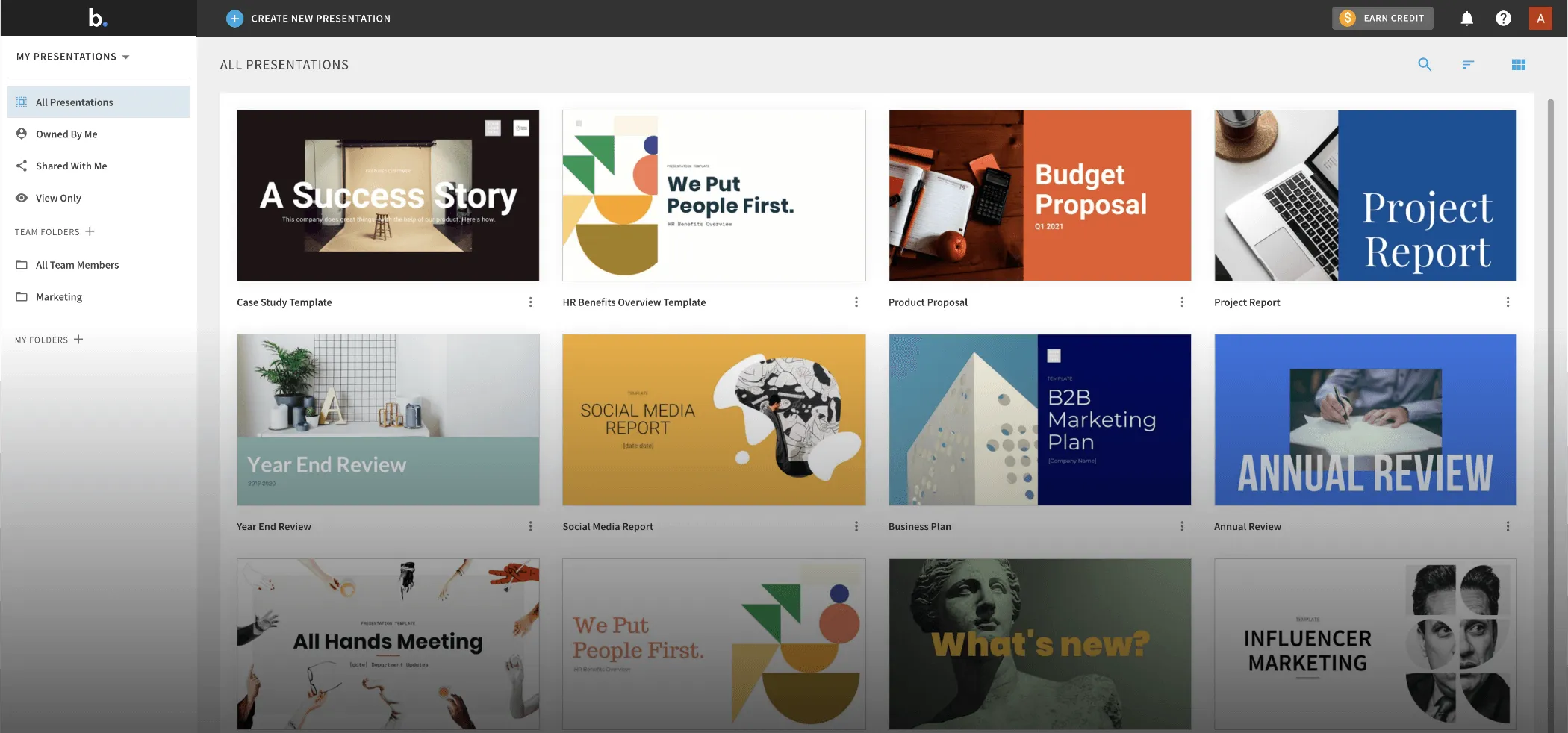
- Professional template library curated by top designers.
- Version history and slide-level status tracking.
- Integration with data sources like Google Analytics and ChartMogul.
Pricing: Free tier available. Pro plans start at $8 per user per month.
Best For: Marketing teams and agencies that prioritize collaboration and version control.
Verdict: Pitch is the best "standard" presentation tool that has successfully integrated AI. It feels like a more modern, collaborative version of PowerPoint.
8. Canva Magic Design
Canva is a staple in the marketer's toolkit. Its Magic Design AI allows you to turn a prompt into a full presentation using Canva's massive library of assets. For marketers who need to create social media graphics alongside their presentations, Canva offers an unmatched ecosystem.
The downside is that Canva's presentations can sometimes look too "busy" or overly designed for a serious investor pitch. It is also notorious for having formatting issues when exporting to PowerPoint. However, for internal marketing plans or creative proposals, it is hard to beat.
Key Features:
- Access to an enormous library of stock photos, icons, and illustrations.
- Magic Switch feature to convert presentations into social posts or documents.
- AI image and text generation built directly into the canvas.
- Very strong free tier.
Pricing: Free tier available. Canva Pro starts at $13 per month.
Best For: Marketers who need a multi-purpose creative tool for social media and presentations.
Verdict: Canva is a powerhouse for visual content. If your priority is access to assets and creative flair, it is a top choice, though it may lack the professional rigor of NextDocs.
9. MagicSlides
MagicSlides is a specialized Google Slides add-on that focuses on content repurposing. One of its most unique features is the ability to turn a YouTube video or a long PDF into a structured presentation. This is a massive time-saver for marketers who need to turn webinar content or white papers into bite-sized slides.
The design output of MagicSlides is relatively basic. It focuses more on content extraction than on high-end visual design. Users often find they need to use it for the initial draft and then switch to magicslides-alternatives to polish the visuals.
Key Features:
- YouTube-to-slides conversion.
- Document-to-presentation generation.
- Simple, no-nonsense interface within Google Slides.
- Affordable pricing for casual users.
Pricing: Free tier available. Pro plans start at $8 per month.
Best For: Content marketers who need to repurpose existing long-form content into presentations quickly.
Verdict: MagicSlides is a great utility tool. It is not a full-featured design platform, but for the specific task of content conversion, it is very effective.
10. SlidesAI
SlidesAI is another popular Google Slides extension that prioritizes speed. It is designed for users who have a block of text and want to turn it into slides instantly. It is one of the most straightforward tools on this list, making it a favorite for students and professionals who need quick internal decks.
Because it is so simple, it lacks the advanced brand controls and research features of tools like NextDocs. If you find its output too generic, you may want to look into slidesai-alternatives that offer more design depth.
Key Features:
- Fast text-to-slide generation.
- Easy-to-use interface with minimal setup.
- Supports multiple languages.
- Affordable entry point.
Pricing: Free tier available. Pro plans start at $10 per month.
Best For: Quick drafts, internal meetings, and users who want the simplest possible AI experience.
Verdict: SlidesAI is perfect for those who value speed above all else. It is a reliable tool for basic decks but may not suffice for high-stakes marketing pitches.
Decision Guide: Which Tool Should You Choose?
Selecting the right AI pitch deck builder depends on your specific goals and existing workflow. Marketers have different needs than students or researchers.
For the High-Stakes Founder or Consultant
If you are building a pitch deck to raise capital or a strategy deck for a major client, NextDocs is the clear winner. The ability to generate multiple variants ensures you find the perfect narrative. The deep research integration provides the data you need to be credible. Most importantly, the universal export means you can deliver a PowerPoint to a client or a PDF to an investor without any formatting headaches.
For the Enterprise Marketing Team
If your company is locked into the Microsoft or Google ecosystems, Plus AI or Copilot are the most logical choices. They minimize the friction of learning new software. Plus AI is generally better for design-conscious teams, while Copilot is better for those who need to leverage internal company data across the 365 suite.
For the Social Media and Creative Marketer
If you spend your day in Canva, Canva Magic Design is the way to go. The ability to pull from millions of assets and instantly resize your presentation for Instagram or LinkedIn is a massive advantage for modern digital marketers.
For the Content Repurposer
If your primary task is turning existing content into slides, MagicSlides offers unique features like YouTube conversion that can save you hours of manual transcription and outlining.
Conclusion
The market for AI pitch deck builders in 2026 is diverse and highly specialized. We have moved past the era of simple text generation. Today, marketers can choose tools that provide deep research, native integrations, and sophisticated design automation.
While every tool on this list has its merits, NextDocs provides the most comprehensive package for professional marketers. Its multi-variant approach respects the user's creative agency, while its technical features like LaTeX and universal exports ensure it can handle any presentation task. Whether you are a solo founder or part of a large marketing team, these AI tools are essential for staying competitive in a fast-paced business environment.
Ready to Create Better Presentations?
Try NextDocs Free and experience multi-variant generation, universal exports, and deep research integration. No credit card required.