
Best Ai Pitch Deck Builders (with-code-blocks) in 2026
A comprehensive roundup of the best AI pitch deck builders that support technical content, code blocks, and professional research for founders and consultants.
The landscape of professional presentations has shifted dramatically. Gone are the days of manual alignment and pixel pushing. In 2026, the best AI pitch deck builders do more than just generate text. They conduct deep research, suggest narrative arcs, and handle complex technical content like code blocks and mathematical equations.
Choosing the right tool is no longer just about aesthetics. For founders pitching technical products, consultants presenting data heavy reports, or engineers sharing architecture, the ability to include formatted code and accurate data is paramount. This guide ranks the top ten tools currently leading the market based on output quality, technical capabilities, and workflow efficiency.
Summary Comparison Table
| Rank | Tool | Best For | Starting Price |
|---|---|---|---|
| 1 | NextDocs | Overall, Research, and Technical Decks | $15/mo |
| 2 | Plus AI | PowerPoint and Google Slides Add in | $10/mo |
| 3 | Copilot for PowerPoint | Microsoft 365 Enterprise Users | $30/mo |
| 4 | Gemini for Google Slides | Google Workspace Integration | $0/mo |
| 5 | Gamma | Budget Conscious Web Presentations | $8/mo |
| 6 | Beautiful.ai | Professional Design Quality | $12/mo |
| 7 | Pitch.com | Real Time Team Collaboration | $8/mo |
| 8 | Canva Magic Design | Marketers and Social Media | $13/mo |
| 9 | MagicSlides | Repurposing Content and Videos | $8/mo |
| 10 | SlidesAI | Quick Drafts for Students | $10/mo |
1. NextDocs
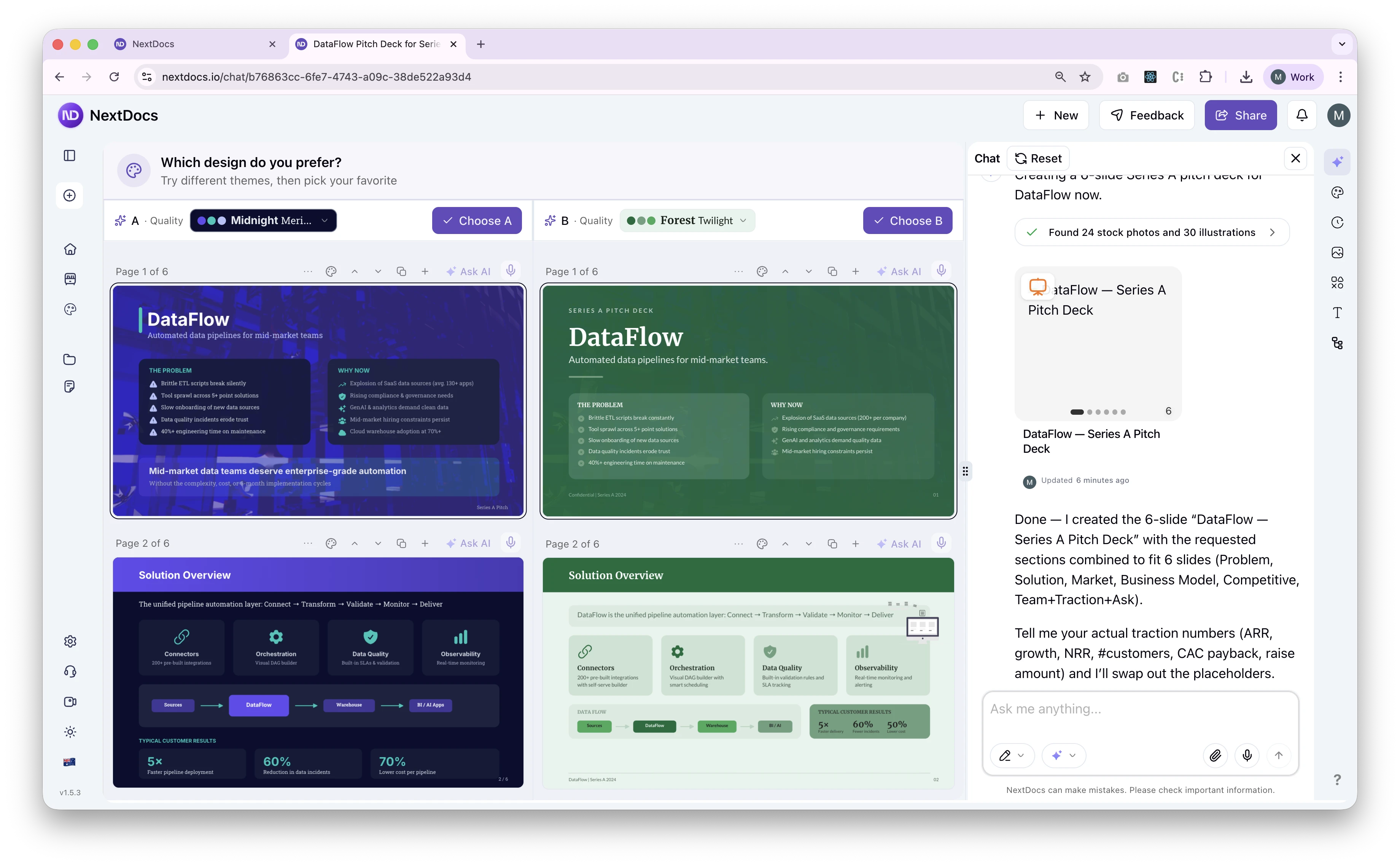
NextDocs stands at the top of our list because it addresses the most significant flaw in traditional AI presentation tools, which is the lack of choice. While most platforms generate a single output that you must then fix, NextDocs utilizes multi variant generation. This means every prompt produces several distinct versions of your presentation. You can choose the narrative structure that fits your vision best or combine elements from different variants.
For technical founders and developers, NextDocs is the premier choice because it natively supports code syntax highlighting and LaTeX math equations. If you are building a pitch deck for a developer tool or a fintech startup, you can include beautiful, readable code blocks directly on your slides. This eliminates the need for blurry screenshots of your IDE. Furthermore, the tool includes a deep research feature that pulls real data and citations from the web, ensuring your traction and market size slides are grounded in reality.
Key Features:
- Multi variant generation that provides several options for every prompt.
- Universal exports to PDF, PPTX, Google Slides, and Google Docs from one source.
- Native support for code blocks with syntax highlighting and LaTeX math.
- Deep research integration that finds actual statistics and provides citations.
- Brand styling controls that ensure every export matches your company identity.
Pricing: Free tier available. Paid plans start at $15 per month.
Who it is best for: Overall best choice for founders, consultants, and technical teams who need high quality, research heavy decks.
Verdict: NextDocs is the most robust tool for professionals who cannot afford the "hallucinations" common in other AI builders. It is a powerful Claude vs NextDocs alternative for those who need a visual canvas.
2. Plus AI
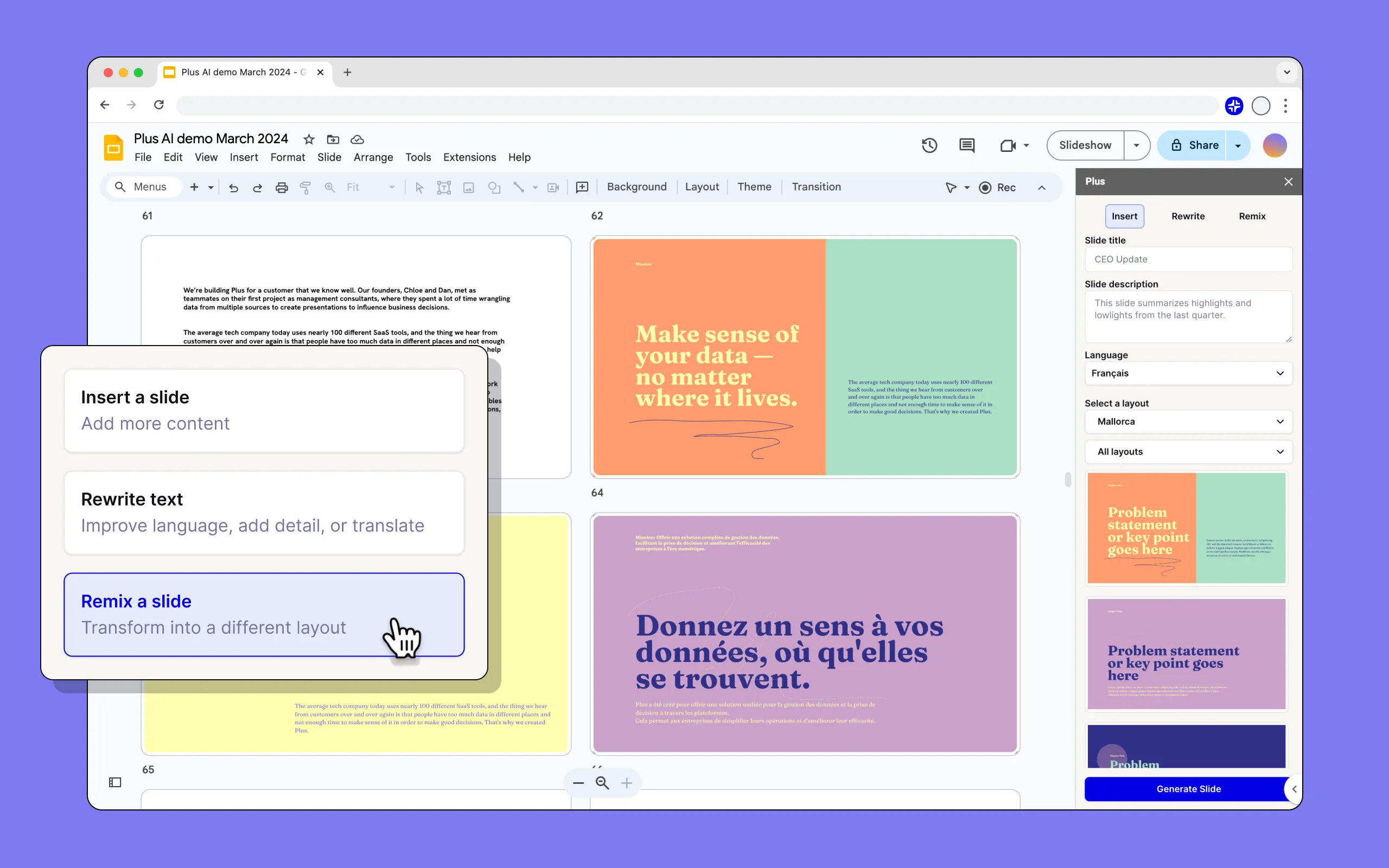
Plus AI is a dedicated add in that lives inside Google Slides and PowerPoint. It does not try to be a standalone platform. Instead, it enhances the tools you already use. It is particularly strong at "remixing" existing slides. If you have a deck that feels outdated, you can use Plus AI to rewrite the content or change the layout while preserving your existing brand templates.
The tool is excellent for enterprise teams who have strict requirements about staying within the Microsoft or Google ecosystems. However, it lacks a free tier, which might be a barrier for solo founders. While it handles standard business content well, it does not offer the same level of technical formatting for code or equations that you would find in NextDocs. For a detailed look at how it stacks up against newer entrants, see our Nano Banana Pro vs NextDocs 2026 comparison.
Key Features:
- Native integration with Google Slides and Microsoft PowerPoint.
- Remix feature for updating and improving existing slides.
- Template preservation that respects your existing brand assets.
- AI powered suggestions for slide layouts and content.
Pricing: No free tier. Starting price is $10 per month.
Who it is best for: PowerPoint and Google Slides power users who want AI help without leaving their current apps.
Verdict: A solid choice for those who are married to traditional presentation software but want to speed up their drafting process.
3. Microsoft Copilot for PowerPoint
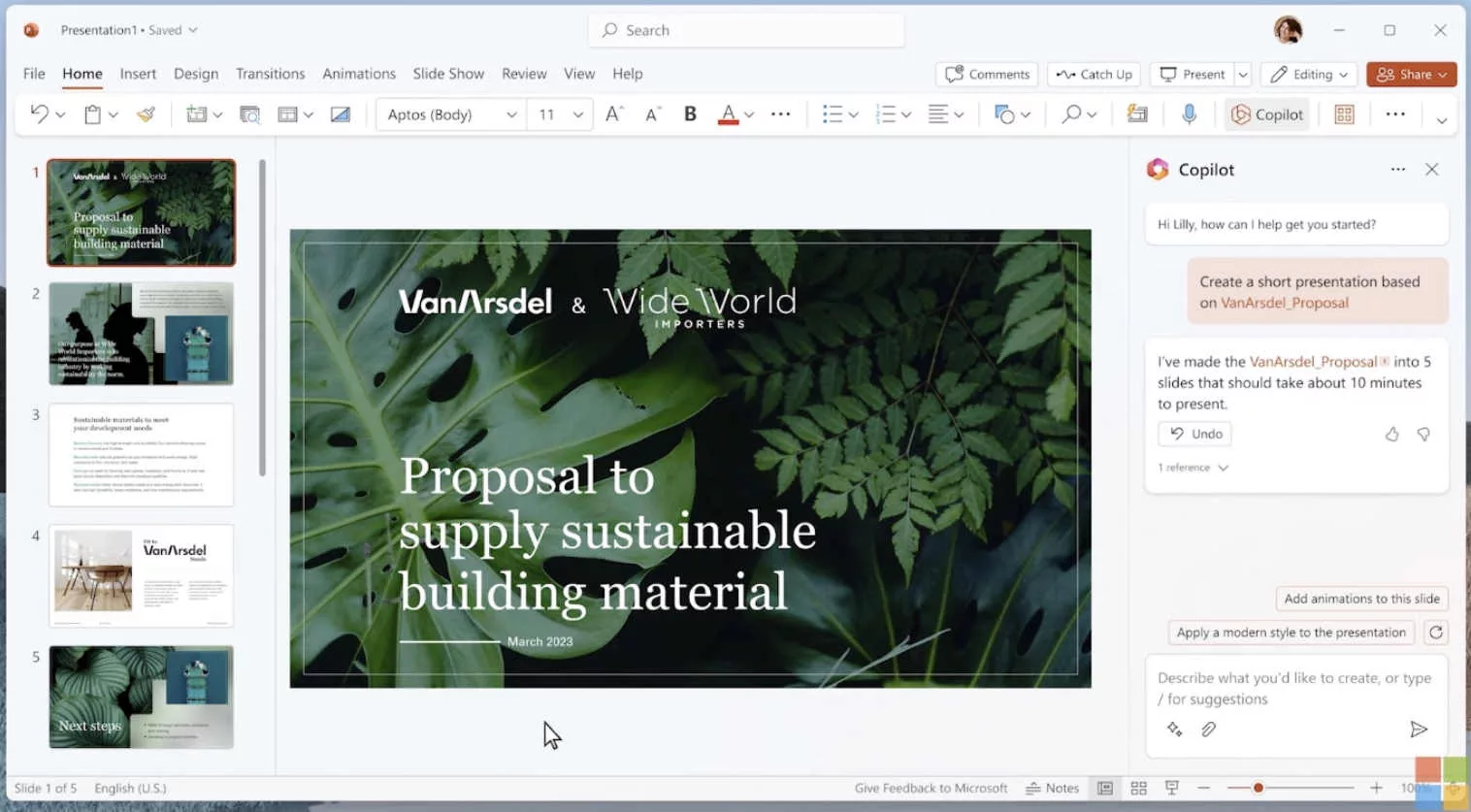
Copilot is the official Microsoft solution for AI assisted presentations. Its greatest strength is organizational context. If you are an enterprise user, Copilot can look at your Word documents, Outlook emails, and Teams chats to gather information for your deck. This makes it incredibly efficient for internal presentations where the data already exists within your company network.
The design output tends to be quite conservative, which is perfect for corporate settings but might feel a bit stiff for a modern startup pitch. It is also the most expensive option on this list because it requires a Microsoft 365 business license in addition to the Copilot subscription.
Key Features:
- Deep integration with the entire Microsoft 365 suite.
- Ability to generate presentations directly from Word documents.
- Automatic creation of speaker notes based on slide content.
- Enterprise grade security and data privacy controls.
Pricing: No free tier. Costs $30 per month per user on top of a Microsoft 365 plan.
Who it is best for: Large enterprise teams and organizations already fully committed to the Microsoft ecosystem.
Verdict: The gold standard for internal corporate reporting, though perhaps too expensive and rigid for early stage startups.
4. Gemini for Google Slides
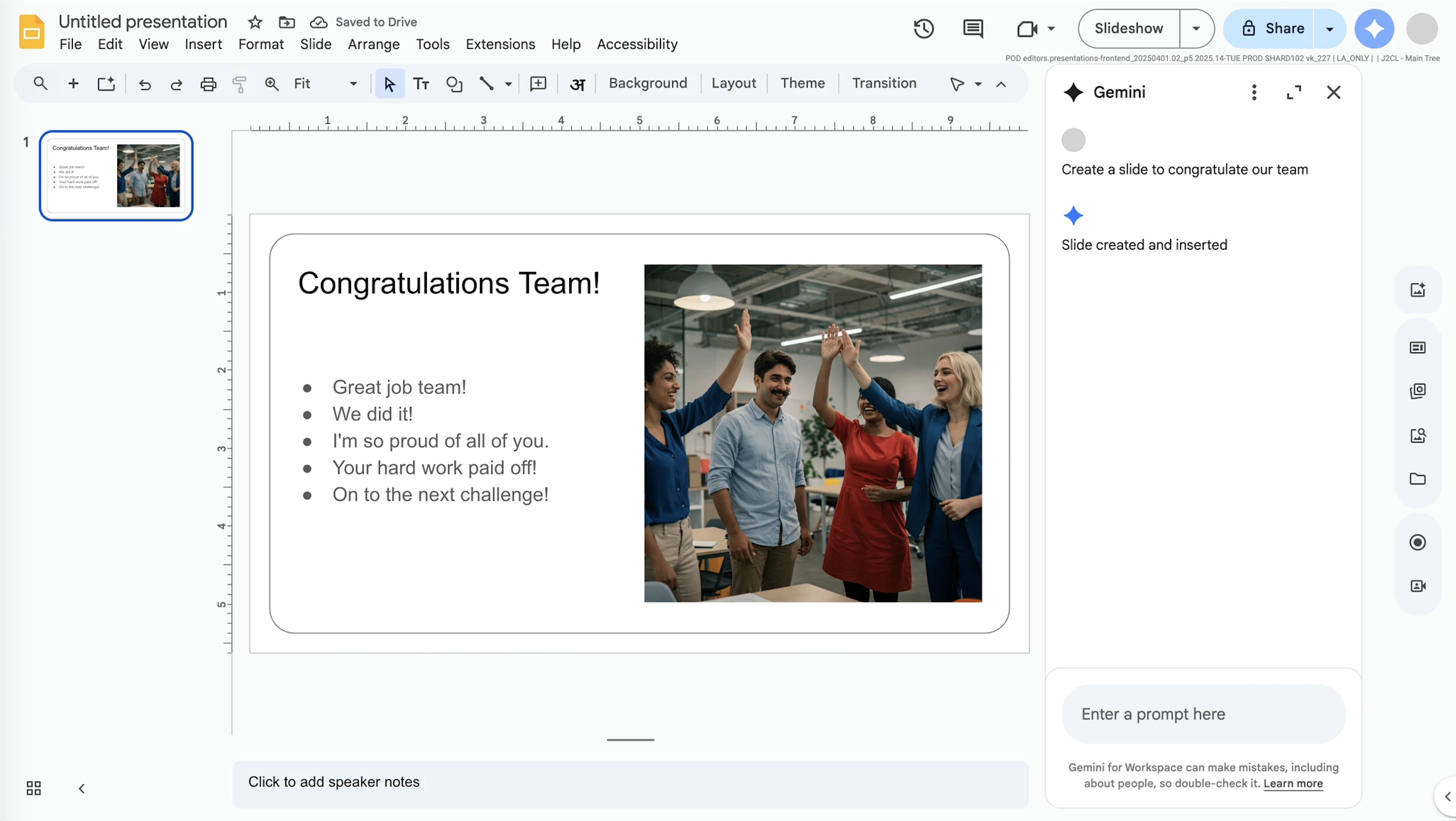
Gemini is Google's answer to Copilot. It is built directly into Google Slides and allows users to generate images and text content on the fly. Its main advantage is the lack of friction for existing Google Workspace users. Because it is part of the Workspace ecosystem, it can easily access information stored in your Google Drive.
In our testing, the output quality can be inconsistent compared to dedicated tools. The slide layouts are often quite basic, and the AI sometimes struggles with complex narrative structures. However, for a quick internal deck or a student presentation, it is a very convenient option. You can see how it compares to more specialized tools in our 2026 Gemini Google Slides vs NextDocs analysis.
Key Features:
- Native Google Workspace integration.
- Direct access to Google Drive content for slide generation.
- Built in AI image generation for custom visuals.
- Simple, familiar interface with no learning curve.
Pricing: Free tier available for basic use. Workspace tiers start at $0 additional cost for some plans.
Who it is best for: Google Workspace users who need to create quick drafts or internal updates.
Verdict: Convenient and accessible, but lacks the professional polish required for high stakes investor pitches. For better results, explore these 2026 Gemini Google Slides alternatives.
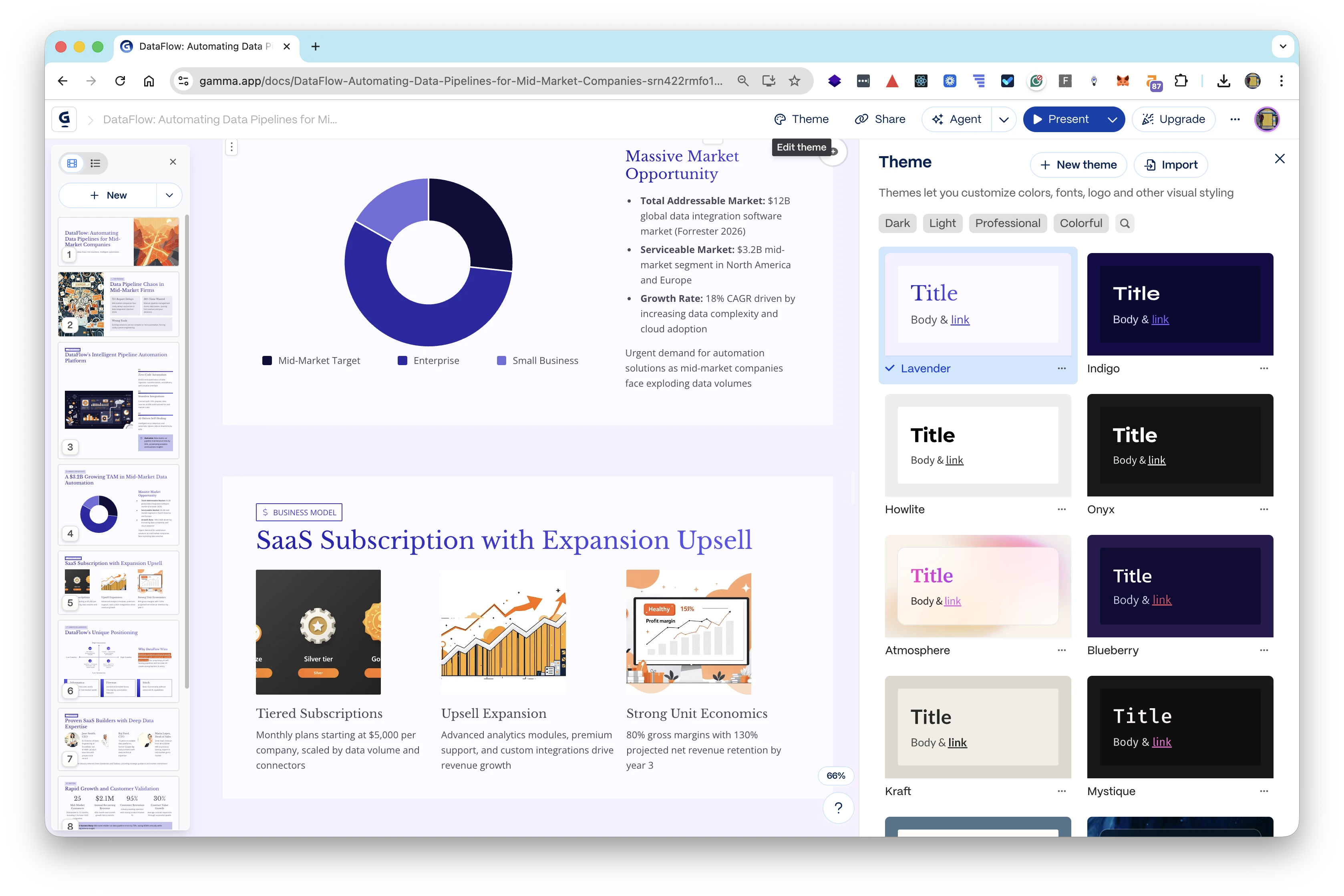
5. Gamma
Gamma has gained a significant following by moving away from the traditional "slide" metaphor. It creates web native presentations that feel more like interactive documents. This makes Gamma decks perfect for sharing via a link, as they look great on mobile devices and browsers. The free tier is quite generous, allowing users to experiment with most of the core features.
One drawback is that Gamma decks can sometimes feel like websites rather than presentations. While you can export to PDF and PPTX, the conversion is not always perfect. If you need a traditional file to present at a conference, you might find the layout shifts frustrating. For those looking for different options, we have a list of Gamma alternatives 2026 to help you decide.
Key Features:
- Web native format that is optimized for online sharing.
- Modern, stylish themes that require very little customization.
- Fast generation from simple text prompts.
- Interactive elements like embeds and videos.
Pricing: Free tier available. Pro plans start at $8 per month.
Who it is best for: Startups and individuals who prefer sharing presentations via a link rather than a file.
Verdict: An excellent choice for modern, web first presentations, though it may struggle with traditional corporate requirements.
6. Beautiful.ai
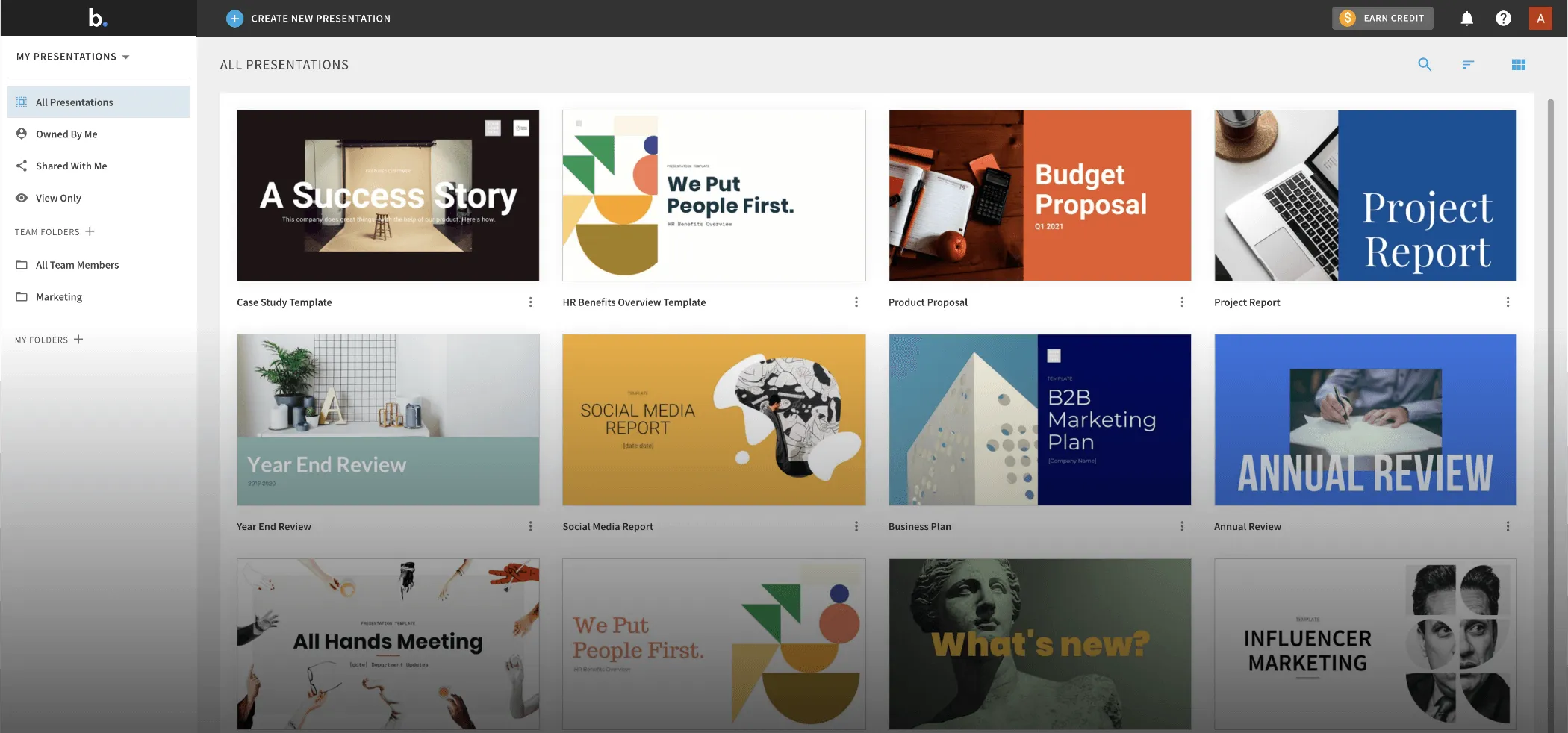
Beautiful.ai was one of the first players in the smart presentation space. It uses a "constrained" design system. This means you cannot just move elements anywhere you want. Instead, the tool automatically adjusts the layout as you add content to ensure everything remains aesthetically pleasing. This is perfect for people who are not designers but want their decks to look like they were made by a pro.
The primary limitation is flexibility. If the tool does not have a template for exactly what you want to show, it can be difficult to build it manually. It also lacks some of the newer AI research capabilities found in tools like NextDocs. You can read a deep dive in our Beautiful.ai vs Gamma comparison.
Key Features:
- Smart templates that automatically adjust to your content.
- A vast library of professional icons and stock photos.
- Consistent brand controls for colors and typography.
- Polished animations and transitions.
Pricing: No free tier. Pro plans start at $12 per month.
Who it is best for: Non designers who need to create consistently high quality, visually stunning decks.
Verdict: Still a top contender for visual quality, even if it lacks some of the more advanced AI content generation features. Check out our Beautiful.ai alternatives for more info.
7. Pitch.com
Pitch.com is built with a focus on team collaboration. It combines a professional editor with powerful AI generation features. It is particularly good for teams that need to work on a deck simultaneously, offering version history, commenting, and task assignments. The templates provided by Pitch are some of the most modern and "tech forward" in the industry.
While the AI is helpful for generating starting points, Pitch still feels very much like a manual design tool at its core. This is great for those who want total control but might be slower for users who want the AI to do the heavy lifting.
Key Features:
- Real time collaboration features for teams.
- Extensive library of high quality, professional templates.
- Built in version history and commenting.
- Ability to integrate with data sources like Google Analytics.
Pricing: Free tier available. Pro plans start at $8 per month.
Who it is best for: Collaborative teams who want a balance of AI speed and manual design control.
Verdict: A fantastic tool for teams, though it requires more "hands on" work than some of the more automated AI builders.
8. Canva Magic Design
Canva is a household name in design, and its Magic Design feature brings AI to the world of presentations. The biggest draw here is the asset library. When you use Canva, you get access to millions of photos, illustrations, and videos. The AI can generate a full deck from a prompt, and you can then use Canva's intuitive drag and drop editor to refine it.
The downside is that Canva presentations can sometimes look a bit "templatey." For a high stakes Series A pitch, the designs might feel too casual or generic. However, for marketing decks or social media presentations, it is hard to beat.
Key Features:
- Massive library of design assets and templates.
- AI powered text to presentation generation.
- Multi format exports including video and social posts.
- Strong free tier for casual users.
Pricing: Free tier available. Canva Pro starts at $13 per month.
Who it is best for: Marketers, social media managers, and small business owners.
Verdict: Great for visual variety and ease of use, but perhaps not the first choice for a formal investor pitch.
9. MagicSlides
MagicSlides is a specialized tool that excels at repurposing content. One of its unique features is the ability to turn a YouTube video or a long PDF document into a slide deck. This is incredibly useful for educators or content creators who need to summarize existing material into a presentable format.
The design output is relatively basic, often requiring a fair amount of manual cleanup to look professional. It functions as a Google Slides add in, making it easy to use if you are already in that ecosystem.
Key Features:
- YouTube to slides conversion.
- Document to presentation generation.
- Simple, prompt based slide creation.
- Integration with Google Slides.
Pricing: Free tier available. Paid plans start at $8 per month.
Who it is best for: Educators and creators who need to repurpose existing video or text content.
Verdict: A useful niche tool for content repurposing, though it lacks the design sophistication of standalone platforms.
10. SlidesAI
SlidesAI is another popular Google Slides add in that focuses on speed. It is designed to take a block of text and turn it into a series of slides. It is a no frills tool that gets the job done quickly. It is particularly popular with students and for internal company updates where the visual design is less important than the speed of delivery.
Because it is an add in, it suffers from the same limitations as others in its category, such as limited control over complex layouts. The AI generation can also be a bit repetitive in its slide structures.
Key Features:
- Fast text to slide generation.
- Support for multiple languages.
- Simple interface within Google Slides.
- Affordable pricing for individuals.
Pricing: Free tier available. Pro plans start at $10 per month.
Who it is best for: Students and professionals who need to turn text outlines into slides very quickly.
Verdict: A reliable, basic tool for quick drafts, but not recommended for high stakes presentations.
Choosing the Best Tool for Your Workflow
Selecting the right AI pitch deck builder depends on your specific needs. If you are a technical founder or a consultant, your requirements will be very different from a social media manager.
For Technical and Research Heavy Decks
If your presentation requires code blocks, math equations, or verified market data, NextDocs is the clear winner. The ability to generate multiple variants ensures you find the right narrative, while the universal export options give you the flexibility to present in any environment. You can see more about why it leads the market in our best AI presentation builders 2026 roundup.
For Enterprise Users
If you are working within a large corporation, Microsoft Copilot or Plus AI are likely your best bets. They respect your existing brand templates and keep your data within your company's secure cloud. While they may lack some creative flair, they make up for it in reliability and integration.
For Visual and Design First Decks
If you have a clear vision but lack design skills, Beautiful.ai provides the best "guardrails" to ensure your deck looks professional. For those who want more creative freedom and access to a massive library of illustrations, Canva remains a strong choice.
Conclusion
The "best" AI pitch deck builder is the one that removes the most friction from your specific workflow. In 2026, we have moved past simple text generation. The leading tools now act as research assistants, designers, and technical editors all in one.
For most professional use cases, especially those involving technical content or rigorous research, NextDocs provides the most comprehensive feature set. Its multi variant approach and support for code blocks make it uniquely suited for the modern professional landscape. However, whether you choose a standalone platform or an add in, the goal remains the same: spend less time on the slides and more time on the story you are telling.
Ready to Create Better Presentations?
Try NextDocs Free and experience multi-variant generation, universal exports, and deep research integration. No credit card required.