
Best Ai Slide Makers (with-code-blocks) in 2026
A comprehensive roundup of the best AI presentation tools including those with specialized code block support for technical decks, founders, and consultants.
The Evolution of Presentation Design in 2026
The landscape of presentation software has shifted dramatically over the last few years. We have moved past simple templates and basic auto layout features. Today, the most effective tools leverage artificial intelligence to handle the heavy lifting of research, content structuring, and visual design. For professionals in technical fields, the requirements are even stricter. You do not just need a pretty slide. You need a tool that can handle complex data, render mathematical equations perfectly, and provide syntax highlighting for code blocks.
In this roundup, we evaluate the top ten AI slide makers currently available. We have tested these tools based on their ability to generate high quality content, maintain brand consistency, and support technical features like code blocks and LaTeX. Whether you are a founder preparing a Series A pitch deck or a software engineer explaining a new architecture, there is a tool here designed for your specific workflow. For a deeper dive into the general landscape, you can view our best AI presentation builders 2026 guide.
Summary Comparison of the Best AI Slide Makers
| Rank | Tool | Best For | Starting Price |
|---|---|---|---|
| 1 | NextDocs | Overall, Technical Decks, Research | $15/mo |
| 2 | Plus AI | PowerPoint and Google Slides Users | $10/mo |
| 3 | Beautiful.ai | Design Quality for Non-Designers | $12/mo |
| 4 | Gamma | Web-Native Interactive Presentations | $8/mo |
| 5 | Copilot for PowerPoint | Microsoft 365 Enterprise Users | $30/mo |
| 6 | Pitch.com | Collaborative Team Workflows | $8/mo |
| 7 | Canva Magic Design | Visual Marketing and Social Media | $13/mo |
| 8 | Gemini for Google Slides | Google Workspace Power Users | $0/mo |
| 9 | MagicSlides | Repurposing Content and YouTube | $8/mo |
| 10 | SlidesAI | Fast Internal Drafts and Students | $10/mo |
1. NextDocs
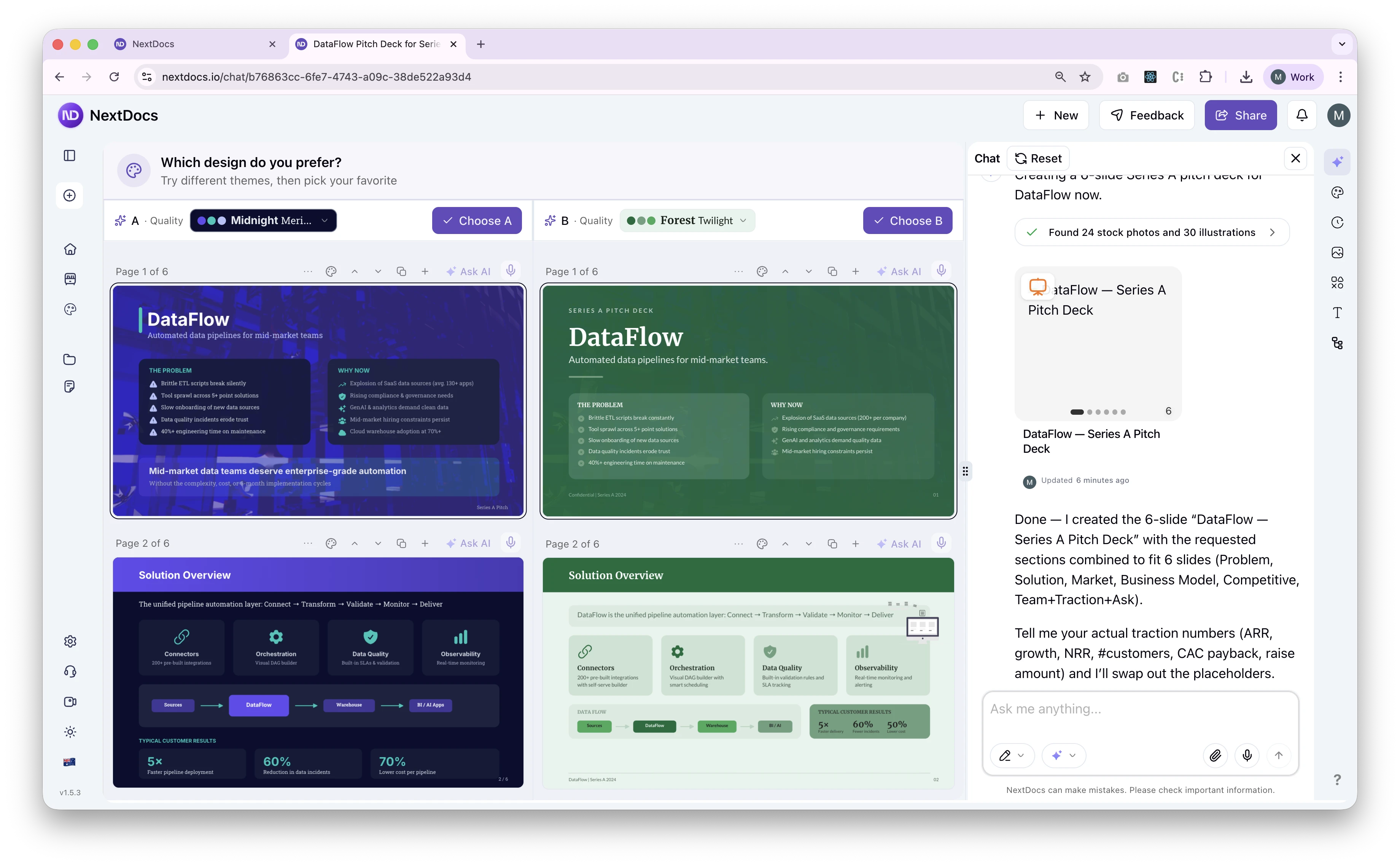
NextDocs earns the top spot on our list because it addresses the core frustrations of professional presentation building. Most AI tools provide a single output that you are forced to accept or manually fix. NextDocs uses a multi variant generation approach. This means that for every prompt you enter, the system generates several different versions of the deck. You can choose the narrative flow that works best for your specific audience. It is an AI native platform, meaning it does not just put text on a page. It understands the underlying structure of a professional presentation.
For technical users, NextDocs is a standout choice. It includes native support for code syntax highlighting across dozens of languages, ensuring that your snippets are readable and professional. It also handles mathematical equations using KaTeX, which is essential for academic or scientific presentations. When it comes to data, the tool allows for real tables within the rich text editor rather than just static images. If you are comparing different LLM outputs, you might find our analysis of Claude vs NextDocs useful for understanding how specialized tools outperform general chatbots.
Key Features:
- Multi variant generation allows you to choose from several different AI interpretations of your prompt.
- Deep research integration pulls real world data and provides citations to ensure accuracy.
- Universal exports allow you to move your work into PDF, PPTX, Google Slides, or Google Docs seamlessly.
- Specialized technical support for code syntax highlighting and LaTeX math equations.
- Brand kit support ensures that every generated slide matches your company colors and fonts.
Pricing: Free tier available. Paid plans start at $15 per month.
Who it is best for: Consultants, founders, sales teams, and technical professionals who need research heavy decks with code blocks or math.
Verdict: NextDocs is the most comprehensive tool on the market. It balances high end design with deep technical functionality, making it the clear winner for professional use.
2. Plus AI
Plus AI is a powerful add in that brings artificial intelligence directly into the tools you already use. It works within Google Slides and Microsoft PowerPoint. This is a significant advantage for those who do not want to learn a new standalone platform. Instead of generating a deck in a vacuum, Plus AI allows you to use your existing corporate templates. This ensures that the AI generated content fits perfectly with your previous work.
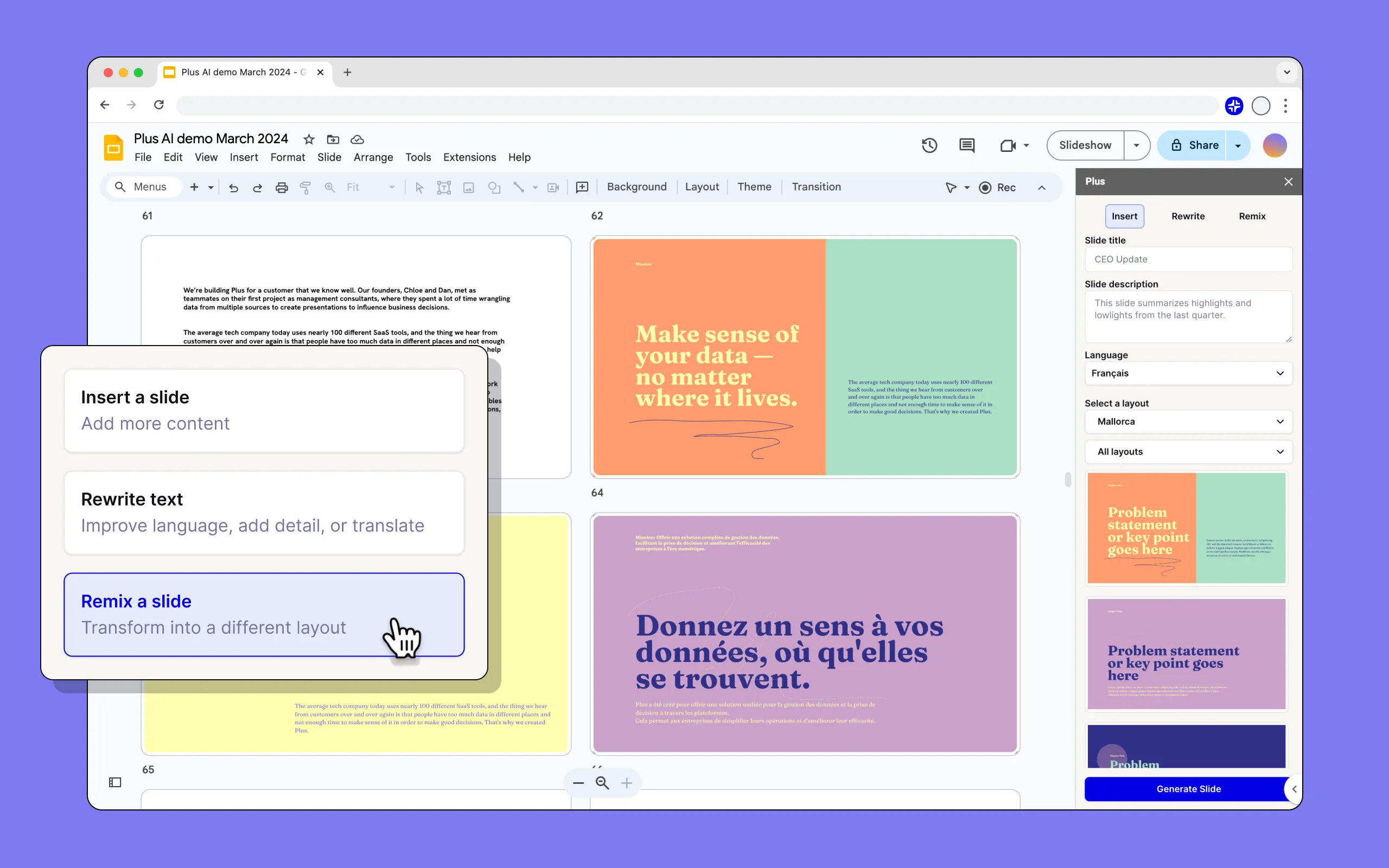
The tool includes a unique remix feature. This allows you to take an existing slide and ask the AI to transform it into a different layout or update the content based on new data. While it lacks some of the standalone power of NextDocs, its integration is its greatest strength. It is an excellent choice for teams that are already committed to traditional presentation software.
Key Features:
- Native integration as an add in for Google Slides and PowerPoint.
- Template preservation ensures the AI uses your specific brand styles and master slides.
- Remix feature for transforming existing slides into new layouts.
- Content enhancement tools for rewriting or summarizing bullet points.
Pricing: No free tier. Paid plans start at $10 per month.
Who it is best for: Enterprise teams and individuals who want to stay within the PowerPoint or Google Slides ecosystems.
Verdict: Plus AI is the best choice for those who value workflow continuity. It makes your existing tools smarter without forcing you to switch platforms.
3. Beautiful.ai
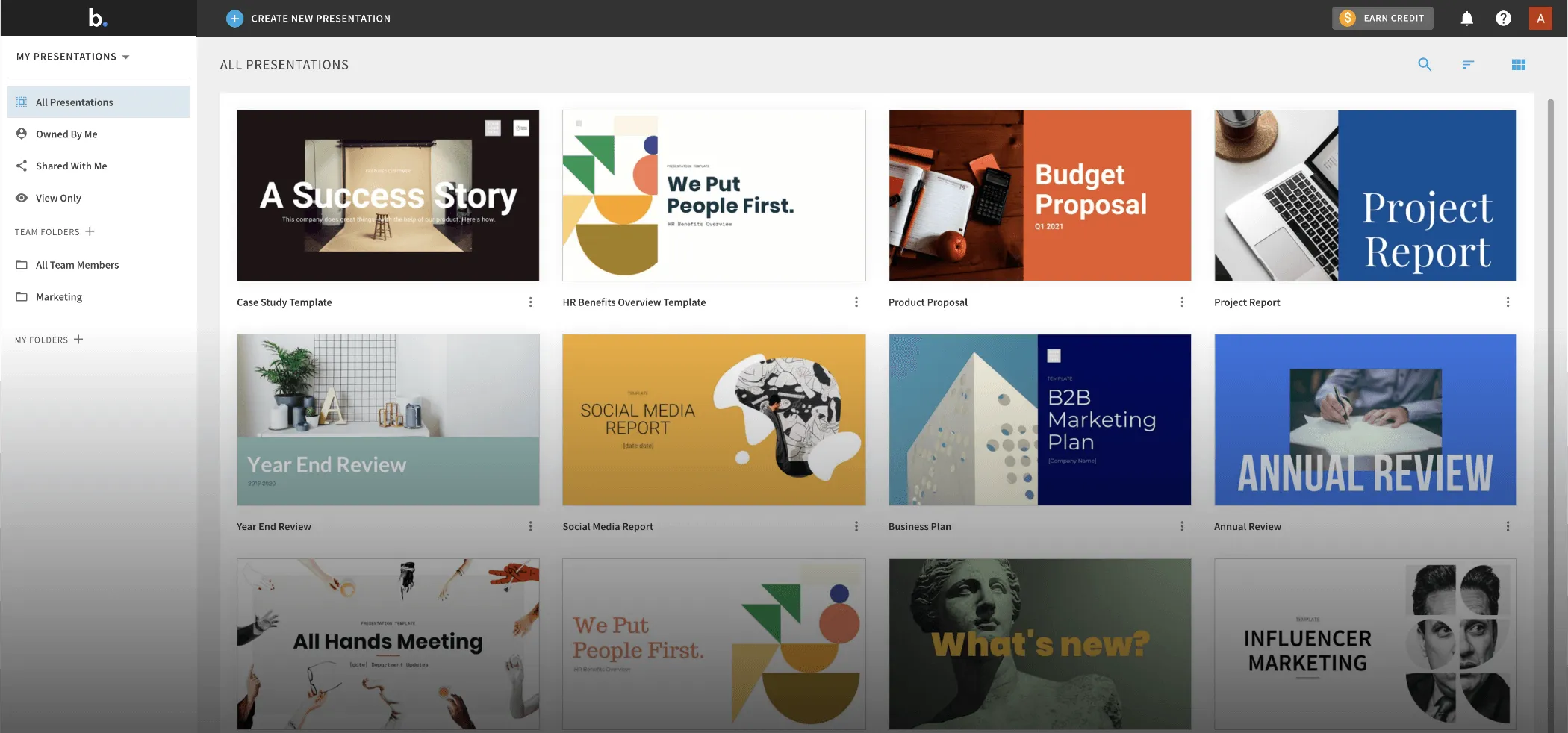
Beautiful.ai focuses on the visual aspect of presentation building. It uses smart templates that automatically adjust as you add content. If you add a fourth bullet point to a slide, the layout shifts to accommodate it while maintaining perfect alignment and white space. This makes it nearly impossible to create an ugly presentation. For those who are not designers, this automated guardrail is invaluable.
The tool recently added more robust AI generation features, allowing you to build entire decks from a single prompt. However, it is less flexible than other tools when it comes to custom layouts. You are often limited by what the smart templates allow. If you find yourself needing more freedom, you might want to look at Beautiful.ai alternatives that offer more manual control.
Key Features:
- Smart templates that use design rules to automatically format your slides.
- AI slide designer for generating content from text prompts.
- Shared team folders and brand kits for organizational consistency.
- Professional animation and transition effects.
Pricing: No free tier for individuals. Plans start at $12 per month.
Who it is best for: Non designers who need to produce high quality, polished presentations for clients or internal stakeholders.
Verdict: Beautiful.ai remains the gold standard for automated design. It is perfect for users who want to focus purely on content and let the software handle every visual detail.
4. Gamma
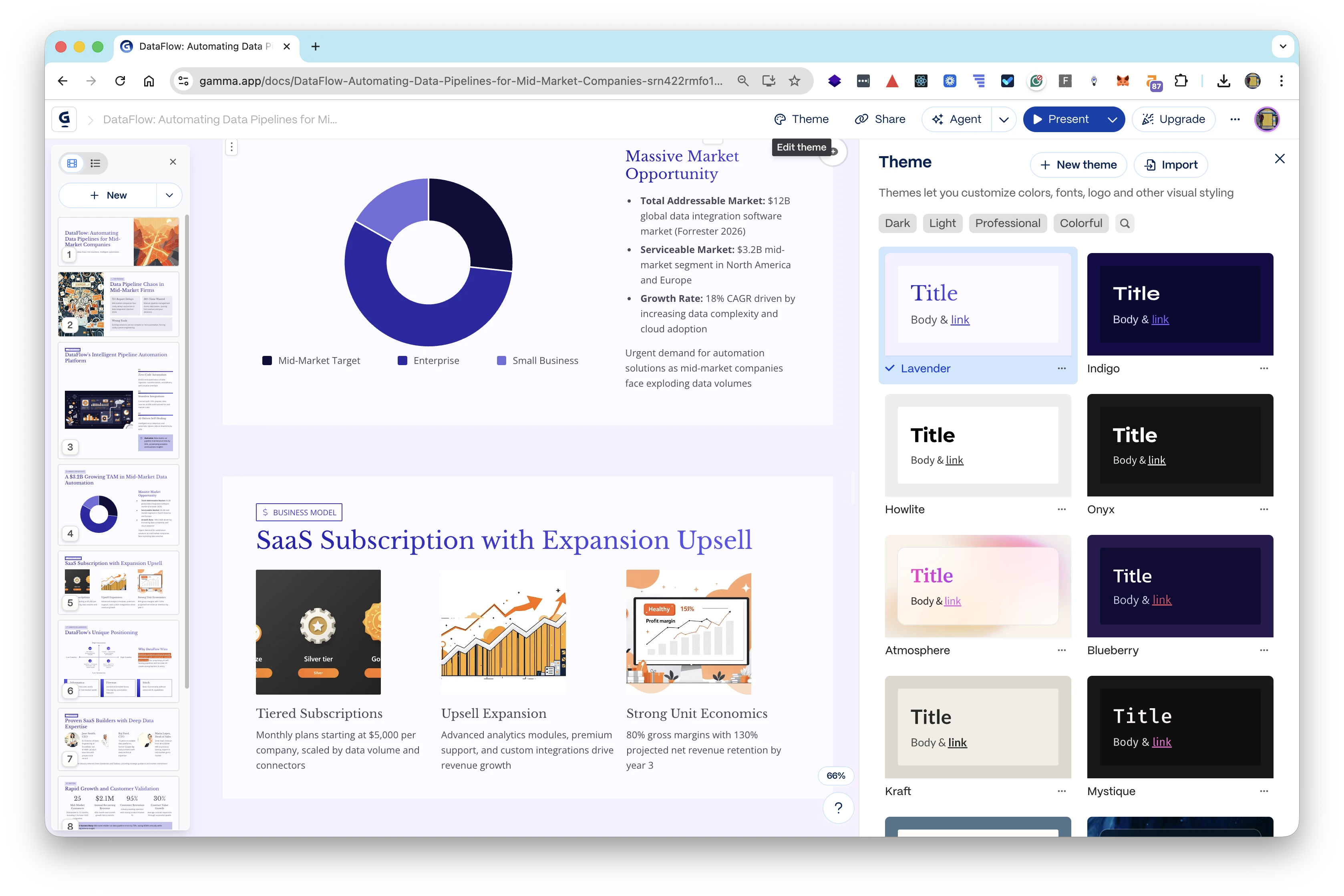
Gamma takes a different approach by focusing on web native presentations. Instead of traditional slides that are meant to be printed or exported as static files, Gamma creates interactive cards. These cards can be shared via a link and viewed on any device. They can include embedded videos, live web pages, and interactive charts. It is a modern format that feels more like a website than a PowerPoint deck.
The AI generation in Gamma is fast and produces visually striking results. It is particularly popular among startups and creative professionals who want a more dynamic way to present their ideas. While it does support exports to PDF and PPTX, the best experience is found within the Gamma web player.
Key Features:
- Web native format that is responsive and interactive.
- Fast AI generation that builds decks, docs, or even simple websites from a prompt.
- Modern design aesthetics with a wide variety of themes.
- Flexible layout options that go beyond the standard 16:9 slide ratio.
Pricing: Free tier available with watermarks. Pro plans start at $8 per month.
Who it is best for: Startups, students, and professionals who prefer sharing presentations as interactive web links.
Verdict: Gamma is the best option for those who want to break away from the traditional slide deck format. Its free tier is generous, making it highly accessible.
5. Copilot for PowerPoint
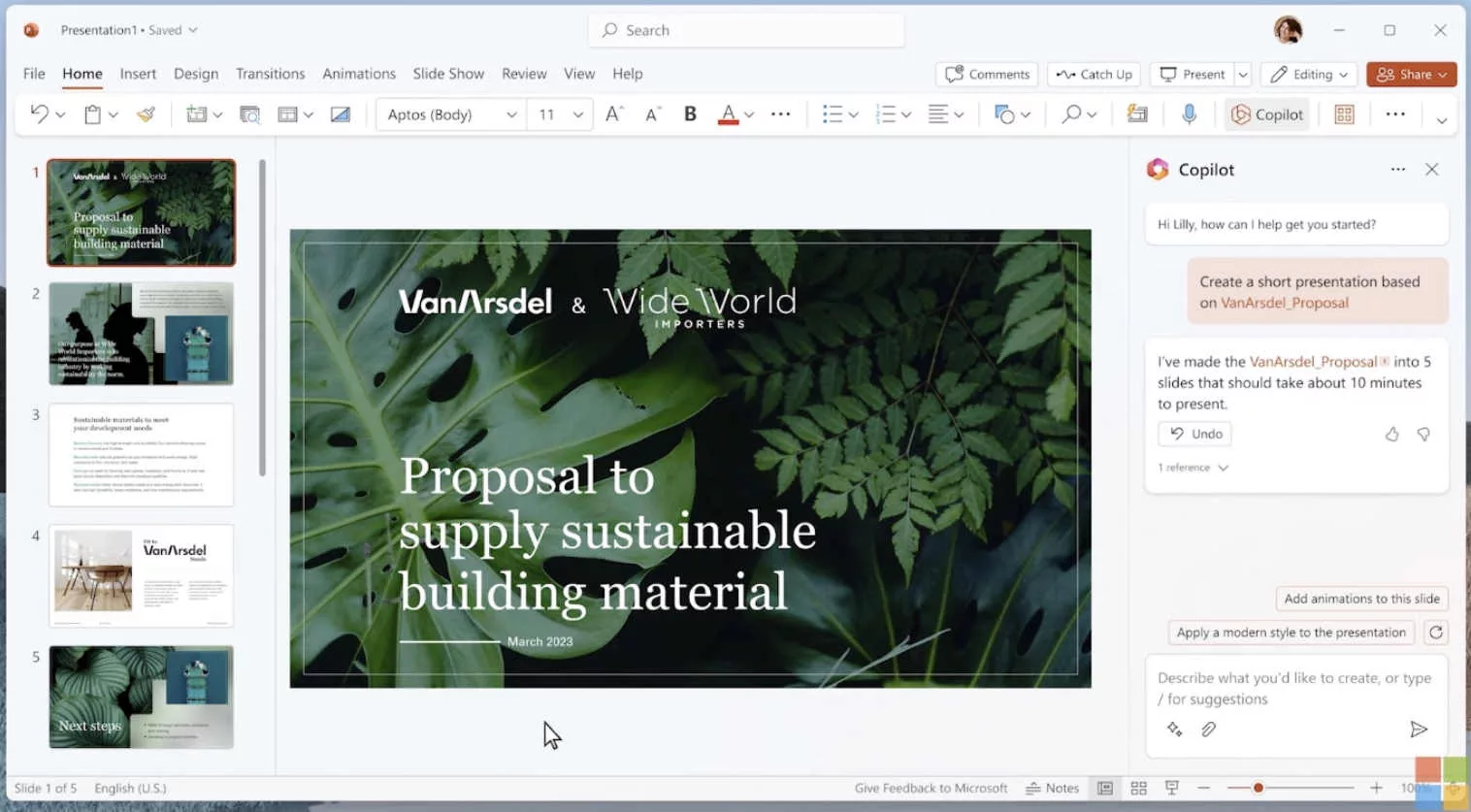
Microsoft has integrated its powerful Copilot AI directly into the Office suite. For PowerPoint users, this means you can generate presentations based on existing Word documents or Excel data. This contextual awareness is a massive advantage for enterprise users. Copilot can pull a project summary from a document and turn it into a 10 slide deck in seconds.
However, the design output is often quite conservative. It looks like a standard corporate PowerPoint presentation. While it is highly functional and secure, it may not have the visual flair of standalone tools. For a comparison of how this stacks up against Google's offering, see our Copilot for PowerPoint vs Gemini for Google Slides breakdown.
Key Features:
- Deep integration with the entire Microsoft 365 ecosystem.
- Ability to generate presentations from existing Word and Excel files.
- Enterprise grade security and data privacy.
- Automated speaker notes and summary generation.
Pricing: Requires a Microsoft 365 subscription plus a Copilot license, which is $30 per month.
Who it is best for: Corporate employees and large organizations already using Microsoft 365.
Verdict: Copilot is the most powerful tool for internal corporate use. Its ability to reference your company documents makes it a massive time saver for administrative tasks.
6. Pitch.com
Pitch.com is built with collaboration at its center. While it has introduced AI generation features to help users get started, its true power lies in its team workflow tools. It features real time co editing, slide status tracking, and a very robust commenting system. The design aesthetic is clean and professional, aimed squarely at the modern tech company.
If you are working on a deck with five other people, Pitch is likely your best choice. It handles version control much better than traditional tools. However, its AI capabilities are slightly more basic compared to specialized builders like NextDocs. You can explore Pitch alternatives if you find the AI features too limited for your needs.
Key Features:
- Excellent real time collaboration and project management tools.
- Modern, high quality template library.
- AI assisted generation for outlines and slide content.
- Integration with data sources like Google Analytics and ChartMogul.
Pricing: Free tier available. Paid plans start at $8 per month.
Who it is best for: Tech teams and startups that prioritize collaborative design and version control.
Verdict: Pitch is a fantastic platform for teams. It balances a sleek interface with the features needed for group projects.
7. Canva Magic Design
Canva is a household name in design, and its Magic Design AI brings that expertise to presentations. The tool is incredibly easy to use. You simply type in a prompt, and Canva generates a selection of decks using its massive library of assets. Because Canva has access to millions of stock photos, icons, and graphics, the visual variety is unmatched.
Canva is great for marketing presentations or social media content. However, it can sometimes feel too cluttered for professional corporate settings. The export to PowerPoint can also be a bit messy, with fonts and layouts shifting unexpectedly.
Key Features:
- Access to an enormous library of stock photos, videos, and graphic elements.
- Extremely simple AI generation process.
- Multi format support for social media, print, and video.
- Strong free tier for casual users.
Pricing: Free tier available. Canva Pro starts at $13 per month.
Who it is best for: Marketers, social media managers, and small business owners who need quick, visual content.
Verdict: Canva is the king of visual assets. If you need a presentation that relies heavily on beautiful imagery and graphics, Canva is the way to go.
8. Gemini for Google Slides
Google has integrated its Gemini AI into Google Slides to compete with Microsoft. It is very similar in function to Copilot. You can use it to generate images, summarize text, or create new slides from scratch. One of its best features is the ability to reference documents within your Google Drive. This makes it easy to turn a Google Doc into a slide deck.
The tool is still evolving, and the output can sometimes be generic. However, for those who live in Google Workspace, it is a convenient and often free addition. If you want to see how it compares to smaller players, check out our Copilot for PowerPoint vs SlidesAI 2026 comparison, as Gemini follows a similar add in logic.
Key Features:
- Native integration with Google Workspace.
- AI image generation directly within the slide editor.
- Content suggestions based on Google Drive files.
- Real time collaboration within the familiar Slides interface.
Pricing: Included with certain Google Workspace tiers or available through a Gemini subscription.
Who it is best for: Google Workspace users who want a simple, integrated AI assistant.
Verdict: Gemini is a solid, no frills AI assistant for Google Slides. It is perfect for quick drafts and internal updates.
9. MagicSlides
MagicSlides is a specialized Google Slides add on that excels at repurposing content. One of its unique strengths is the ability to turn a YouTube video or a long article into a presentation. You simply paste the URL, and the AI extracts the key points to create a structured deck. This is a huge benefit for educators and content creators who need to transform video content into teaching materials.
The design quality is fairly basic, so you will likely need to do some manual polishing. However, as a starting point for content repurposing, it is very effective. You can find more options in our MagicSlides alternatives list.
Key Features:
- YouTube to slides conversion.
- Article and PDF to slides generation.
- Support for over 100 languages.
- Simple, straightforward interface.
Pricing: Free tier available. Paid plans start at $8 per month.
Who it is best for: Teachers, students, and content creators who need to repurpose existing video or text content.
Verdict: MagicSlides is a great utility tool. It is not a full design suite, but it is excellent for its specific niche of content conversion.
10. SlidesAI
SlidesAI is another popular Google Slides add on that focuses on speed. It is designed for users who have a lot of text and need to turn it into slides as quickly as possible. You paste your text into the tool, choose a general style, and it builds the deck for you. It is one of the most affordable options on the market.
While it lacks the advanced features of NextDocs or the design polish of Beautiful.ai, it is a reliable workhorse for simple presentations. It is particularly popular in academic settings.
Key Features:
- Fast text to slide generation.
- Simple style selection.
- Affordable pricing tiers for students.
- Works directly within Google Slides.
Pricing: Free tier available. Paid plans start at $10 per month.
Who it is best for: Students and professionals who need to convert large amounts of text into slides quickly.
Verdict: SlidesAI is a budget friendly, efficient tool for basic presentation needs. It does one thing well: turning text into slides.
Choosing the Right Tool for Technical Presentations
When you are creating a technical presentation, your needs differ from a standard business user. You cannot rely on generic AI that might hallucinate data or fail to format your code. This is where specialized features like code syntax highlighting and math equation rendering become critical.
If you are considering a tool that focuses more on visual flair rather than technical precision, you should compare it against the market leader. For example, our NextDocs vs Gamma comparison highlights how NextDocs provides better support for the structured data and technical blocks that engineers and researchers require. Similarly, if you have seen tools like Nano Banana Pro vs NextDocs 2026, you will notice that image based generation often fails when you need to edit the actual code within a slide.
Technical Features Checklist
When evaluating these tools for a technical workflow, look for the following:
- Code Blocks: Does the tool support syntax highlighting for languages like Python, Javascript, or C++?
- Math Equations: Can it render LaTeX or KaTeX for scientific formulas?
- Data Tables: Are tables editable rich text, or are they just static images that you cannot change?
- Export Quality: When you export to PDF or PPTX, does the code remain readable and the formatting stay intact?
- Research Accuracy: Does the AI provide citations for the statistics it includes in your slides?
Conclusion
The best AI slide maker for you depends on your specific needs and your existing workflow. If you are looking for the absolute best in class for professional, research heavy, or technical presentations, NextDocs is the clear choice. Its multi variant generation and support for code blocks make it stand out from the competition.
For those who want to stay within their current software, Plus AI and Copilot offer the best integration. If your goal is purely aesthetic, Beautiful.ai will ensure your slides look perfect every time. And for those who want to experiment with new, web native formats, Gamma provides a fresh perspective on what a presentation can be.
The technology is moving fast. We recommend trying a few of these tools with your most common presentation tasks to see which one feels the most natural. Most offer a free tier, so the risk of experimentation is low. For further reading on the latest trends, stay tuned to our best AI presentation builders 2026 updates.
Ready to Create Better Presentations?
Try NextDocs Free and experience multi-variant generation, universal exports, and deep research integration. No credit card required.