

Le paysage des présentations professionnelles a changé radicalement. En 2026, le défi ne consiste plus à trouver une IA capable d'écrire du texte. Au lieu de cela, l'accent s'est déplacé vers la recherche d'outils qui s'intègrent profondément aux flux de travail existants, maintiennent la cohérence de la marque et offrent des exportations PPTX de haute qualité. Les professionnels ont besoin de plus qu'un simple brouillon. Ils ont besoin de decks prêts pour les investisseurs et de présentations destinées aux clients qui ne nécessitent pas des heures de nettoyage manuel.
Ce guide explore les meilleurs constructeurs de présentations IA disponibles aujourd'hui. Nous avons testé ces outils en fonction de leur capacité à générer des récits structurés, de leur flexibilité de conception et de la fiabilité de leurs fonctions d'exportation. Que vous soyez consultant, fondateur de startup ou responsable des ventes, ce tour d'horizon vous aidera à identifier l'outil adapté à vos besoins spécifiques. Cet article fait partie de notre série continue sur les meilleurs constructeurs de présentations IA 2026 et propose une analyse approfondie des fonctionnalités qui comptent le plus pour les utilisateurs professionnels.
Tableau comparatif
| Rang | Outil | Idéal pour | Prix de départ |
|---|---|---|---|
| 1 | NextDocs | En général, présentations très axées sur la recherche | $15/mo |
| 2 | Plus AI | Utilisateurs PowerPoint et Google Slides | $10/mo |
| 3 | Beautiful.ai | Qualité de design soignée | $12/mo |
| 4 | Gamma | Web natif et startups | $8/mo |
| 5 | Copilot for PowerPoint | Entreprise Microsoft 365 | $30/mo |
| 6 | Gemini for Google Slides | Utilisateurs Google Workspace | $0/mo |
| 7 | Pitch.com | Équipes collaboratives | $8/mo |
| 8 | Canva Magic Design | Marketeurs et réseaux sociaux | $13/mo |
| 9 | SlidesAI | Brouillons internes rapides | $10/mo |
| 10 | MagicSlides | Réutilisation de contenu | $8/mo |
1. NextDocs
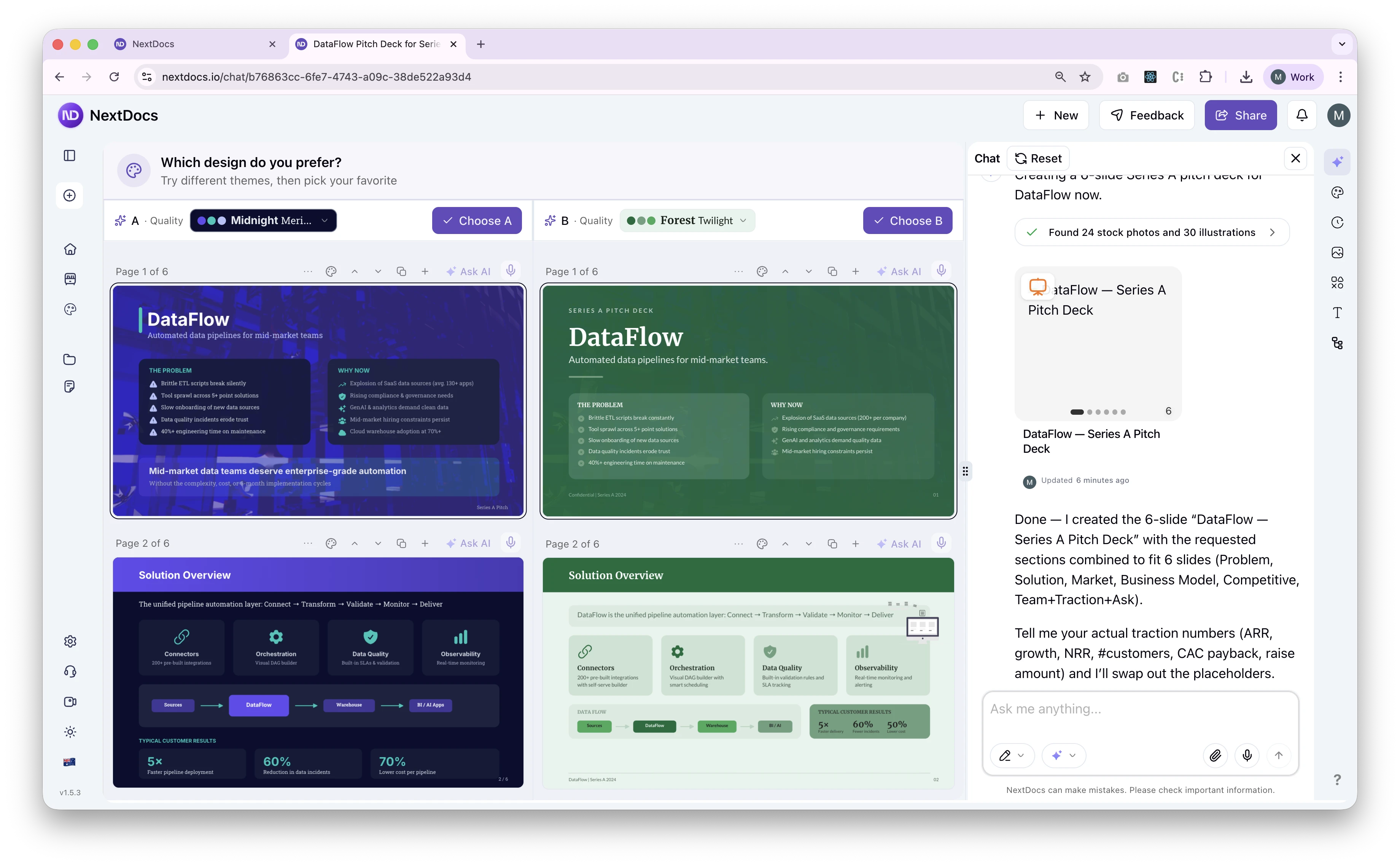
NextDocs se place en tête de notre classement grâce à son approche innovante de la génération de diapositives. Alors que de nombreux outils fournissent une sortie unique basée sur une invite, NextDocs utilise la génération multi-variantes. Cela signifie que les utilisateurs reçoivent plusieurs versions différentes de leur deck, leur permettant de choisir le récit et le style qui conviennent le mieux. Il est conçu pour les professionnels qui ne peuvent pas se permettre les hallucinations souvent présentes dans les outils d'IA généraux. Pour ceux qui comparent différentes approches créatives, notre analyse Nano Banana Pro vs NextDocs 2026 met en évidence pourquoi une approche document structurée l'emporte souvent sur une génération purement basée sur les images.
La plateforme excelle dans la recherche approfondie. Elle peut extraire des chiffres réels et des données de marché avec des citations, ce qui est essentiel pour les fondateurs et les consultants. Sa capacité d'exportation universelle garantit que votre travail ne reste jamais bloqué dans un format propriétaire. Vous pouvez passer sans effort entre PPTX, PDF, Google Slides et Google Docs. Bien qu'il y ait une légère courbe d'apprentissage pour ses fonctionnalités avancées de style de marque, le résultat est un niveau de cohérence que les autres outils peinent à égaler.
Fonctionnalités clés :
- Génération multi-variantes pour des choix divers de mise en page et de contenu.
- Intégration de recherche approfondie qui extrait des données réelles avec des citations.
- Exportations universelles vers PPTX, PDF et les formats Google Workspace.
- Prise en charge de plusieurs modèles d'IA pour optimiser la qualité du contenu.
- Contrôles robustes du kit de marque pour une identité d'entreprise cohérente.
Tarification : Niveau gratuit disponible. Les plans Pro commencent à 15 $/mois. Idéal pour : Consultants, fondateurs et équipes commerciales qui ont besoin de présentations professionnelles et riches en recherche. Verdict : L'outil le plus complet et fiable pour un usage professionnel en 2026.
2. Plus AI
Plus AI est le choix privilégié pour les utilisateurs qui souhaitent rester dans leur logiciel existant. Il fonctionne comme un add‑in natif pour PowerPoint et Google Slides. Cette approche préserve vos modèles et diapositives maîtres existants, ce qui en fait une solution idéale pour les environnements d'entreprise avec des directives de marque strictes. Lors de l'évaluation de Gemini for Google Slides vs Plus AI, Plus AI l'emporte souvent grâce à sa capacité à modifier et améliorer les présentations existantes plutôt qu'à créer de nouvelles à partir de zéro.
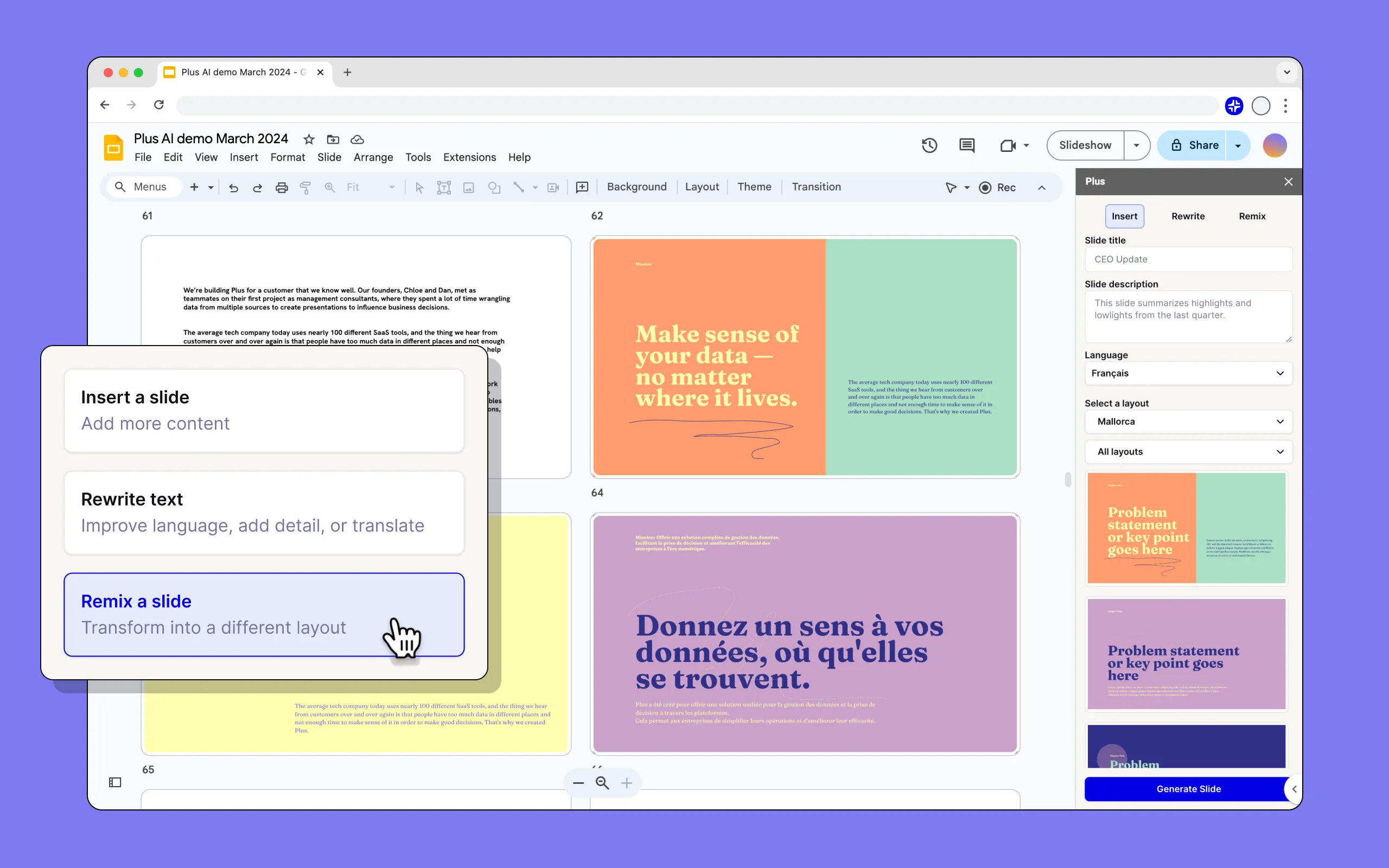
L'outil comprend une fonctionnalité unique de « remix » qui vous permet de transformer des diapositives individuelles en nouvelles mises en page sans perdre votre contenu. Cela est particulièrement utile pour rafraîchir d'anciennes présentations. Cependant, comme il dépend de votre environnement d'application existant, la variété de conception est naturellement limitée à ce que ces plateformes peuvent supporter. C'est un outil robuste pour les utilisateurs avancés qui privilégient l'intégration au flux de travail plutôt que des fonctionnalités autonomes tape‑à‑l'œil.
Fonctionnalités clés :
- Intégration native avec PowerPoint et Google Slides.
- Fonction remix pour mettre à jour les mises en page de diapositives existantes.
- Préservation des modèles pour maintenir les normes de marque.
- Réécriture de contenu alimentée par l'IA et amélioration des diapositives.
Tarification : Aucun niveau gratuit. Les plans commencent à 10 $/mois. Idéal pour : Utilisateurs avancés qui souhaitent une IA intégrée à leur flux de travail PowerPoint ou Google Slides existant. Verdict : Le meilleur add‑in pour les professionnels qui refusent de quitter leurs éditeurs de diapositives familiers.
3. Beautiful.ai
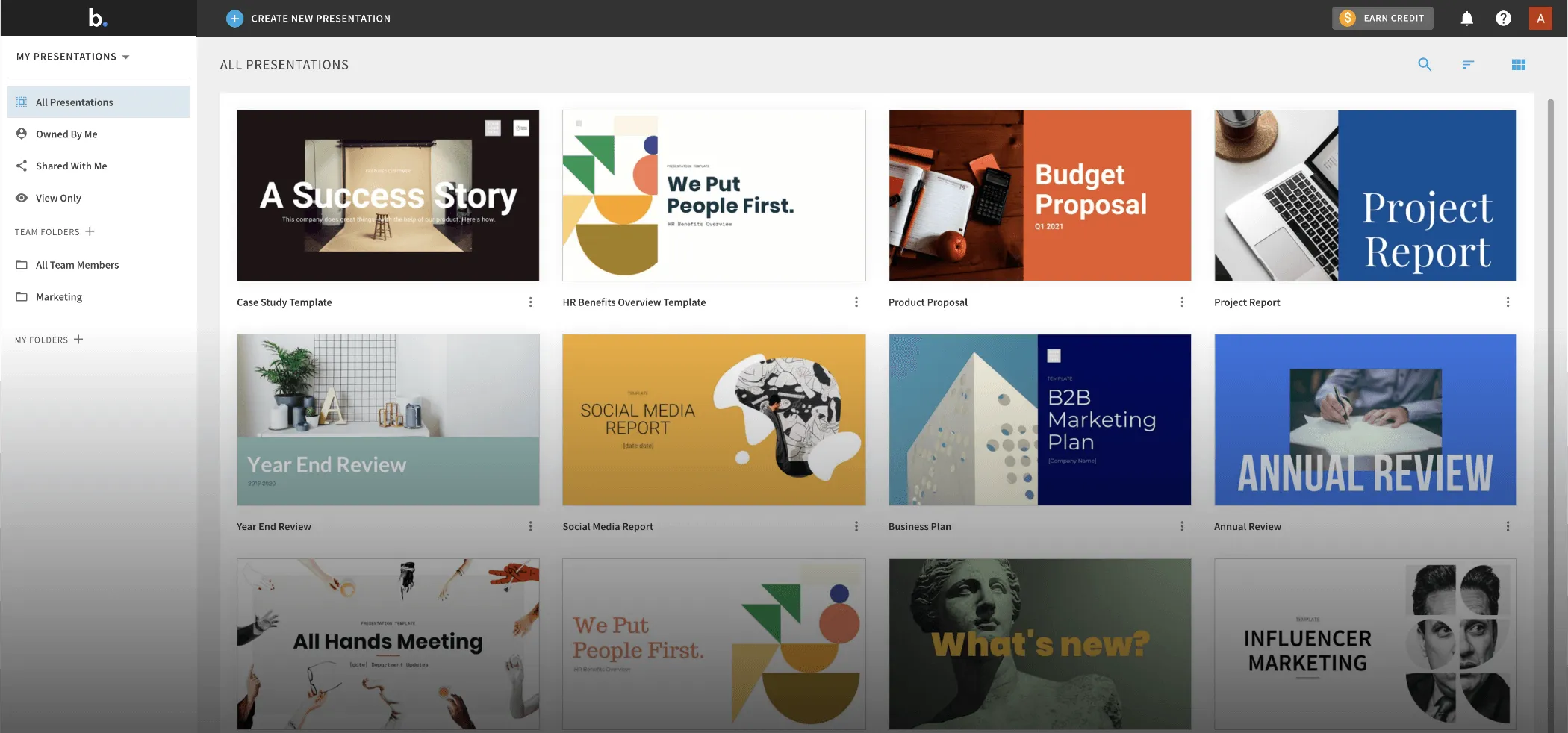
Beautiful.ai est depuis longtemps la référence en matière de logiciel de présentation axé sur le design. Il utilise des modèles intelligents qui s'ajustent automatiquement à mesure que vous ajoutez du contenu. Cela évite le problème courant de « diapositive laide » qui survient lorsque des non‑designers tentent de créer des mises en page complexes. Si vous trouvez les modèles trop restrictifs, vous pouvez consulter diverses alternatives à Beautiful.ai qui offrent plus de contrôle manuel.
Les capacités d'IA de Beautiful.ai se sont étendues pour inclure des fonctionnalités d'invite à présentation. Le rendu est constamment soigné et haut de gamme, ce qui le rend idéal pour les travaux destinés aux clients. Bien qu'il propose une exportation PPTX, les diapositives peuvent parfois être difficiles à modifier une fois transférées dans PowerPoint en raison de la façon propriétaire dont les modèles intelligents sont structurés. Il reste un choix de premier plan pour ceux qui privilégient la qualité visuelle avant tout.
Fonctionnalités clés :
- Modèles intelligents qui gèrent automatiquement la mise en page et l'espacement.
- Résultat soigné, de qualité designer pour chaque diapositive.
- Bibliothèque robuste d'animations et de transitions.
- Kits de marque pour assurer la cohérence des couleurs et des polices.
Tarification : Aucun niveau gratuit. Les plans individuels commencent à 12 $/mois. Idéal pour : Non‑designers qui ont besoin de présentations à enjeux élevés et visuellement impressionnantes. Verdict : Inégalé pour le design automatisé, bien qu'il sacrifie une certaine flexibilité pour ce raffinement.
4. Gamma
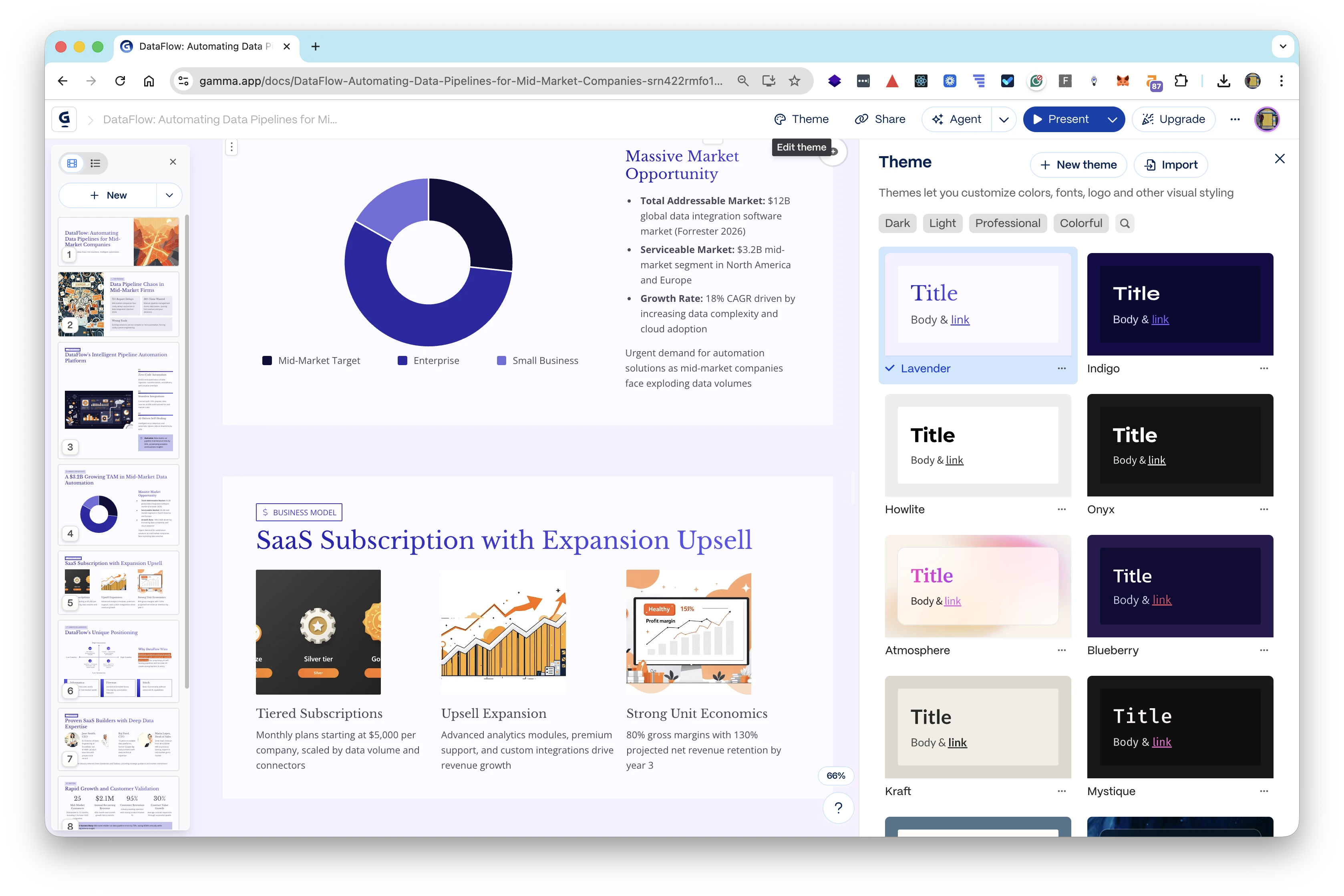
Gamma a redéfini le format de présentation en s'éloignant des diapositives traditionnelles au profit d'un système "carte" web‑natif. Il génère du contenu incroyablement rapidement et propose un niveau gratuit très généreux. Pour une analyse détaillée de sa comparaison avec notre meilleur choix, consultez notre comparaison Gamma vs NextDocs 2026. Les présentations Gamma ressemblent à des sites web modernes, ce qui les rend très efficaces pour les pitchs de startups et les mises à jour internes.
Bien que Gamma se concentre sur son format web‑natif, il propose une exportation PPTX. Cependant, la conversion des cartes web en diapositives traditionnelles peut parfois entraîner des problèmes de mise en forme. L'outil est parfait pour les utilisateurs qui souhaitent partager un lien plutôt qu'un fichier. Son IA est particulièrement efficace pour transformer de longs documents ou plans en sections digestes et visuellement attrayantes.
Fonctionnalités clés :
- Format web‑natif optimisé pour le partage d'écran et les liens.
- Génération IA rapide et intuitive à partir d'invites simples.
- Éléments interactifs comme vidéos intégrées et graphiques en direct.
- Thèmes de design modernes et minimalistes.
Tarification : Niveau gratuit disponible. Les plans Pro commencent à 8 $/mois. Idéal pour : Startups, présentations internes rapides et partage web. Verdict : Le moyen le plus rapide de passer d'une idée à une présentation belle et partageable.
5. Copilot for PowerPoint
Microsoft Copilot est le choix d'entreprise pour les organisations déjà profondément intégrées à l'écosystème Microsoft 365. Sa plus grande force est son contexte organisationnel. Il peut extraire des informations de vos documents Word, feuilles Excel et conversations Teams pour créer une présentation qui connaît réellement ce qui se passe dans votre entreprise. Ce niveau d'intégration est difficile à reproduire pour les outils autonomes.
Le rendu design de Copilot tend à être plus conservateur et fonctionnel. Il est parfait pour les rapports internes et les mises à jour d'entreprise où la clarté prime sur le flair créatif. Le prix est élevé, car il nécessite une licence Microsoft 365 spécifique. Pour de nombreuses grandes entreprises, les avantages en matière de sécurité et de conformité de rester dans le cloud Microsoft justifient le coût.
Fonctionnalités clés :
- Conscience contextuelle des données internes de votre organisation.
- Intégration directe avec Word et Excel pour la création de diapositives.
- Sécurité de niveau entreprise et confidentialité des données.
- Génération automatisée de notes de présentateur et de résumés.
Tarification : 30 $/utilisateur/mois (nécessite un abonnement Microsoft 365). Idéal pour : Employés d'entreprise et organisations utilisant l'ensemble de la suite Microsoft 365. Verdict : L'option la plus sécurisée et consciente du contexte pour les environnements d'entreprise à grande échelle.
6. Gemini for Google Slides
Gemini est la réponse de Google à Copilot. Il est intégré directement à Google Workspace, ce qui en fait un choix naturel pour les équipes qui travaillent dans Google Drive. Il est particulièrement performant pour générer des images accompagnant vos diapositives et rédiger du contenu à partir de vos Google Docs existants. L'intégration est fluide, et pour de nombreux niveaux de Workspace, il est inclus sans frais supplémentaires.
Bien que pratique, le rendu peut parfois sembler générique comparé aux outils spécialisés. Les modèles sont les mises en page standard de Google Slides, qui manquent de l'automatisation de design sophistiquée d'outils comme Beautiful.ai ou NextDocs. Cependant, pour un deck interne rapide ou un projet étudiant, c'est un outil incroyablement accessible et performant.
Fonctionnalités clés :
- Intégration fluide avec Google Workspace et Google Drive.
- Génération d'images IA intégrée pour les visuels des diapositives.
- Rédaction et synthèse de contenu directement dans l'interface Slides.
- Fonctionnalités de collaboration en temps réel inhérentes à Google Slides.
Tarification : À partir de 0 $/mois pour les fonctionnalités de base dans Workspace. Idéal pour : Utilisateurs de Google Workspace qui ont besoin de brouillons rapides sans quitter leur navigateur. Verdict : Un outil pratique et à faible friction pour les besoins de présentation quotidiens.
7. Pitch.com
Pitch.com se concentre sur l'aspect collaboratif de la création de présentations. Il propose un éditeur sophistiqué qui ressemble à un mélange entre un outil de design et un créateur de diapositives traditionnel. Ses fonctionnalités IA aident à la rédaction initiale et aux suggestions de mise en page, mais la plateforme excelle dans la gestion des flux de travail d'équipe. Des fonctionnalités comme l'historique des versions, les commentaires en direct et le suivi du statut en font le meilleur choix pour de grands groupes travaillant sur un même projet.
L'exportation PPTX dans Pitch est fonctionnelle, bien que la plateforme souhaite clairement que les utilisateurs restent dans son propre écosystème pour profiter de ses fonctionnalités interactives. Les modèles sont modernes et professionnels, avec une esthétique « startup ». C'est un outil complet qui équilibre l'assistance IA avec de puissantes capacités d'édition manuelle.
Fonctionnalités clés :
- Collaboration en temps réel avec gestion d'équipe avancée.
- Bibliothèque de modèles professionnels axée sur le design moderne.
- Historique des versions et boucles de rétroaction intégrées.
- Génération de contenu et de mise en page assistée par IA.
Tarification : Niveau gratuit disponible. Les plans Pro commencent à 8 $/utilisateur/mois. Idéal pour : Équipes créatives et startups qui privilégient la collaboration et le contrôle des versions. Verdict : Une expérience collaborative premium pour les équipes qui souhaitent à la fois IA et contrôle manuel.
8. Canva Magic Design
Canva est passé d'un simple outil de conception graphique à un constructeur de présentations IA complet. Magic Design permet aux utilisateurs de saisir une invite et de recevoir un deck entièrement conçu en quelques secondes. L'avantage principal réside dans le volume impressionnant d'actifs disponibles. Canva donne accès à des millions de photos, icônes et vidéos libres de droits qui peuvent être intégrées à vos diapositives.
Si Canva excelle en impact visuel, il peut parfois avoir du mal avec des données commerciales complexes ou des récits professionnels structurés. Les équipes marketing recherchent souvent des alternatives à Canva lorsqu'elles ont besoin d'une logique de diapositive plus rigoureuse. Cependant, pour les rapports sur les réseaux sociaux, les pitchs créatifs ou le contenu éducatif, sa facilité d'utilisation et sa vaste bibliothèque sont difficiles à surpasser.
Fonctionnalités clés :
- Bibliothèque massive d'actifs incluant photos, vidéos et graphiques.
- IA Magic Design pour une génération rapide d'invite à deck.
- Exportations multi-format incluant PPTX, PDF et vidéo.
- Éditeur glisser‑déposer intuitif ne nécessitant aucune compétence en design.
Tarification : Niveau gratuit disponible. Canva Pro commence à 13 $/mois. Idéal pour : Marketeurs, éducateurs et gestionnaires de réseaux sociaux. Verdict : Le meilleur outil pour la variété visuelle et la flexibilité créative.
9. SlidesAI
SlidesAI est un add‑on simple pour Google Slides qui se concentre sur la rapidité. Il est conçu pour prendre un bloc de texte et le transformer en un ensemble de diapositives. Il ne possède pas les nombreux gadgets d'une plateforme autonome, mais il est efficace pour ceux qui ont déjà leur contenu rédigé et ont simplement besoin d'une structure visuelle. Si sa simplicité est trop limitante, vous pouvez explorer des alternatives à SlidesAI offrant plus de profondeur de design.
L'outil est particulièrement populaire parmi les étudiants et les chercheurs qui doivent visualiser rapidement leurs résultats. Le rendu design est basique, nécessitant souvent quelques ajustements manuels pour paraître vraiment professionnel. C'est l'une des options les plus abordables du marché, ce qui en fait un choix solide pour ceux qui ont des besoins simples.
Fonctionnalités clés :
- Conversion texte‑vers‑présentation dans Google Slides.
- Prise en charge de plus de 100 langues.
- Interface simple et sans fioritures pour une génération rapide.
- Tarification abordable pour les utilisateurs individuels.
Tarification : Niveau gratuit disponible. Les plans Pro commencent à 10 $/mois. Idéal pour : Étudiants et professionnels qui ont besoin de brouillons rapides à partir d'un texte existant. Verdict : Un outil fiable et basique pour transformer du texte en diapositives sans tracas.
10. MagicSlides
MagicSlides est une autre intégration Google Slides qui se spécialise dans la réutilisation de contenu. L'un de ses atouts uniques est la capacité de transformer une vidéo YouTube ou un article long en présentation. Cela représente un gain de temps considérable pour les éducateurs ou créateurs de contenu qui doivent résumer des médias existants. En considérant Genspark vs NextDocs, les utilisateurs constatent souvent que, bien que les assistants de recherche aident à trouver des données, MagicSlides excelle dans la conversion brute de médias existants.
La qualité visuelle est similaire à SlidesAI, s'orientant davantage vers le fonctionnel que l'artistique. C'est un outil utilitaire conçu pour résoudre un problème spécifique : transférer des informations d'un format à un deck de diapositives le plus rapidement possible. L'exportation PPTX fonctionne bien car elle reste dans le cadre standard de Google Slides.
Fonctionnalités clés :
- Conversion de vidéos YouTube et d'articles en decks de diapositives.
- Intégration simple avec l'écosystème Google Workspace.
- Synthèse rapide de contenu long.
- Prise en charge de divers types d'entrée, y compris les URL et les PDF.
Tarification : Niveau gratuit disponible. Les plans Pro commencent à 8 $/mois. Idéal pour : Créateurs de contenu et éducateurs réutilisant des médias existants. Verdict : Un outil spécialisé qui excelle dans la transformation et la synthèse de contenu.
Méthodologie : Comment nous avons évalué ces outils
Pour fournir un classement objectif, nous avons testé chaque outil en utilisant un ensemble de critères standardisés. Nous nous sommes concentrés sur les besoins des utilisateurs professionnels qui exigent plus qu'un simple générateur de nouveauté. Notre évaluation a porté sur les dimensions suivantes :
- Fiabilité de l'exportation : Nous avons testé l'exportation PPTX pour chaque outil. Nous avons recherché des mises en page cassées, des polices manquantes et du texte non éditable. Une exportation de haute qualité doit être entièrement éditable dans Microsoft PowerPoint.
- Logique narrative : Nous avons utilisé une invite standard pour un pitch deck B2B SaaS. Nous avons évalué si l'IA comprenait des concepts commerciaux tels que "traction", "paysage concurrentiel" et "proposition de valeur".
- Exactitude de la recherche : Nous avons vérifié si les outils pouvaient fournir de vraies données de marché ou s'ils se contentaient de placeholders génériques. NextDocs était particulièrement fort dans ce domaine.
- Automatisation du design : Nous avons évalué le travail manuel requis après la génération initiale. Des outils comme Beautiful.ai et NextDocs ont obtenu de bons scores pour réduire le "pixel pushing" manuel.
- Intégration au flux de travail : Nous avons examiné la facilité avec laquelle ces outils s'intègrent dans le quotidien d'un professionnel. Les add‑ins comme Plus AI ont bien performé ici, tandis que les outils autonomes ont été jugés sur leur flexibilité d'export.
Guide de décision : quel outil est fait pour vous ?
Choisir le bon constructeur de présentations IA dépend de votre objectif principal. Si vous êtes fondateur préparant un pitch de série A, vos besoins diffèrent de ceux d'un responsable marketing créant un rapport hebdomadaire sur les réseaux sociaux.
Pour les présentations d'affaires à enjeux élevés : Si vous avez besoin de précision, d'un design professionnel et de la capacité d'exporter vers n'importe quel format, NextDocs est le gagnant évident. Sa génération multi‑variantes garantit que vous ne restez pas bloqué avec un seul mauvais brouillon, et ses capacités de recherche offrent la crédibilité nécessaire aux investisseurs.
Pour rester dans PowerPoint ou Google Slides : Si vous avez déjà une bibliothèque de modèles d'entreprise et que vous voulez simplement que l'IA vous aide à les remplir, Plus AI est le meilleur choix. Il respecte vos actifs de marque existants et fonctionne où vous passez déjà votre temps.
Pour un partage rapide et web‑natif : Si vous êtes une startup qui préfère envoyer un lien plutôt qu'une pièce jointe lourde, Gamma offre l'expérience la plus moderne et impressionnante. Ses cartes web‑natives sont parfaites pour la visualisation mobile et les présentations interactives.
Pour la pure perfection du design : Si vous n'êtes pas designer mais que vos diapositives doivent ressembler à celles d'un professionnel, Beautiful.ai est l'outil le plus fiable. Ses modèles intelligents font le gros du travail de mise en page et d'alignement pour vous.
Conclusion
L'évolution des constructeurs de présentations IA en 2026 a rendu possible la création de decks de haute qualité, étayés par la recherche, en une fraction du temps qu'il fallait autrefois. Bien que de nombreux outils puissent générer des diapositives de base, les meilleures options sont celles qui offrent l'export PPTX, la cohérence de la marque et des fonctionnalités de recherche approfondies.
NextDocs obtient notre première place parce qu'il répond aux besoins fondamentaux des professionnels : choix, précision et flexibilité. Cependant, des outils comme Plus AI et Copilot restent essentiels pour ceux qui ont besoin d'une intégration profonde avec les écosystèmes Microsoft et Google. En adaptant l'outil à votre flux de travail spécifique, vous pouvez dépasser l'ère de la création manuelle de diapositives et vous concentrer sur ce qui compte vraiment : votre message et votre audience.
Prêt à créer de meilleures présentations ?
Essayez NextDocs gratuitement et découvrez la génération multi‑variantes, les exportations universelles et l'intégration de recherche approfondie. Aucun carte de crédit requise.